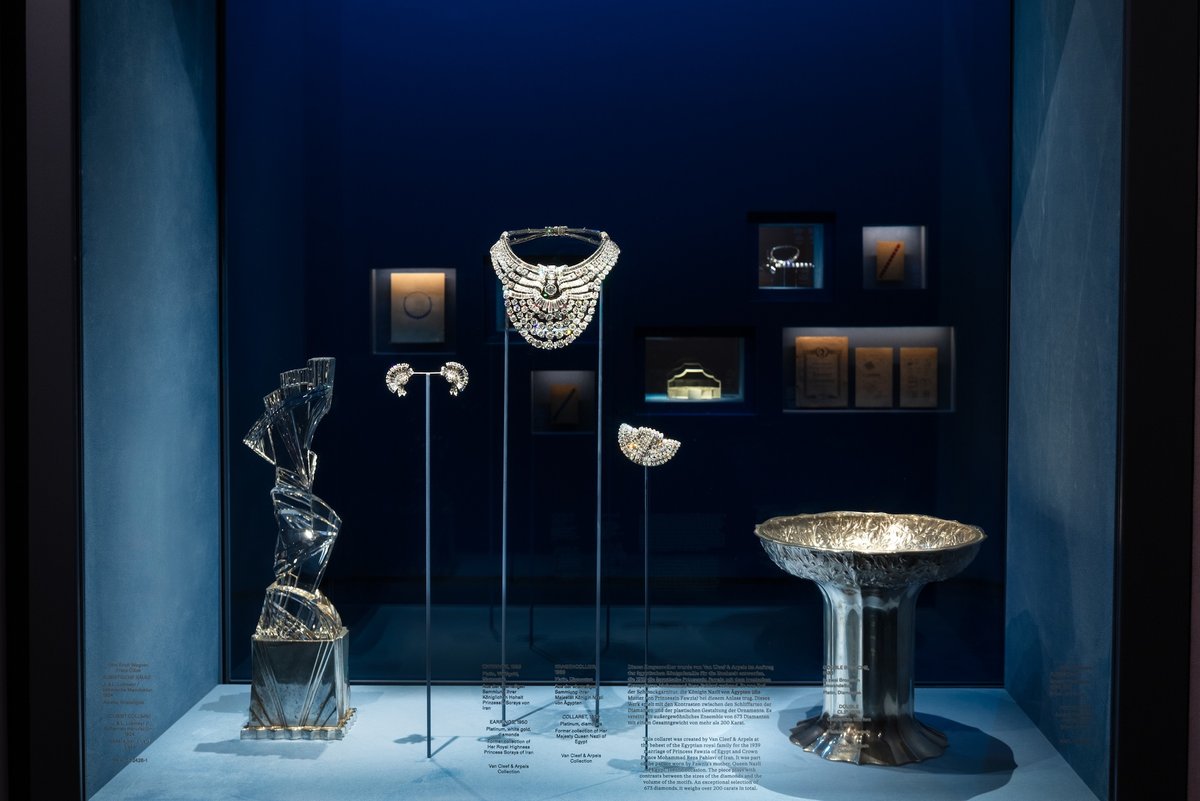
An international manhunt is underway for two suspects who stole a legendary diamond necklace that once belonged to Queen Nazli of Egypt from Vienna’s Museum of Applied Arts (MAK).
In a brazen daylight robbery on 27 August, the unmasked suspects bought museum tickets before walking into the gallery, smashing the display case with a hammer and walking out into city streets. Austrian police have clear security footage of the suspects and, according to Interpol, the necklace has been added to agency’s database of stolen artworks by Austrian authorities.
Queen Nazli of Egypt commissioned the Art Deco, bib-style necklace in 1938 and wore it with a matching tiara to the 1939 wedding of her daughter, Princess Fawzia, to the future Shah of Iran. Made of pure platinum, it features 673 baguette-cut and brilliant-cut diamonds. It was on display as a part of the museum’s exhibition Glanzstücke: Van Cleef & Arpels High Jewellery x Masterpieces from the MAK Collection (until 27 September), which includes around 500 pieces of jewellery, timepieces and precious objects. More than 300 are from the collection of jeweller Van Cleef & Arpels and more than 200 come from the MAK’s own permanent collection. The exhibition was closed briefly due to the robbery, but reopened the following day.
The stolen necklace is considered one of the most exceptional pieces Van Cleef & Arpels ever created. After Queen Nazli (an educated and emancipated Western educated woman) was stripped of her royal title by her son King Farouk in 1950 because her youngest daughter, Princess Fathia, married a Coptic Christian, she moved to Beverley Hills but later fell into debt.
In 1975, Nazli sent her 274-carat diamond tiara inlaid with 720 diamonds and the matching necklace to auction at Sotheby’s, where they sold for $127,500 and $140,000 respectively. In 2015, the necklace returned to Sotheby’s and sold for $4.3m.
“The theft of a high-value piece of jewellery by Van Cleef & Arpels has hit us hard, especially considering the incidents at major museums in recent years,” Lilli Hollein, MAK’s general and artistic director, said in a statement shared with The Art Newspaper.

According to a recent report by Europol, there has been a rise in violent museum heists alongside a “growing focus on high-value items such as precious metals, gemstones and culturally significant artefacts”. In recent years, thieves have targeted museums big and small in France, the UK, Germany and elsewhere, making off with crown jewels, ancient coins, crystals and a golden toilet, among other valuable objects. Such objects can be more attractive to thieves as their component metals and precious stones can be broken down and sold as separate items that are harder to trace, whereas ill-gotten art is very hard to sell because it will almost certainly be identified as stolen.
In a Facebook post on 29 August, the great granddaughter of Queen Nazli, Fawzia Farouk, expressed “profound sorrow” at the theft of the “historic necklace”.
“Beyond its exceptional craftsmanship and beauty, this jewel is an irreplaceable part of our family’s history and of Egypt’s cultural heritage. It is a precious testament to an era of elegance, artistry, and vision, whose significance extends far beyond personal interests,” Farouk wrote. “It is my sincere hope that, once recovered, this exceptional piece will continue to be preserved and safeguarded with the dignity it deserves, so that its history and cultural significance may endure for generations to come.”