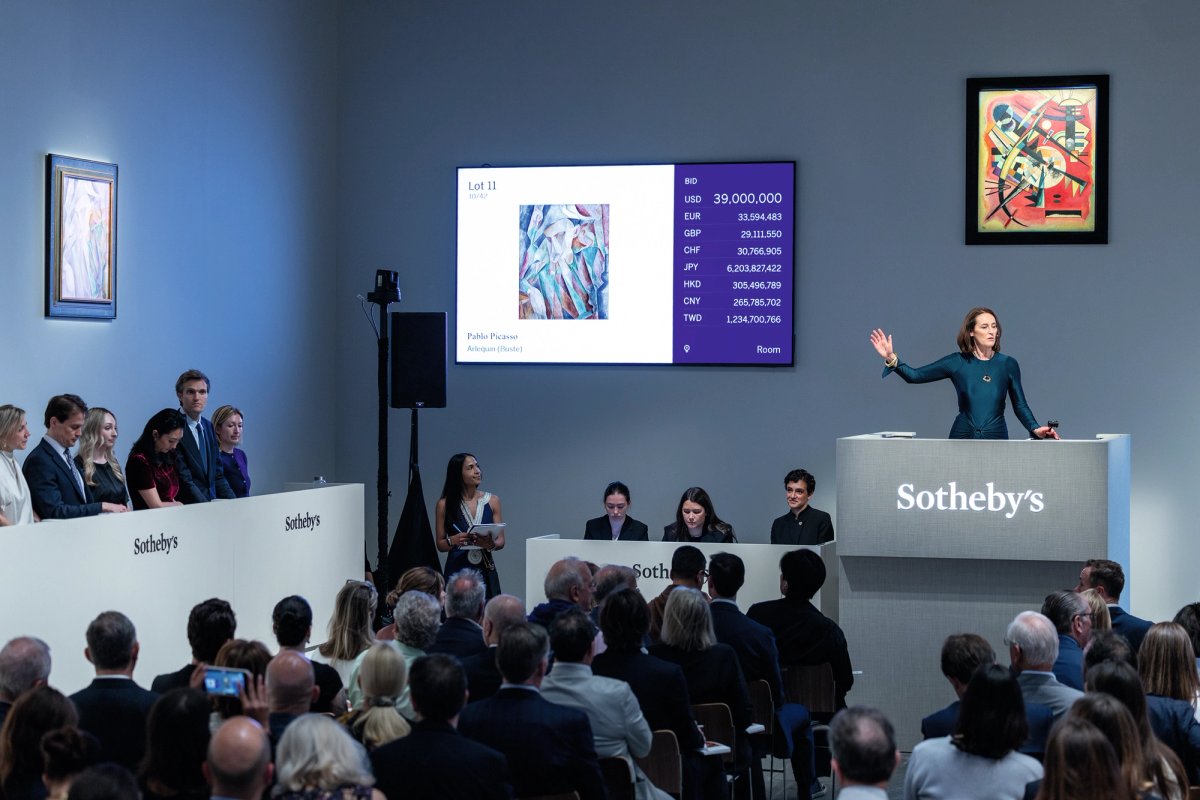
It is well-documented that the art market is top-heavy. But, over the past few years, its centre of gravity has become even more concentrated, with an increasingly small number of trophy works accounting for a growing share of sales, pursued by an ever-shallower pool of ultra-wealthy collectors.
The figures illustrate the scale of that concentration, particularly at auction. In 2025, just 1,761 works of art—less than 0.3% of all lots sold at auction—generated almost 45% of global auction sales by value, according to the arts and finance professor Rachel Pownall.
And now, new research by Pownall suggests that widening wealth and income inequality is not merely reinforcing the art market’s “winner takes all” dynamic but is actively driving it—and, in doing so, creating a more fragile cultural ecosystem that has become too dependent on the ultra-rich.
In her research paper “Art Prices, Disparities, and Cultural Leadership”, due to be published this month, Pownall examines long-term data from the US and UK and finds evidence to show that rising income inequality exacerbates shifts in price dynamics over time, particularly at the top end of the market.
The top end of the market has been driven by changes in income and wealth distributionsRachel Pownall, finance professor
Other possible factors that could push up the prices of trophy art, including stock market wealth effects, are materially less significant, according to Pownall. Over the longer term, she also rules out the recent financialisation of art as an asset class and ultra-low interest rates, which were in effect for much of the 2010s and early 2020s. “My research shows that the top end of the market has really been driven by changes in income and wealth distributions, and that hasn’t been documented before in the US and UK for the post-war period,” she says.
When art behaves like a luxury good
Pownall’s argument begins with a familiar economic principle: art, particularly at the highest level, behaves like a luxury good. As incomes rise, spending on luxury goods increases more than proportionally. But when wealth becomes increasingly concentrated, demand does not simply expand across the market, it becomes concentrated in the rarest, most expensive objects.
Pownall’s findings echo some recent observations by the cultural economist Clare McAndrew. In the latest Art Basel and UBS Survey of Global Collecting, McAndrew argues that greater wealth concentration has been one of the key drivers of rising prices at the top end of the market for many years.

Magnus Resch (above left) Professor Rachel Pownall (above right) and believe the art market has become increasingly polarised Courtesy of Magnus Resch and Rachel Pownall
But McAndrew also suggests inequality can reshape demand further down the wealth ladder. More unequal societies, she argues, often foster greater status competition, encouraging some consumers to emulate the spending habits of wealthier peers through conspicuous consumption. While this can support sales at lower price points, it may also encourage higher borrowing and financial strain. At the other extreme, growing inequality can discourage participation altogether if collecting begins to feel permanently out of reach.
The longer-term consequence is a narrowing collector base. As McAndrew writes: “If lower, middle and even upper-middle wealth tier consumers engage less—or never start collecting—the market could narrow further and value concentrate more at the top.”
The art market economist and entrepreneur Magnus Resch believes the evidence points to an increasingly polarised market. “Around 150 works accounted for nearly 60% of global auction sales in the first half of 2026,” he says. “That’s exactly what you’d expect in a world where wealth is increasingly concentrated among a small number of billionaires. The biggest beneficiaries are the rarest trophy assets, not the broader market.”
Resch cautions against extrapolating from headline auction totals to the market as a whole. “What we’re seeing is a widening gap between the very top and everything else,” he says. “Headline auction results are increasingly driven by a tiny number of museum-quality works competing for the attention of an equally small group of ultra-wealthy buyers, while much of the middle market remains subdued.”
Concentrating cultural influence
Pownall’s thesis reaches well beyond the auction houses. With the role of public institutions diminishing in the face of government funding cuts, museums—and artists—have also become exposed not only to the tastes of wealthy collectors but also to fluctuations in their fortunes. As a result, philanthropy, acquisitions and even exhibition programming risk becoming concentrated among a relatively small group of patrons.
It is here that Pownall introduces the idea of “cultural leadership”. Rising wealth concentration, she argues, is not simply an economic issue but a governance challenge. While generous donors have long played an essential role in supporting the arts, increasing dependence on a narrow pool of benefactors risks concentrating cultural influence alongside financial power. The concern is not simply who buys art, but who shapes culture.
Pownall also argues that the arts have become trapped within an overly economic framework. Their value is too often measured through prices, attendance figures or financial returns, rather than their broader cultural and social contribution. That imbalance, she suggests, weakens the case for public investment and reinforces the very inequalities the market increasingly reflects.
Her proposed solutions are deliberately broader than the art market. Pownall thinks institutions could diversify funding through larger membership schemes, micro-philanthropy, community partnerships and long-term endowment funds, reducing reliance on a handful of major donors. She also points to hybrid financial mechanisms—including cultural investment funds and arts-focused financing vehicles—that could help bridge public and private support while strengthening institutional resilience.
None of these proposals would reverse the concentration of wealth driving today’s trophy market. Nor are they intended to.
As it stands, however, the very top of the market continues to produce spectacular prices, even as activity softens elsewhere. That divergence could be interpreted as resilience or as increasing polarisation. But, Pownall suggests, if the ecosystem beneath those headline sales continues to narrow, the industry’s greatest long-term risk may not be volatility at the top but the gradual erosion of the broader collector base, public support and institutional independence on which the health of the wider cultural sector ultimately depends.