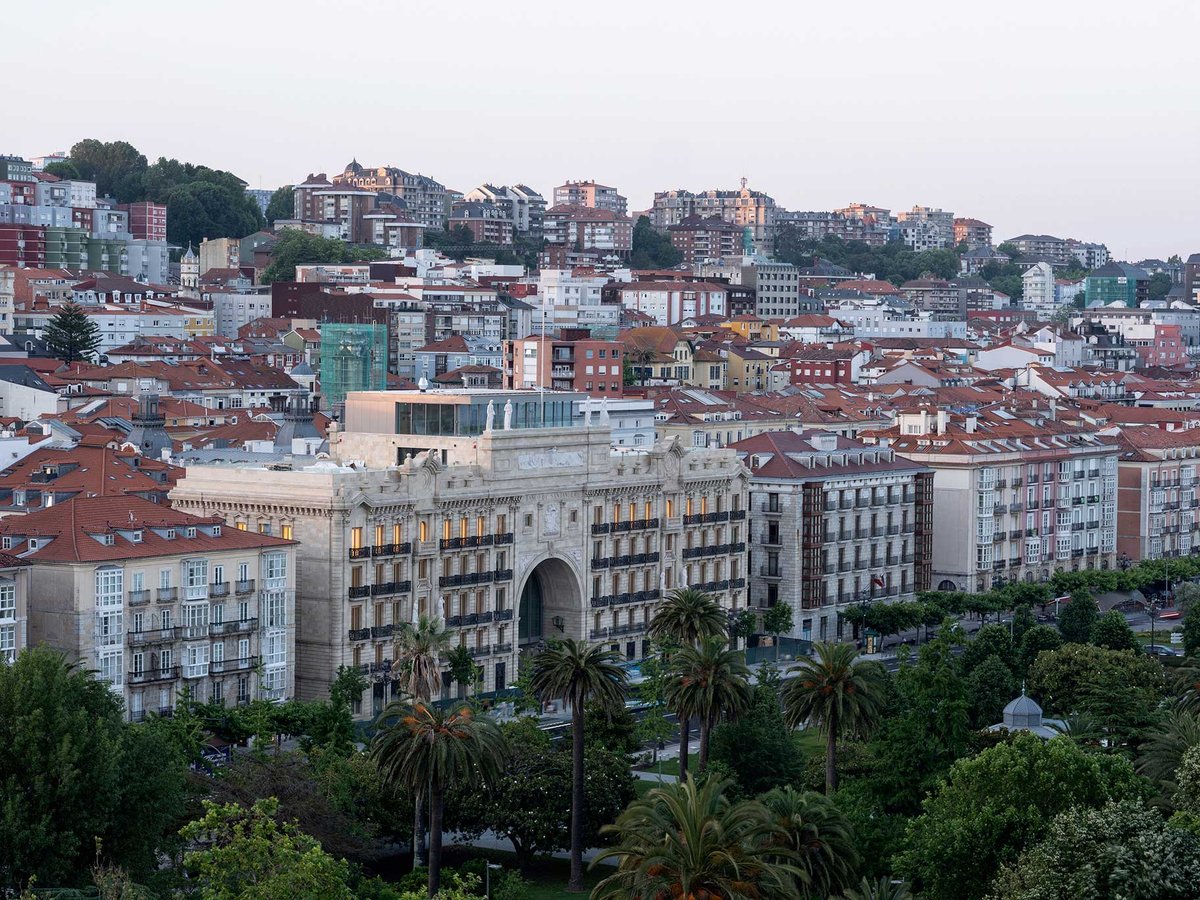
A grand Neo-Classical building overlooking the Bay of Santander and the Cantabrian mountains in north-western Spain is to become the new home of a 1,000-piece collection including works by Lucas Cranach the Elder, Velásquez, Titian, Rubens, Goya and Picasso.
The new Faro Santander museum opens on 8 September to show Banco Santander’s collection, which also includes works by Francisco de Zurburán, El Greco, Joaquín Sorolla, Joan Miró, Eduardo Chillida and Anthony van Dyck, as well as contemporary audio-visual installations and a coin collection.
The museum’s home is the imposing 1795 Pereda Building. Previously Banco Santander’s headquarters, it has been refashioned by the British architect David Chipperfield, who has retained its original structure to provide 10,000 sq. m of exhibition space. Chipperfield has, however, glazed over the central archway, which had previously separated the twin parts of the building’s double-fronted façade, and created landings for easy access across both sides.
A major addition to the local art scene, the museum has been financed by the Santander Foundation and cost €40m, the bank said in 2018. (Santander and Daniel Vega Pérez, Faro Santander’s director, declined to give a more recent figure.)
Cantabrian attraction
Santander has often been overlooked as little more than an entry point for ferries. But since the arrival in 2017 of the dramatic, Renzo Piano-designed Centro Botín for contemporary art, the Cantabrian capital has started to attract art lovers. Its development as an art destination seems likely to accelerate as Faro Santander becomes part of an ‘art triangle’ encompassing not only the Centro Botín but also a new outpost of Madrid’s Reina Sofia, due to open in 2027.
“What has struck me since arriving in Cantabria is the high number of cultural and artistic projects in development, both public and private,” Vega says. “There’s a very high demand for projects of this kind, particularly given that this is a relatively small region. I think this new project of major museums will respond to the demand which is already there in our community but also, at the same time, attract visitors from further afield.”
Faro Santander is spread across 10 floors, with four floors of exhibition spaces. Two upper levels, including roof terraces with panoramic views, accommodate the café and restaurant. The basement houses an auditorium and technical facilities. There will also be spaces for children’s and family activities, a VR experience and immersive area where visitors can learn about the history of the bank and the building, as well as spaces devoted to contemporary Cantabrian art and audio-visual installations. The core collection will occupy the fourth floor.
Vega, who was previously the deputy director for exhibitions and conservation at Bilbao’s Guggenheim Museum, says the plan is to showcase the collection in a way that is “permanent yet dynamic, changing the display and focusing on different artists”.
He adds: “Previously, the collection was only on view in Madrid in a gallery in Banco Santander’s corporate offices, far from the centre of the city, so there wasn’t a dedicated space” where visitors could see it.
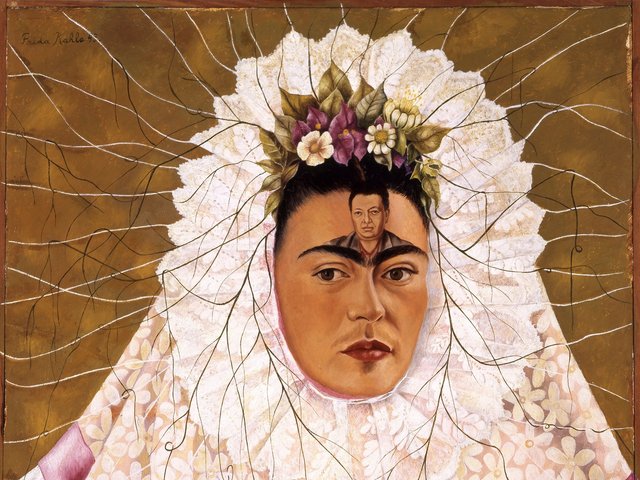
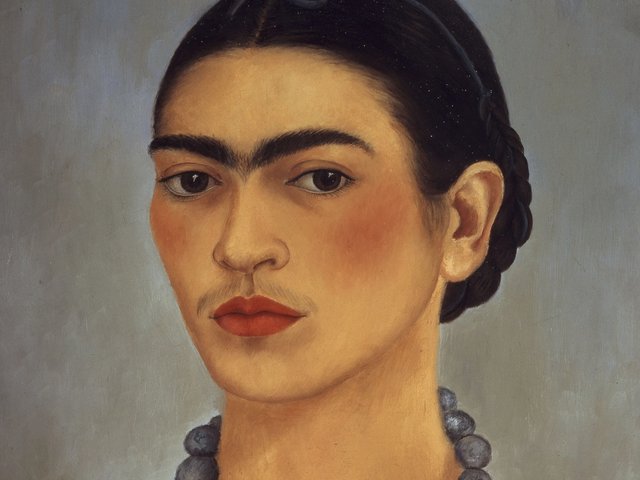
The inaugural exhibition, Masterpieces from the Banco Santander Collection, is curated by the Spanish art historian María Dolores Jiménez-Blanco and will be divided into four thematic sections: landscape, still-life, portraiture and biblical stories, with works from the 16th to 21st centuries. An inaugural temporary exhibition will show part of the Gelman Santander collection, which includes works by Frida Kahlo, Diego Rivera, José Clemente Orozco and María Izquierdo. The show, titled Modern Mexico in the Gelman Santander Collection (until 10 January 2027, before touring), will feature paintings, drawings and prints by Kahlo, including some of her most renowned self-portraits such as Diego en mi pensamiento (Diego on my mind) and Autorretrato con monos (self-portrait with monkeys)—both from 1943—as well as Rivera’s 1943 Portrait of Natasha Gelman.
The Gelman Santander collection has been dogged by controversy over a loan agreement for 160 works between the owners, the Zambrano family, Banco Santander and the Mexican authorities. Many of the works are designated as part of Mexico’s national artistic heritage with stipulations that they cannot be permanently exported; in July, a citizen collective, Defence of the Gelman Collection, took legal action to annul the agreement. Asked about the future of the Gelman collection, Vega says it “will be back in Mexico in 2028 at the latest”. A spokesperson for Faro Santander said the display at the new museum is “in full compliance with the Mexican legislation”.
Faro Santander’s temporary programme also features Leonora Carrington: The Symptomatic Surreal, transferring from London’s Freud Museum. The show has a particular resonance in Santander as Carrington spent time at a local sanatorium during the Second World War. It will feature her 1940 work Villa Pilar, recently discovered in the home of the Santander psychiatrist who treated her.