Hungary’s new government has scrapped plans for a New National Gallery that was to form part of a development in Budapest’s City Park (Városliget) aimed at elevating the capital’s cultural standing.
The Liget project has been unfolding in and around Városliget for over a decade. Major new buildings, including the House of Hungarian Music and a new building for the Museum of Ethnography have been constructed, while the nearby Museum of Fine Arts (Szépművészeti Múzeum) has undergone a substantial restoration.
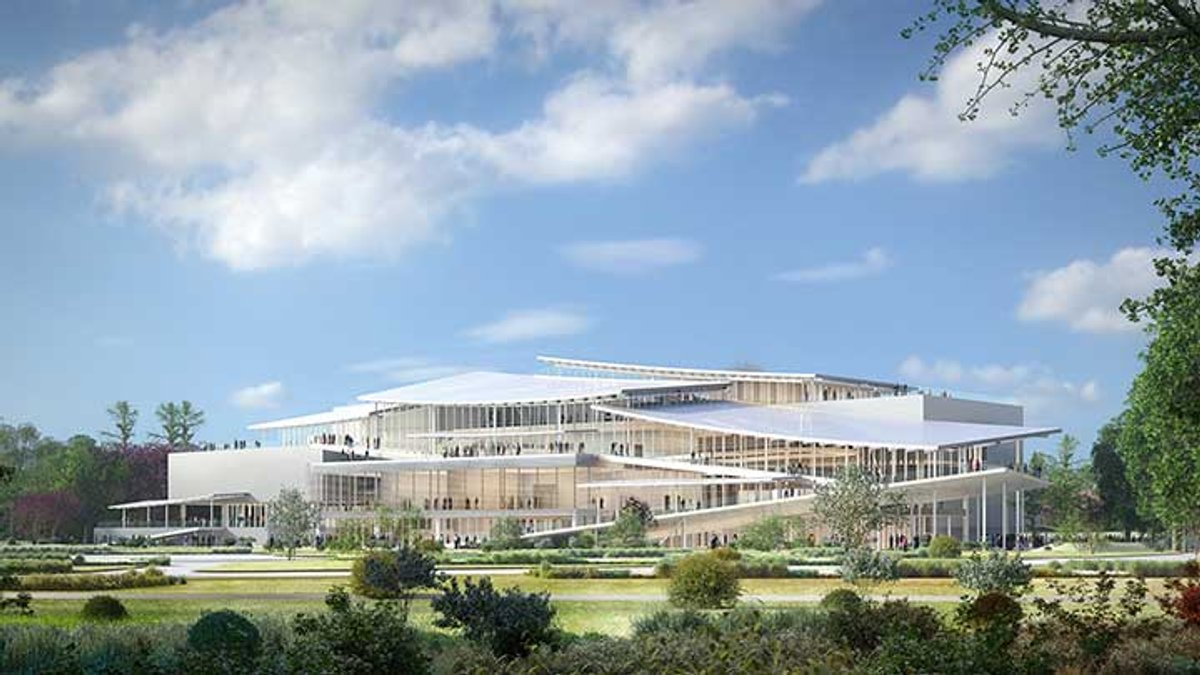
The New National Gallery, designed by Japan’s SANAA architects, was to be the centrepiece of the project. But construction of the 50,000 sq. m museum has effectively been stalled since 2019 due to opposition from Budapest’s mayor and environmental groups. A decree published by Hungary’s new government on 18 June has now officially brought all construction work on the Liget project to an end.
Dávid Vitézy, the newly appointed minister of transport and public works, told The Art Newspaper it was clear that the gallery “will not be constructed in [the] City Park”, while the project’s remaining building sites are to be reinstated as public parkland. Instead, Vitézy said, the government “must develop a new plan for the future location of the Hungarian National Gallery”, which has been located across the Danube in the castle in Buda since 1975.
According to Vitézy, the castle cannot be “considered a viable long-term solution” because its technical infrastructure does not “fully meet the standards required for the long-term operation of a modern national art gallery and the safe preservation of its collection”. The minister added that “no decision has yet been taken” on an alternative location and that “a professional review” will now take place.
A spokesperson for the National Gallery declined to comment on current speculation. But in recent remarks to the Hungarian news site HVG, László Baán, who acts as the combined director general of the museum and the Szépművészeti Múzeum, said he remained hopeful that SANAA’s design, which he described as “a world-class contemporary building”, could still be realised in a different location.
Failing that, Baán argued that a full-scale renovation of the castle building would be the most suitable solution. Such a reconstruction, however, would be expected to take eight to ten years and would require significant funding.
The creation of a New National Gallery was spearheaded by Baán, who hoped to bring together a combined display of Hungarian and international art made after 1800 in the new building, while the Szépművészeti Múzeum would show a combined display of older work. At present, Hungary’s two most prestigious fine art collections are largely divided into separate Hungarian and international displays, with the former shown in the National Gallery, while the Szépművészeti Múzeum is home to a highly-regarded Old Master collection.
The cost of constructing SANAA’s design has been estimated at around 100bn forints (around €300m). The former government, under Viktor Orbán, had planned to fund it from state sources.
The future of the National Gallery is one of several big cultural issues facing the government of prime minister Péter Magyar, who came to power in May. Arts figures say they are impressed that the new administration has already entered into dialogue with the sector.
According to Tamás Don, the president of the Hungarian section of AICA (the International Association of Art Critics), which has been among the groups meeting with government officials, it is important that a “public series of professional discussions about the future of the Hungarian National Gallery” should now take place.
“There are many unresolved questions”, Don explains. “Why should the Hungarian National Gallery move out of Buda Castle? If the reasons are the limitations or obsolescence of the current building, is relocation really the only solution?”
Despite the complex issues at stake, the Budapest gallerist Erika Deák shares Don’s optimism that the new government will continue to engage positively, saying: “I think they understand the role of culture in a newly defined Hungary.” While Deák was supportive of the concept behind the Liget project, hoping it could emulate something similar to Amsterdam's Museumplein, she accepts “that Hungary is not in the financial or mental position to finish such a gigantic construction now.”