Handling pictures directly will soon become a thing of the past, according to the inventor of a new system for moving works of art. Sam Shmith, the former studio manager for artist Adam Pendleton, developed the system to focus on “the problem of the last 100m” and the even bigger “problem of the last 10m” identified by the Canadian Conservation Institute.
Shmith’s invention, called Artist Engineering (AE) Hardware, was created in Melbourne, Australia, and has been on the market for about a year. It is currently being assessed by users including the National Gallery in London.
“The market is such that even minor damage like fingerprints leads to really significant claims, and this is a problem,” says Adam Prideaux, the director of insurance brokers Hallett Independent. “A lot of these instances of damage can be avoided using this system.”
AE Hardware features a grip that disengages from the work, leaving a discreet bracket permanently installed in the frame or support. Though designed with 2D works in mind, AE Brackets are suitable for any material and can be embedded into sculptural or wall-based objects during fabrication.
The bracket avoids repeated drilling and installation of new hardware, which typically happens when a painting is being prepared for installation and is in itself a potential risk. The bracket provides a fixing point for the work to be secured in its transit frame and subsequently removed, contact-free.
Shmith explains the problems his technology circumvents: if a painting is of considerable weight or size the stretcher bar across the back of a canvas may present the most manageable lift point. But handling a work by the stretcher is unsafe, says Mary Gridley, a conservator. “As the whole structure ages, everything gets more brittle, and knuckles going into the back of the canvas can cause the paint to crack.”
Creating a buffer zone
Some damage can be prevented by gloves, but “there’s a psychology to gloved handling”, Shmith says. “You think you’re OK, and you start to drift and take risks. People wipe their brow and then pick up the work.” Gridley puts it simply: “If you can get people’s hands off the artwork, you’re halfway there.”
By creating a buffer zone around the work, AE Hardware mitigates knocks and falls and provides a resting point. Patrick O’Sullivan, the National Gallery’s head of art handling, is primarily interested in how it “might improve the outlook with regards incremental or accumulative damage to paintings over a long period of time”, specifically, the “handling of paintings that have minimal or no significant framing”.
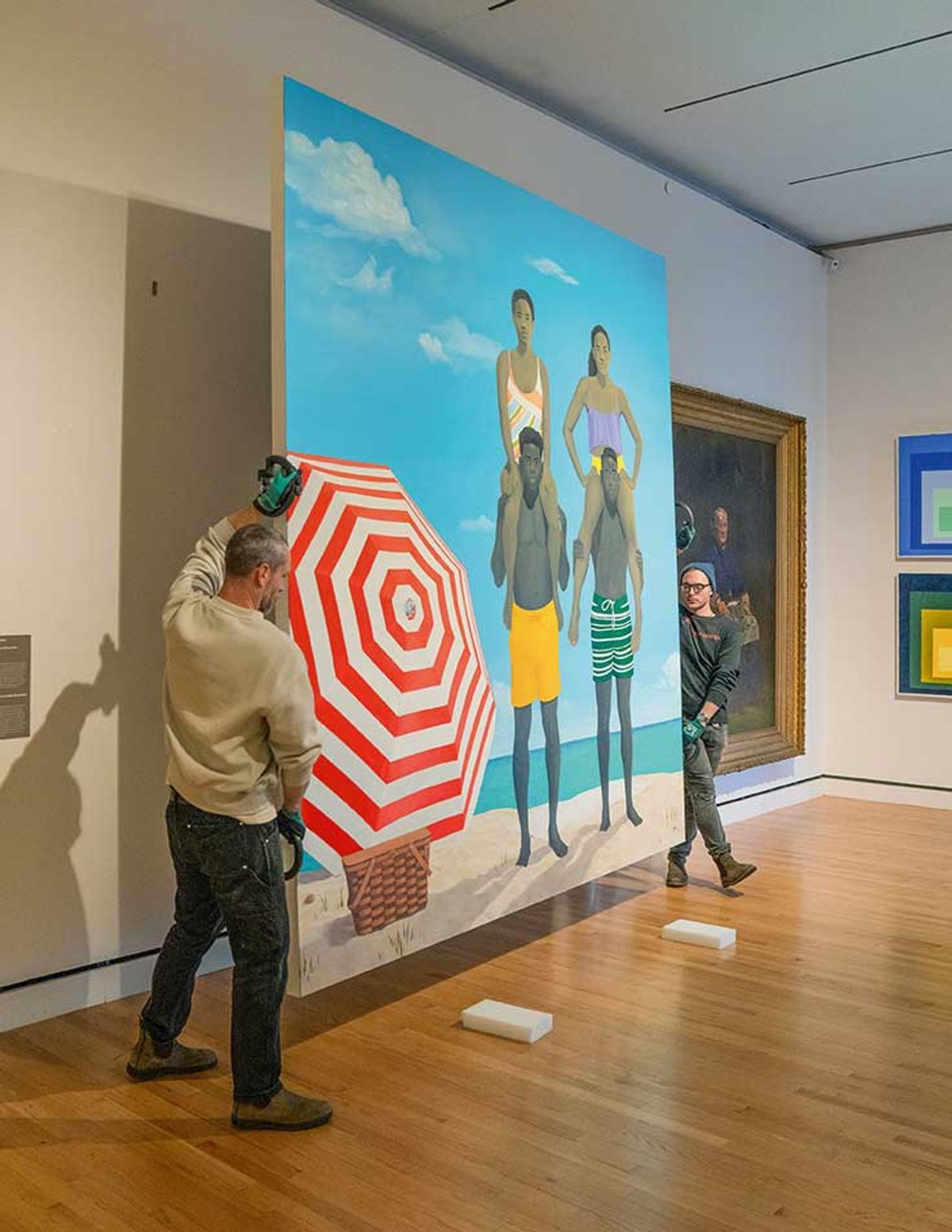
At Crystal Bridges Museum of American Art in the US, the hardware has been installed on a frequently loaned Amy Sherald work, says the head preparator Dave O’Ryan. At approximately 305cm by 274cm, “it needs some firm hands when moving”, he says, which “needs to happen with the work riding on its side due to doorway, truck and loading dock heights. We’ve put the AE Hardware on it in two orientations so that we can put all of our firm grips on an external handle instead of on the unprotected painted canvas edge.”
The hardware’s novelty, and therefore potential misuse, is its current drawback, he says: “Folks in our field are generally very capable and cautious, but it’s still a typical early-adopter’s concern.”
But Thomas Douglas, the head of special projects at Helu-Trans in Hong Kong, emphasises “how easy the system is to understand and use”. His main concern is cost, which compared to traditional mirror plates and current industry standard Oz Clips is significant. Made from heavy gauge brass, or stainless steel in the small size, an Oz Clip comprises two strips of metal, connected by a pivot point. One strip is attached to the work, leaving the second strip to be oriented according to need and screwed into a wall or transit frame. In the UK, it costs approximately £280 to fit large Oz Clips to a painting with eight fixing points, compared with £917 plus shipping to fit AE Hardware to the same painting. Unlike Oz Clips, AE Grips can be removed and shared between works, which Shmith says could make the relative costs across collections comparable.
O’Sullivan at the National Gallery says AE represents good value: “The system appears to be designed with longevity in mind,” he says. Gridley says it could make otherwise difficult loans possible, such as those of works with vulnerable finishes.
Shmith has triggered a second production run to meet demand. “We’ll look back on the time we used to put our hands on these objects and wonder what on earth we were thinking,” he says. “A three- to five-year timeframe for that shift seems like a reasonable estimate”.