Total star rating: ★★★½
The building: ★★★★★
The exhibits: ★★
It is not quite a Trojan Horse. But the life-size Naboo N-1 Starfighter that looms over the lobby of the new Lucas Museum of Narrative Art in Los Angeles, visible in its full chrome glory from outside, is deceptive in a way. It makes the museum founded by the film-maker George Lucas look like a temple to his multi-billion-dollar Star Wars franchise with its 12 movies, many spin-off television series and endless array of merchandise.
Yes, the museum delivers one terrific gallery with original Star Wars artefacts, including costumes like Darth Vader’s samurai-inspired armour and fearsome vehicles such as General Grievous’s wheel bike. But the bulk of the material on display—more than 90%—comes from Lucas’s art collection, rich with illustration, comic books and manga, as well as storyboards and paintings for films. The museum has cooked up the category of “narrative art” to describe these works—heavy on character-building, story-telling and myth-making and largely untouched by abstraction and other innovations of Modern art.
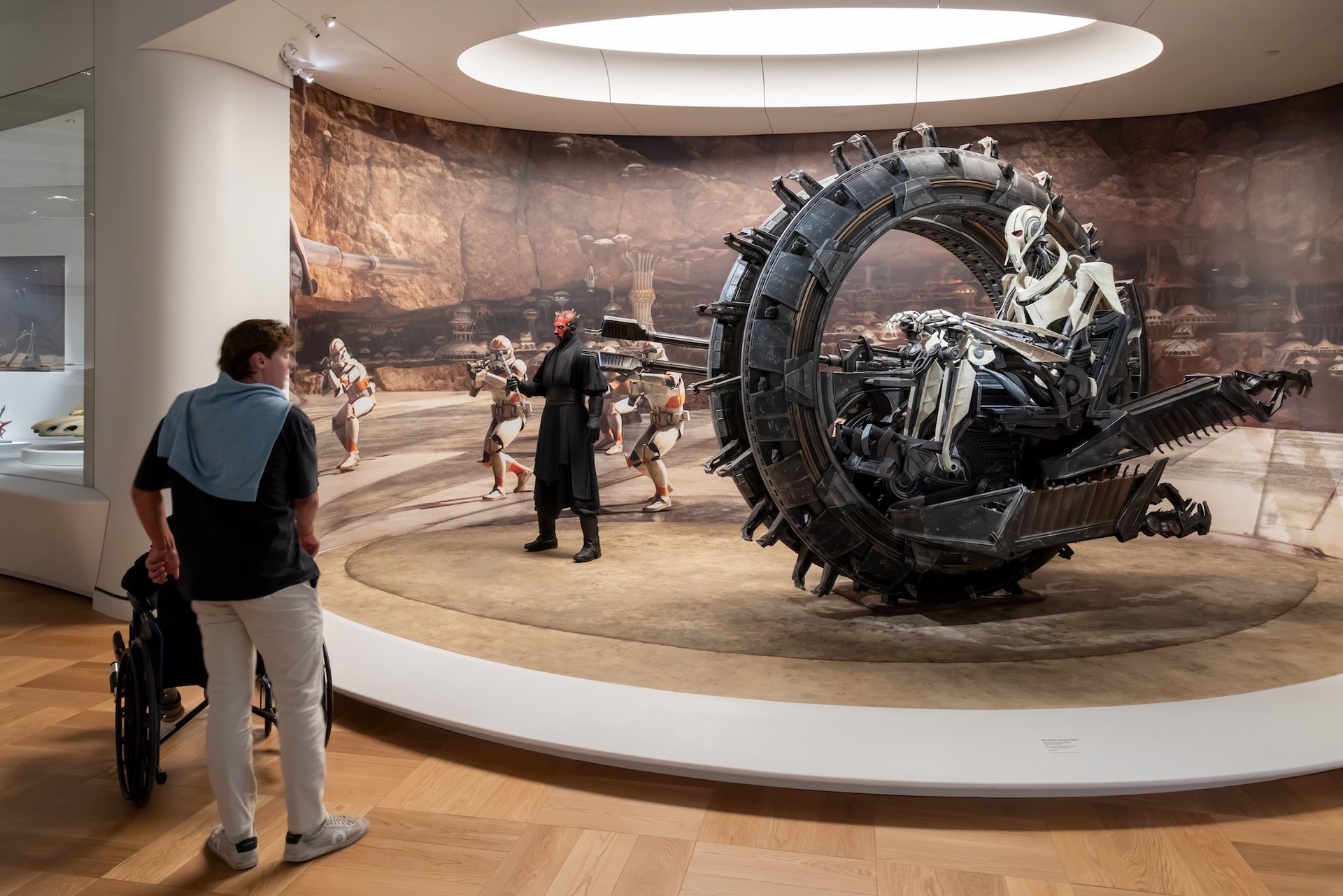
A gallery of Star Wars props, costumes and other ephemera at the Lucas Museum of Narrative Art Courtesy Lucas Museum of Narrative Art. Photo by Iwan Baan
The museum makes a good case for the category. If you do not get the narrative art rubric on the way in, you will by the way out, thanks to many—too many—works by the likes of rugged realist painter N.C. Wyeth and the macho sci-fi illustrator Frank Frazetta.
Along the way there are some nice surprises, like a section on murals featuring works by the street artists Banksy and JR. The highlight there is a suite of sketches that the artist Judy Baca created in the 1980s for her epic visual history of California, the mural The Great Wall of Los Angeles—an acquisition made under the former museum director Sandra Jackson-Dumont and the former chief curator Pilar Tompkins Rivas before staff cuts in 2025 left Lucas as acting curator.
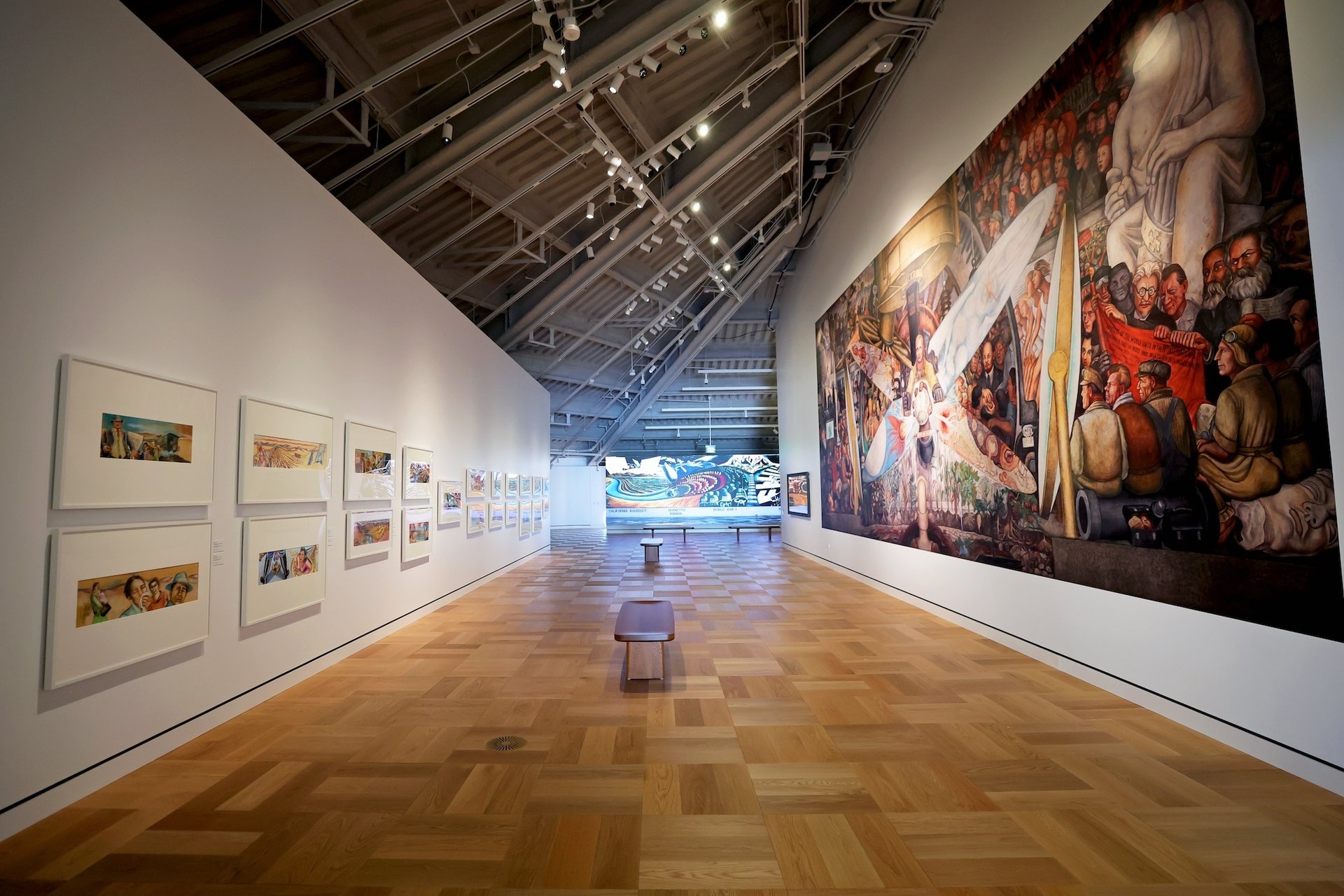
A gallery at the Lucas Museum of Narrative Art featuring works by muralists including Judith F. Baca (left) and Diego Rivera (right) Photo by Stefanie Keenan/Getty Images for Lucas Museum of Narrative Art
There is also a first-rate selection of children’s book illustrations with vitrines that are not to be missed, containing watercolours and sketches by Maurice Sendak (author of Where the Wild Things Are), E.H. Shepard (Winnie-the-Pooh) and Arnold Lobel (Frog and Toad). A different vitrine has a dramatic coloured-pencil drawing made by Georges Méliès for his 1902 film A Trip to the Moon, showing an astronaut emerging from his capsule ready to explore the moon’s craggy, cratered surface.
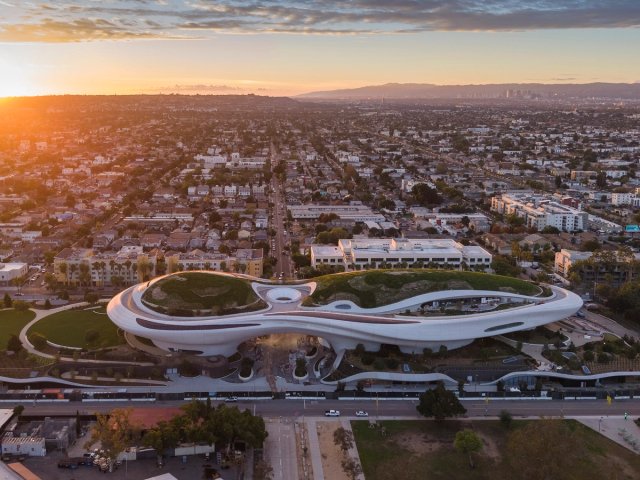
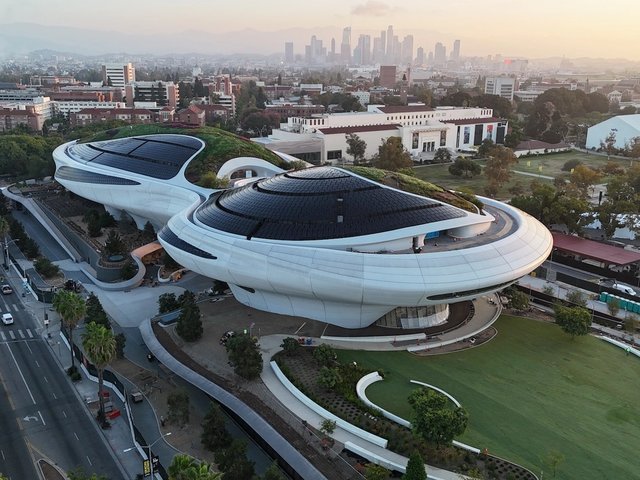
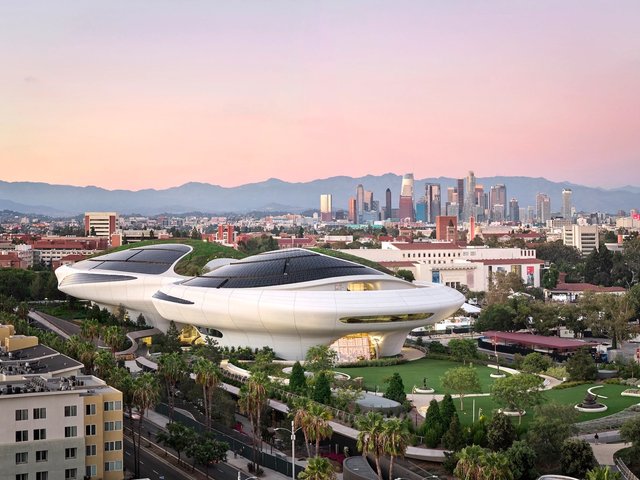
The swooping figure-eight shaped building, designed by Ma Yansong of Mad Architects with a billion-dollar price tag, has a keen sense of adventure too. The parabolic walls and curved ribbons of windows hint at jet planes and spaceships and a set of three central elevators look like pneumatic tubes.
Ripple effects
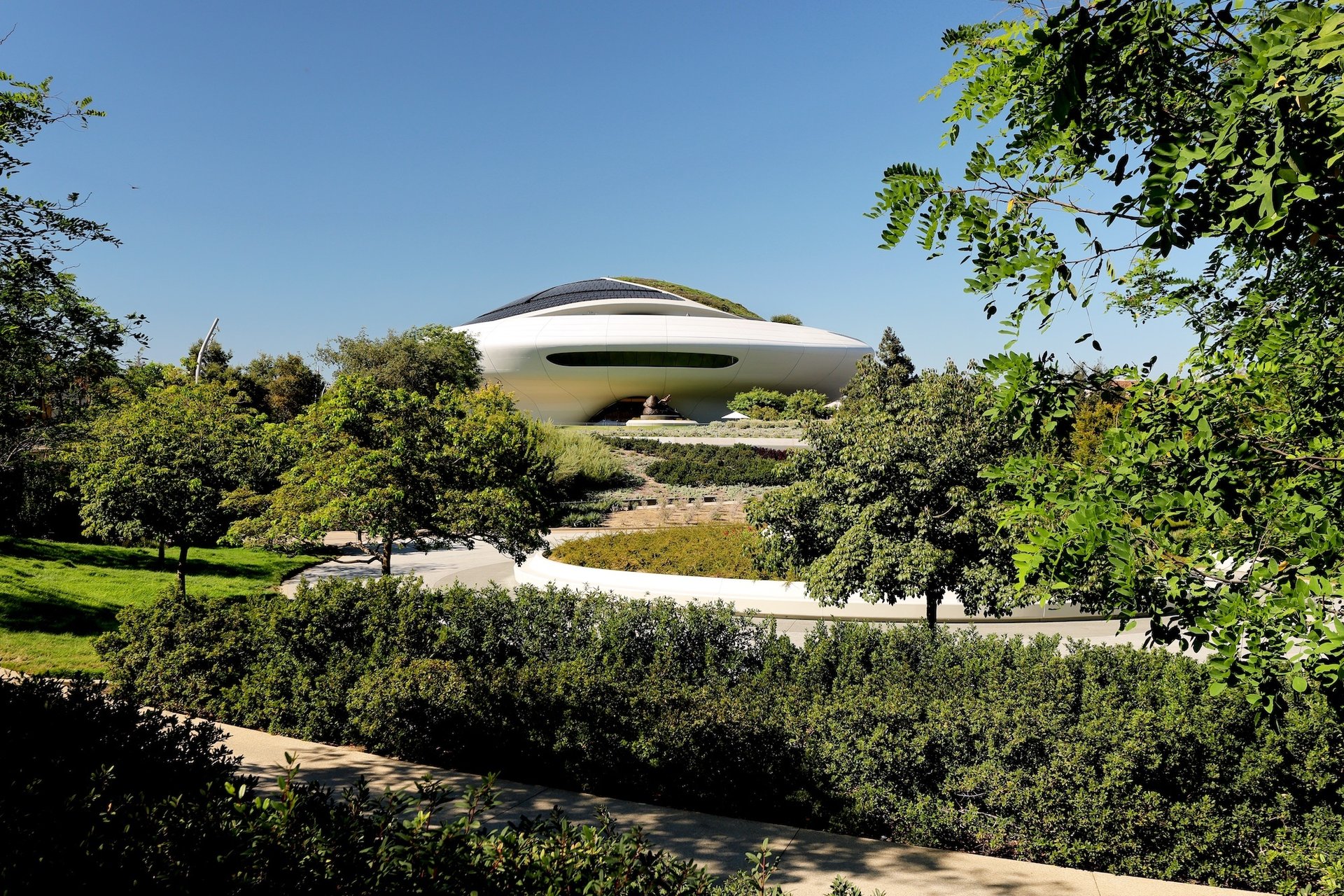
The Lucas Museum of Narrative Art includes a large outdoor area in Exposition Park designed by Studio-MLA Photo by Stefanie Keenan/Getty Images for Lucas Museum of Narrative Art
Like Peter Zumthor’s new David Geffen Galleries for the Los Angeles County Museum of Art across town, the bulk of this building is raised above ground level for a canopy-like effect. Unlike the Zumthor building, where the plaza looks barren by comparison, the Lucas Museum appears to have sent ripple effects into the earth around it—as the landscape architect Mia Lehrer has created a hilly parkland featuring lush meandering and flowering paths. This marriage of architecture and landscape makes Lucas’s earlier thwarted plans to build his museum in San Francisco and Chicago seem like distant history.
Inside, the main fifth-floor exhibition space is vast, almost as big as a suburban Target retail store, but easy to navigate. While some galleries are thematic, others highlight a single artist such as Norman Rockwell or Thomas Hart Benton.
One of my early concerns was that much of this artwork, made by and for white men, would traffic in nostalgia for an idealised American society before the civil rights movement. Would it all feel vaguely white supremacist?
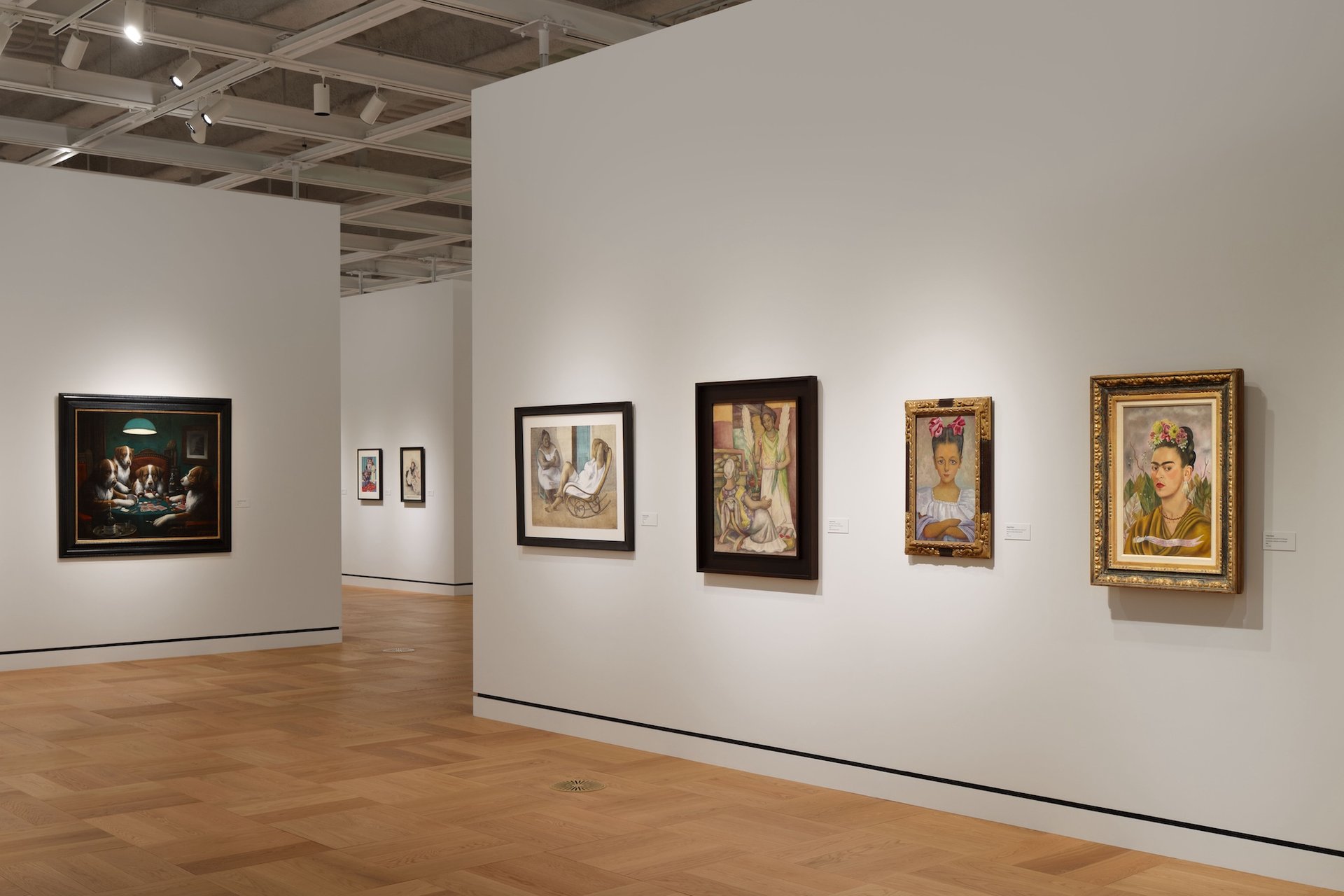
A gallery at the Lucas Museum of Narrative Art that includes Frida Kahlo's Autorretrato dedicado al Dr. Eloesser (Self-Portrait Dedicated to Dr. Eloesse, 1940) at far right and Cassius Marcellus Coolidge's A Pat Hand (1894) at far left Courtesy Lucas Museum of Narrative Art. Photo by Paul Salveson
A section on Western art definitely falls into this trap, made worse by Lucas’s decision across the board to forego wall labels that would put work in context or explore issues it raises. And the museum’s “motherhood” display is lame, rehashing all of the rosy clichés about maternal affection without including any great, truth-telling artist-mothers. Future curators, if there are any, please note that Käthe Kollwitz was a powerful storyteller too!
Still, there are some formidable moments, especially when Black artists enter the picture. Robert Colescott’s satiric 1975 painting of George Washington Carver (the scientist, not the president) crossing the Delaware River sets the stage for a lively section on “history”; images of segregated schoolchildren by Gordon Parks do the same for photography.
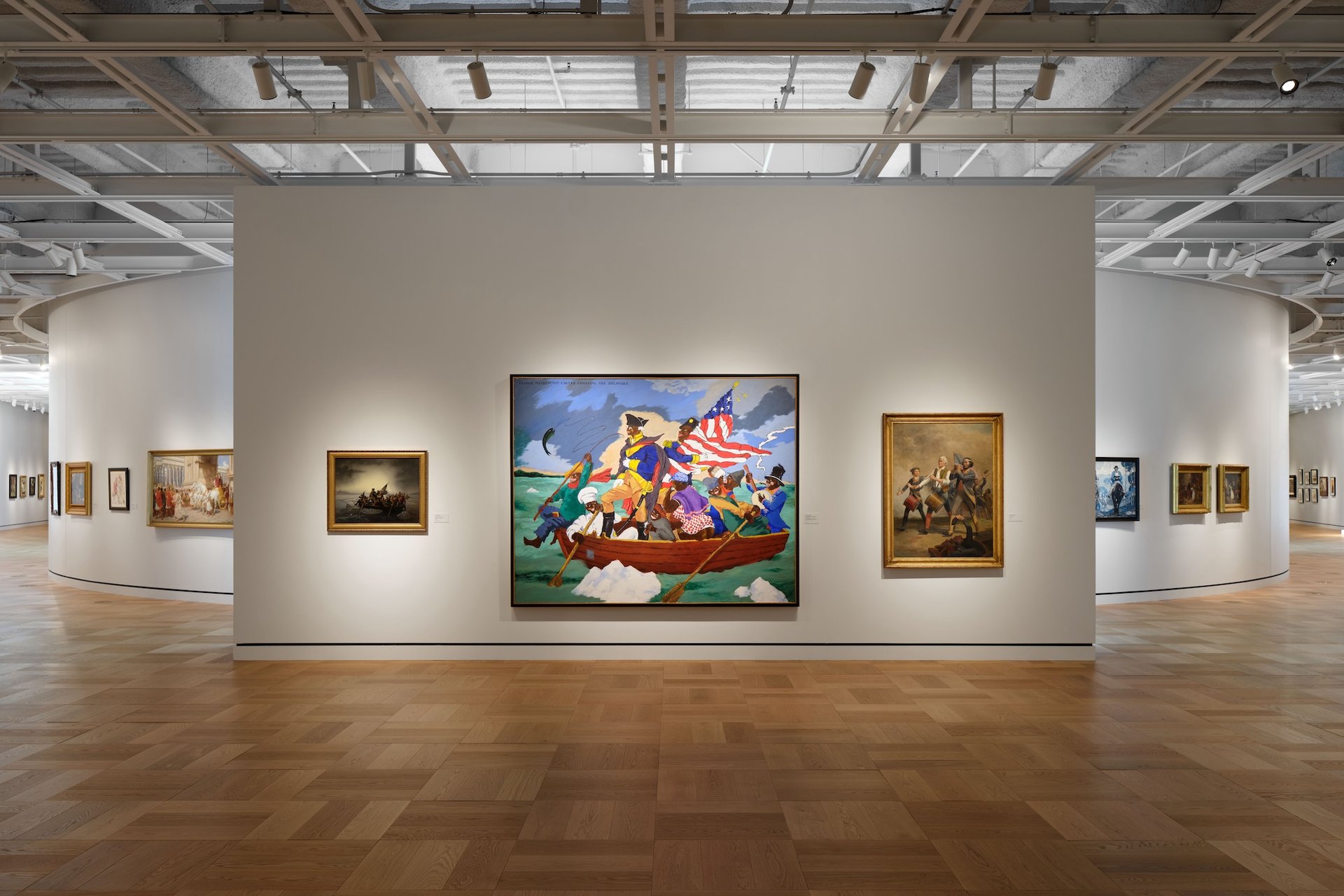
A gallery at the Lucas Museum of Narrative Art, featuring Robert Colescott's George Washington Carver Crossing the Delaware: Page from an American History Textbook (1975) at centre Courtesy Lucas Museum of Narrative Art. Photo by Paul Salveson
The Rockwell section is surprisingly strong in this way—remarkably of the moment. The museum has paired his famous 1958 painting of a runaway boy at a soda counter, chatting with a friendly looking policeman, with Richard Williams’s similar scene from 2014 where the boy is Black and the cop is outfitted in riot gear. Nearby hangs a rare loan from the Norman Rockwell Museum: the artist’s seminal 1964 oil painting of Ruby Bridges walking to her newly desegregated school accompanied by US Marshals and racist graffiti.
Multiples and multitudes
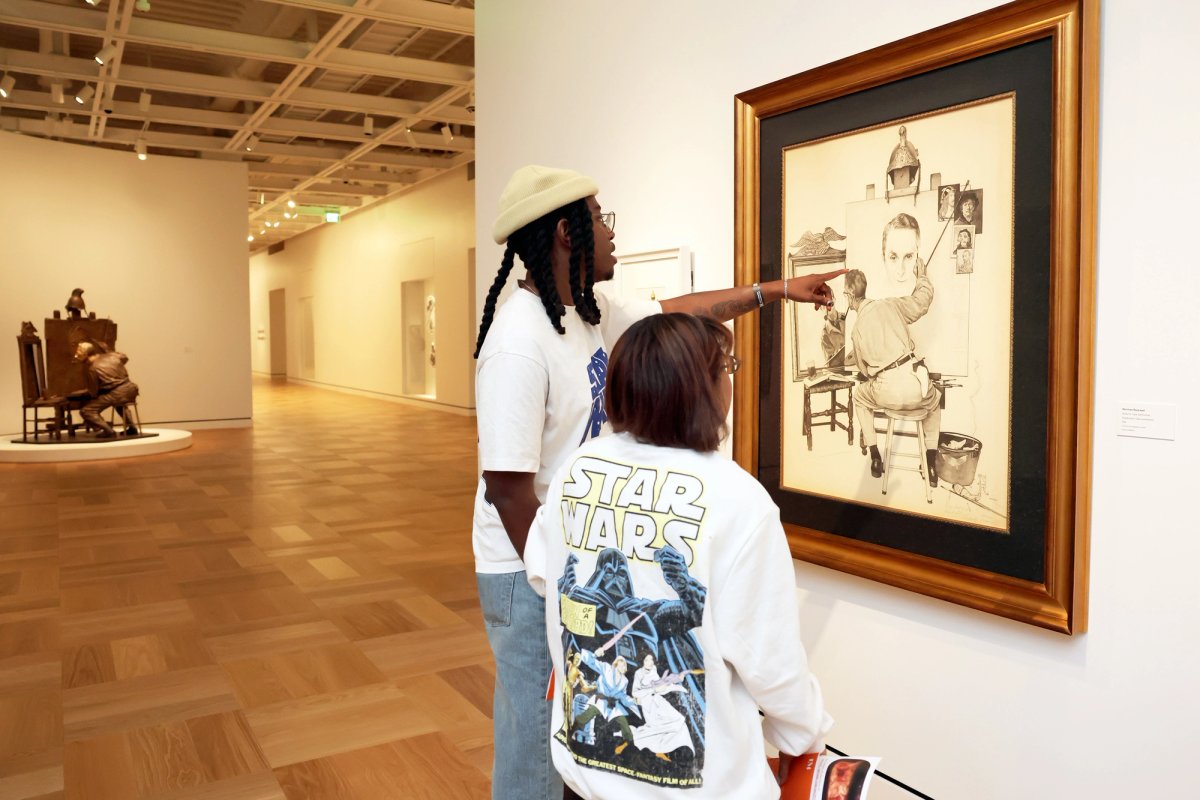
The Rockwell gallery also features, up front, a bronze replica of his witty 1960 painting Triple Self-Portrait, which shows the artist seated at his easel, peering into a large mirror while painting his own portrait. Commissioned last year by the museum, this replica fits the theme of the Rockwell painting, a savvy lesson in how images multiply. At the same time the bronze is museum-sanctioned shlock, clearly made without the participation or consent of the long-deceased artist.
Your particular take on the ethics and value of this kind of image replication matters even more when it comes to a cursory ground-floor survey of narrative art through the ages. Tucked behind two beautiful film theatres, this survey is a bizarre experiment in replicating artworks that the Lucas Museum does not—and could never hope to—own.
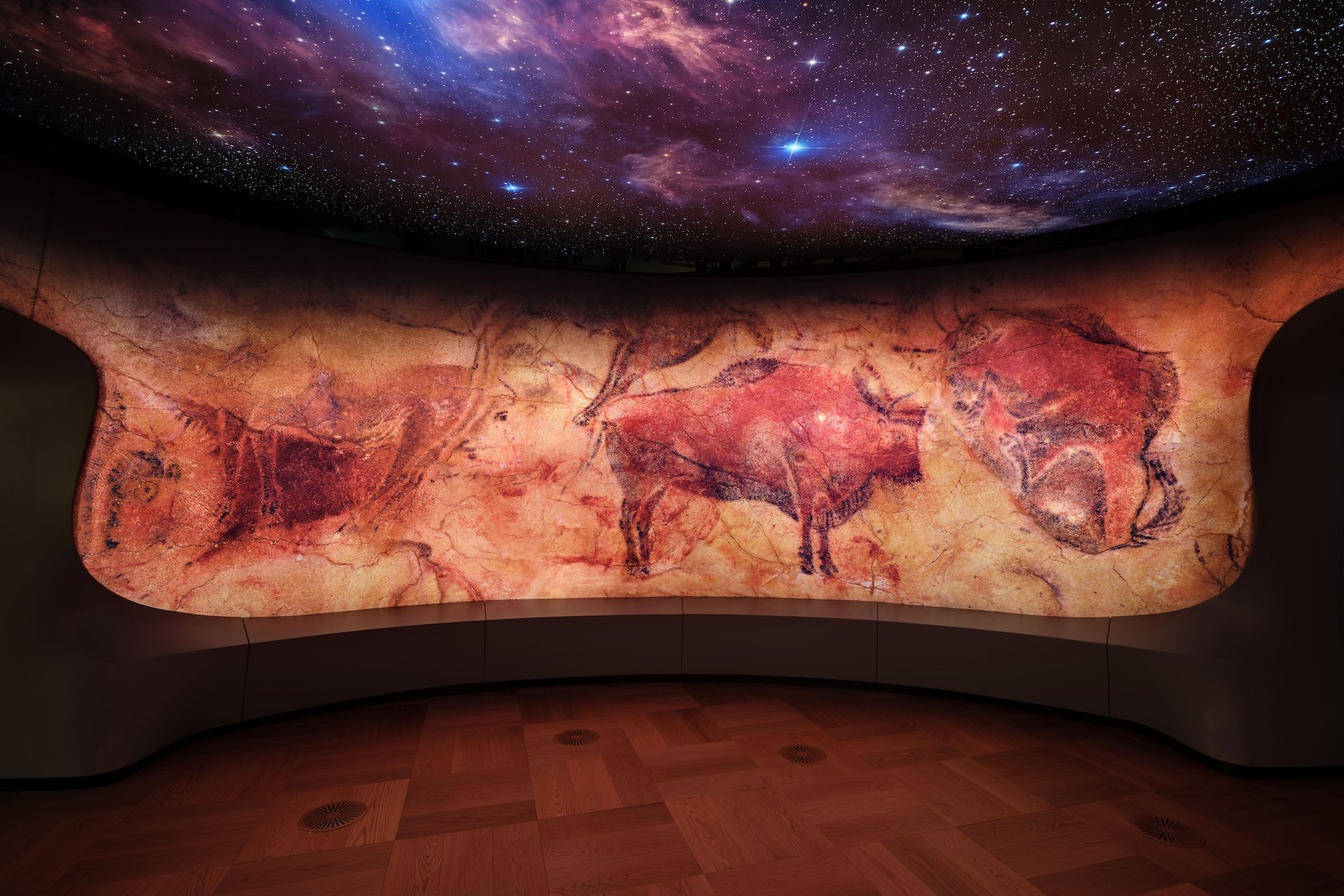
A gallery of large-scale projections and reproductions at the Lucas Museum of Narrative Art includes a scale rendering of a pre-historic cave painting Courtesy Lucas Museum of Narrative Art. Photo by Paul Salveson
First up is a curved space with murals of bison and deer from the Altamira cave paintings of northern Spain. Soon comes a room covered with reproductions of artwork from the Sistine Chapel. Later, shinier versions of Rembrandt and Vermeer paintings hang alongside a few actual Old Masters owned by the Lucas Museum. Throughout, high-res videos show famous sculptures, like the Venus of Willendorf, rotating in space.
The maybe-admirable idea is to let visitors see the Aztec sun stone without going to Mexico City or Michelangelo’s David without going to Florence. But the sheer profusion of simulacra is deeply strange and unsettling, like you are trapped inside the metaverse.
Surely that is an ethos that Lucas brought with him from the film industry, where special effects reign and replicating images in other mediums (whether translating movies into video games or characters into action figures) is an essential business strategy. While museums tend to safeguard and even fetishise original objects, Lucas, like his favourite illustrators, evidently sees every image as ripe for reproduction. It all makes for a profoundly weird museum of art. It is more a museum of images designed to travel to galaxies—or at least countries—far, far away.
What the other critics said
The museum “is among the boldest, most contradictory buildings this city has ever seen. It’s synthetic yet organic, monumental yet welcoming, populist yet elitist”, writes Sam Lubell in the Los Angeles Times. Matt Stromberg of Hyperallergic says that the “thematic arrangement mashes together artworks of different styles and eras ... with little interest in exploring [their] specific cultural or social conditions”. As 13ThingsLA writer Shana Nys Dambrot sums up: “It’s like somebody did a web search for #art and just put it all in a building. But it’s a very cool building.”
- Curator: George Lucas
- Tickets: $25 (concessions available)
- Lucas Museum of Narrative Art, One Lucas Plaza, Los Angeles