
A few years ago, the Japanese creative director Hideki Yoshimoto and the Italian curator Maria Cristina Didero set about introducing non-Japanese designers to the intricacies of that country’s craftsmanship. The results went on show in Tokyo and London. Now, the second exhibition from this initiative returns to the Victoria & Albert Museum in London, once again under the title Craft x Tech, and reveals what happens when traditional techniques meet contemporary design thinking.
“The idea is for each edition to be focused on one region,” Didero says. While in 2024, that was the mountainous Tohoku area, for 2026, it is Tokai. “Tokai is one of the country’s most industrialised parts,” Didero continues. “Tohoku was rural, more traditional.”
Didero asserts that the virtuosic crafts—lacquer, ceramic, wood carving, weaving—are not in danger in Japan. “The project is more about interaction, not preservation,” she says. “My mantra has always been that design is not about chairs, it’s about people. We’re provoking communication here.”
For the designers, it has meant being pushed out of their comfort zones. The London-based Canadian Philippe Malouin, for example, was matched with an enamel master specialising in a centuries-old technique. “Philippe is quite a Brutalist designer, but we made him take on the challenge of decoration,” Didero says.
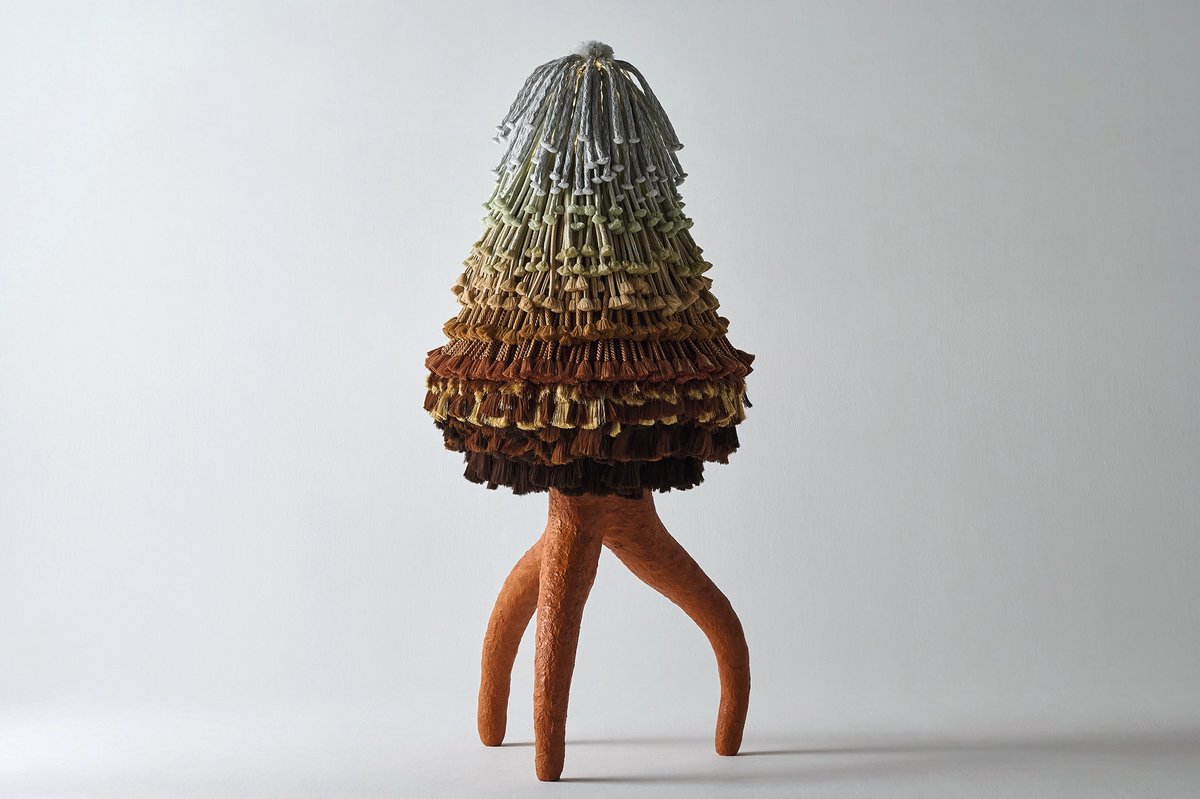
The South African Atang Tshikare works at the intersection of art and design, particularly addressing Tswana heritage. In Japan, he was introduced to the technique called iga kumihimo, where vividly dyed silks are braided into shimmering cords. In Japan, these would be used to fasten a kimono but Tshikare subverted this functional nature to make a lamp with an anthropomorphic form.
Though an initiative driven by experimentation and discovery, the works are also on sale as limited editions. The exhibition is at the V&A until 30 September.