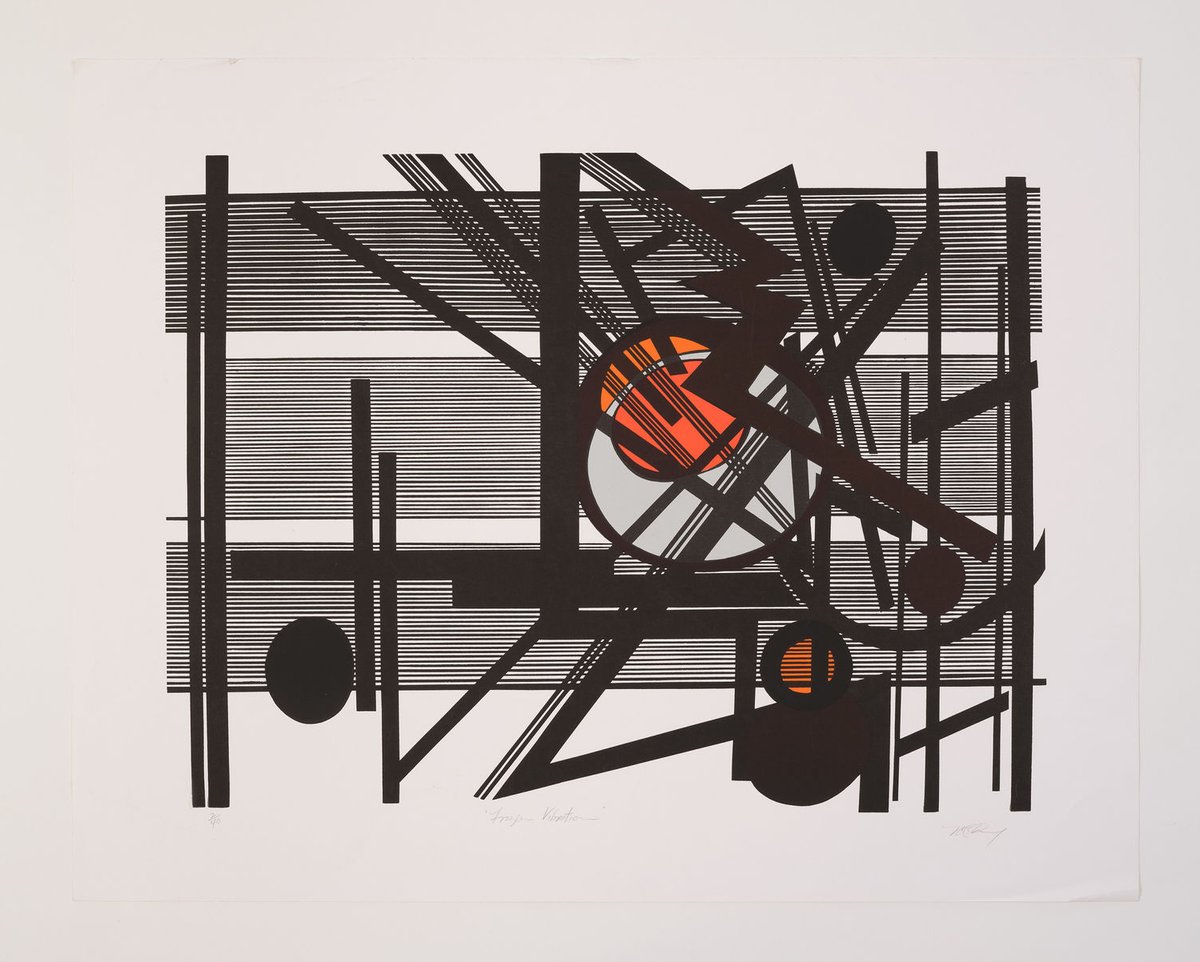
In 1966, Mavis Pusey’s Untitled (Abstract Composition) (1964) travelled to the University of California, Los Angeles (UCLA) for the landmark exhibition The Negro in American Art, a rare, early show of Black American artists during the height of the civil rights movement. Sixty years later, the hard-edged colour lithograph returns to the university in Mavis Pusey: Mobile Images, the first major museum survey of the Jamaican artist (1928-2019).
The exhibition at the Hammer Museum in Los Angeles will gather together more than 60 oil paintings, etchings, silkscreens and drawings in graphite and marker, following Pusey’s geometric vocabulary from garment patterns and bodies to buildings. Photographs, personal notes, poems and other archival materials will help reconstruct a life that had largely disappeared from public view.
In search of the artist
The search began nearly a decade ago after Thelma Golden, the director of the Studio Museum in Harlem, encountered Pusey’s work in an online auction catalogue and encouraged the curator Hallie Ringle, then working at the museum, to investigate. With little more than a website maintained by the dealer Mark Brock, Ringle found the artist in rural Virginia in 2018, a year before her death, and began tracking down works and papers. The resulting survey, curated by Ringle and Kiki Teshome, opened at the Institute of Contemporary Art in Philadelphia in 2025; for the Hammer, the curator, Jessi DiTillio, has rearranged its thematic sections into chronological chapters.
Born in Retreat, Jamaica, in 1928, Pusey learned to sew from the aunt who raised her after her parents died. She moved to New York City in 1958 to study fashion design before turning to fine art. “I look at many of her paintings as pattern pieces, deconstructed garments, laid onto a table,” Ringle says. “Even when the literal figure disappears, the hint of an elbow, knee or thigh remains.”
After her student visa expired in the mid-1960s, Pusey moved to London, where she worked as a patternmaker and studied printmaking with Birgit Skiöld, and then onto Paris, where the student uprisings of May 1968 inspired a turbulent series of lithographs. “She was walking in the street when a protest erupted around her,” Ringle says. “The police started throwing tear gas, so she closed her eyes, and in the chaos of the scene she heard music.” Eighth notes and treble clefs, banjos and fretboards appear among the criss-crossing and clashing forms of her early prints.
Returning to New York in 1969, Pusey walked through Chelsea photographing demolitions and new construction, while researching the city’s history in libraries. In Within Manhattan (1977), louvres, two-by-fours, bricks and boarded-up doors press against one another, competing for space and resisting equilibrium. “She was interested in the residue of the people who lived their whole lives in those buildings as they came down,” Ringle says, “as well as in the potential for what could come next.”
In 1971, her monumental graphic painting Dejygea (1970) was selected for the Whitney Museum of American Art’s exhibition Contemporary Black Artists in America. “Refusal feels like a strong word,” DiTillio says of interpreting Pusey’s abstraction as a rejection of expectations that Black artists address racial politics through figuration. “She was committed to colour, form and abstraction. Her experiences of the world made their way into the work in those distinct and particular ways.”
• Mavis Pusey: Mobile Images, Hammer Museum, Los Angeles, 11 October-
28 February 2027