On her walk into work one morning last May, Austen Bailly, the deputy director of curatorial affairs at the Crystal Bridges Museum of American Art in Bentonville, Arkansas, met an elementary school-aged boy and his mother or caregiver. They stood in the museum’s sculpture garden, looking up at Deborah Butterfield’s Redstick (2007), a horse-shaped sculpture that appears to be constructed of large twigs.
As Bailly offered guidance and got to know the visitors, she learned that the child had undergone a sleep study the previous night at Arkansas Children's Northwest Hospital in nearby Springdale. His grown up, wanting to do something fun and special after the medical procedure, planned their early-morning visit to the museum.
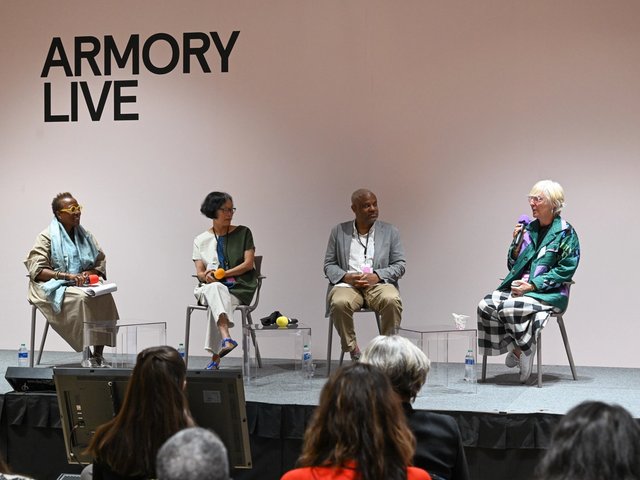
Baily recounted this story on 20 August in her opening remarks for a convening of curators specialised in selecting art for hospitals, held at Crystal Bridges and hosted by Art Bridges Foundation, one of its sister organisations. The encounter, she said, revealed the ways the public has embraced the connection between art and health, and emphasised the significance of that morning’s gathering of curators in healthcare.
As evidence for culture’s role in enhancing health and wellbeing continues to pile up, an increasing number of arts councils, cultural organisations and national health systems are working together to provide opportunities for creative experiences. The Art Bridges Foundation, a non-profit dedicated to expanding access to American art by partnering with local museums across the US, has broadened its support to include hospital art curators.
Nurturing relationships in art and health
This summer’s symposium, which brought together 19 curators working in hospitals across North America, reflects how Art Bridges is nurturing relationships between museums and other arts and health organisations throughout the US, even as its sister organisations build infrastructure and programmes meant to serve the cultural and healthcare needs of local communities in north-west Arkansas.
“Eventually, Art Bridges wants to play the role of partnering art museums and healthcare settings to create their own regionally specific programme,” says Anne Kraybill, Art Bridges’ chief executive.
Each year, the organisation hosts numerous convenings for museum workers, including those offering art and wellness programmes, but this was their first for hospital art curators. As they explored ways to support both their local healthcare systems through Crystal Bridges and museum curators working in medical settings nationally, the organisers started with two questions, Kraybill says: “What does it mean to curate in these spaces? And what does it mean to develop an arts programme?”
To prepare, members of the Art Bridges team travelled to Stanford University in the Bay Area, where they learned “the way that the curators think is just fundamentally different”, Kraybill says.
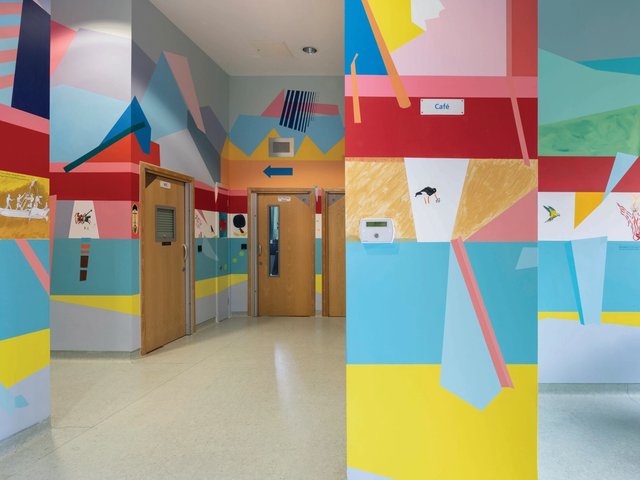
Medical spaces are regulated by various public entities, says Connie Wolf, a consulting director for Stanford Health Care’s arts programme. For example, she and her colleagues are limited by types of materials and how art sits in hallways according to width requirements, she says.
They also consider how people experience healthcare settings, anticipating their frames of mind and how they might navigate often confusing corridors. Wolf says they place art in key locations as a way of creating markers. “By placing art strategically, it creates a sense of place,” Wolf says. “We think of it as wayfinding and place-making.”
Hospital art curators also recognise that art’s purposes vary depending on location. Art meant for passageways has a different sense of meaning and purpose than art in waiting rooms. “It’s really different to be in a cancer centre with a life-threatening illness than it is to be in some place where you’re going to get your leg set in a cast,” says Susan Krane, a curator and consultant for strategic initiatives with Montage Health in Monterey, California.
Krane says she works with staff to learn how a space will be used. During her presentation at the Bentonville symposium, she shared her experiences working on Montage Health’s Ohana Center for Child and Adolescent Behavioral Health, which opened in 2023. For that project, she teamed with the facility’s clinical lead, Susan Swick, who listed ideas, such as resilience and mindfulness, that she thought were important. The selected works were also considered as “tools for the clinicians to trigger conversations, or for the kids to think about”, Krane says.
Ryan Patrick, a curator for arts in medicine at New York City Health and Hospitals—the largest public health system in the US—proposed the mantra “curating for health” at the symposium. He said it is a guiding methodology for how he and his colleagues commission art and use their vast art collection of more than 8,000 works. Their model includes collaborating with researchers and co-designing spaces with patients and staff.
“The arts and medicine department is embedded in the quality and safety cabinet,” says Larissa W. Trinder, who, as the department’s assistant vice president, oversees Patrick’s curatorial programmes. “That means that this department is held to the same kind of rigour and accountability that others are in the same space.”
When Trinder arrived in her role, she and her team were thoughtful and used design principles but lacked a clear strategy, she says. That changed under the quality and safety cabinet, where they have created methodologies that allow them to deliver art while accessing a large database of information. As a result, they are gaining insights into how the arts can be part of solutions for addressing issues such as retention and loneliness.
Trinder also collaborates with researchers, including Nisha Sajnani, a professor at New York University’s Steinhardt School of Culture, Education and Human Development and a founding co-director of the Jameel Arts & Health Lab, which the World Health Organization launched in 2023. Trinder and Sajnani are working on the global Hospital Murals Evaluation project, which is examining the impact of murals in healthcare organisations in Nigeria, Slovenia, the US and the UK. Healing for All, a mural by the artist Ebony Bolt at a municipal hospital in the Bronx, was part of the study.
Growing scientific consensus
“When we know that, statistically, people who are participating in the arts have better health outcomes, we have to think about access to the arts as a social determinant or driver of health,” says Jill Sonke, a US cultural policy fellow at Stanford University and a research professor at the University of Florida. She adds that access to the arts should be thought of as a condition that generates health, much like access to good food, transportation and housing.
A recent review of previous studies conducted by Sajnani and her colleagues found that patients who viewed visual art in healthcare settings reported reduced heart rates, improved mental health outcomes and increased wellbeing. Healthcare staff in the study also reported improved wellbeing along with an “increased capacity to prioritise patient needs”.

A representative of the Vancouver General Hospital speaks at the symposium in August, organised by Art Bridges Foundation and held at the Crystal Bridges Museum of American Art in Bentonville, exploring how art in healthcare spaces can best be utilised Jack Pate
“We found that visual art was able to reduce stress, improve mood, improve a sense of calm and, in some studies, there were actually changes in physiological indicators of stress,” Sajnani says.
Integrating the arts in healthcare environments can help create spaces in which patients and families see their cultures, histories, identities and experiences represented and valued, Sajnani adds. And when those communities participate in creating or selecting the art, “it can also shift them from being passive recipients of an institutional environment to having some agency and actually shaping it”.
Both Sajnani and Sonke caution that adding art to healthcare settings is not always a guaranteed success. “Art is not universally beneficial,” Sajnani says. While current research shows that people respond positively to art in healthcare settings, she says, “we know considerably less about why, for whom, under what circumstances and over what period of time that occurs”.
“The field needs research,” Krane says, echoing an idea expressed by other curators in interviews after the Bentonville symposium. She would like to rely on data to learn how best to expand programmes and assess what purposes they serve. She adds that she and her colleagues developed a kind of camaraderie during the gathering that “is hard to feel on a Zoom call”. They learned that while their needs are different, they all share concerns about presenting appropriate imagery, and have problems with medical supply carts running into walls, she says.
For Wolf, there was meaning in finding colleagues with a depth of knowledge who care about the rigours of the profession and want to learn from each other. She was also impressed by the support Art Bridges offers its local medical systems in north-west Arkansas while seeking “to infuse communities with opportunities that they would never have”, she says. “They’re not just thinking locally; they’re thinking globally.”