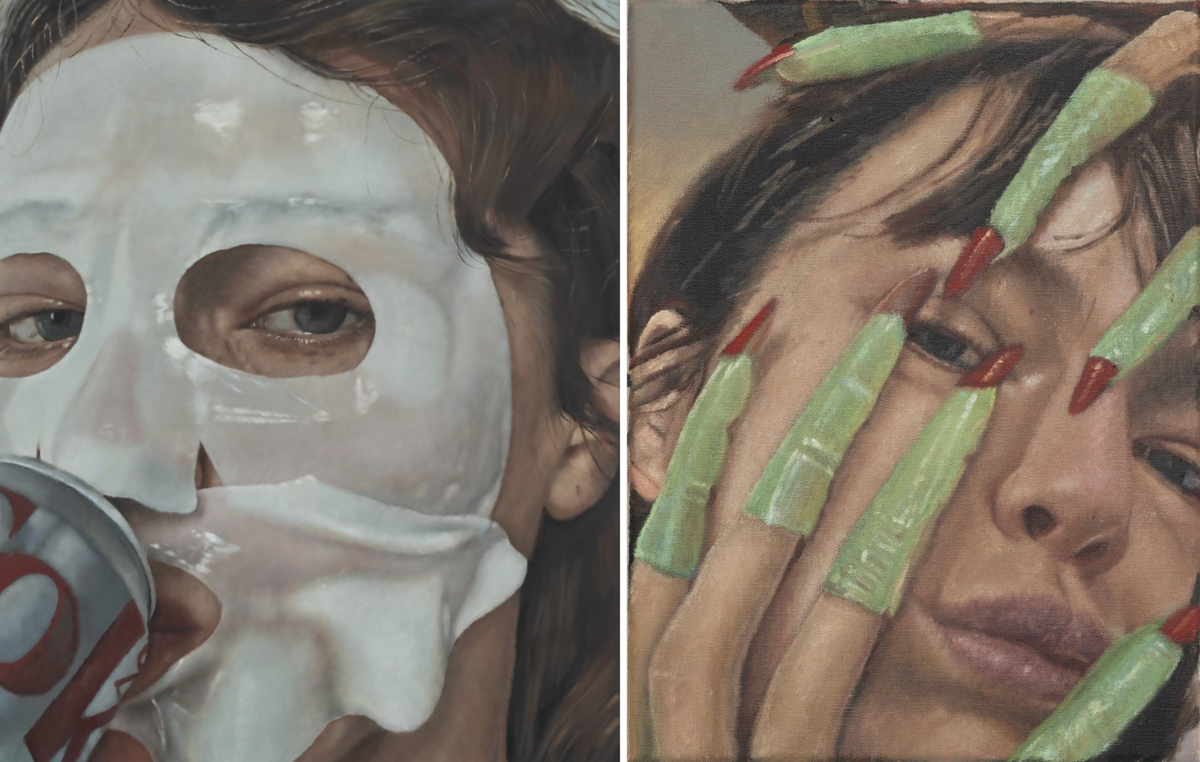
The young British-American painter Issy Wood has gained an international reputation as one of a generation of artists who have rebooted the relevance of figurative painting within a culture dominated by the circulation of digital images. Using a language influenced by Pierre-Auguste Renoir’s “pearly period” as well as the collages of Hannah Höch and John Stezaker, and shaped by the visual languages of advertising, pornography, fashion and social media, Wood’s ominously intimate still lifes and fragmented self-portraits are both seductive and troubling.
Eleven of these self-portrayals have recently gone on show at the National Portrait Gallery in London to launch Artist Focus, a new strand devoted to contemporary artists who are expanding and challenging the genre of portraiture.
The Art Newspaper: You dislike being photographed and describe yourself as someone who “hates” their face. But over the past five years you have painted more than 80 self-portraits using camera phone selfies. What turned you to self-portrayal?
Issy Wood: The self-portraits came from a very practical urge to provide a semi-viable stand-in for a magazine that was writing an article about me and threatening to send a photographer over to my studio. I try to think as little as possible about the beginnings of any series that I paint, and the self-portraits aren’t really any different. They just started to unfold, and there was something useful about making them that has a lot to do with the various issues I have with the way I look, and not really being able to trust my own opinion about my appearance.
I think they also told me that ultimately I have to loosen up on my photographic image never seeing the light of day. It’s not a viable way to go about my life. There’s something to be said for growing out of these hard and fast rules, and maybe the self-portraits are part of that process.
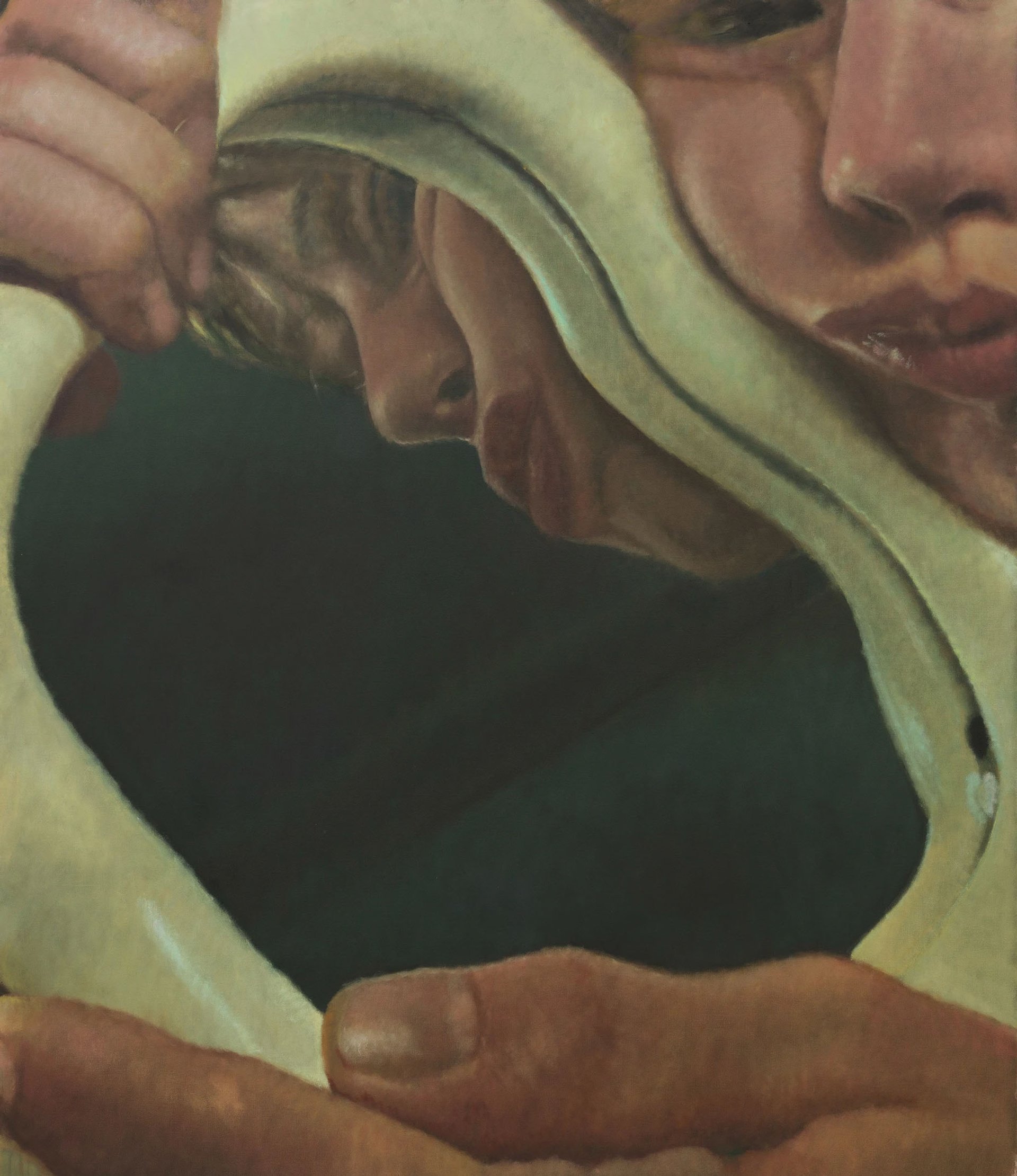
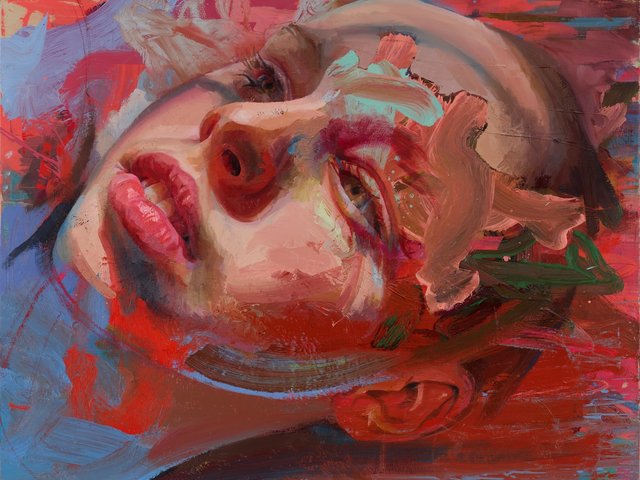
Wood’s Self portrait 22 (2022). “There are a million different decisions when you’re dealing with your own face,” she says. “I’m learning that you can be as adventurous as you want.” © Issy Wood 2026; courtesy the artist, Carlos/Ishikawa, London, and VeneKlasen, New York and London; photo: Eva Herzog
In your self-portraits you appear in many roles and manifestations, sometimes partially masked or concealed, sometimes with a more direct and intimate pose. Often, you seem to be playing with and off stereotypes and societal gazes to form a complicated relationship with the viewer.
I learned at the very beginning of my career, and also through having a lot of therapy, that there’s a way of faking candour where you can be explosively revealing in one area, almost to distract from some maybe more crucial, more telling part of yourself. There are many different ways of being candid and being “vulnerable”, and performing vulnerability. Life—and especially life as a woman or someone who’s putting something of myself into the world on a daily basis—means you just have to figure out what your caveats are and accept that these might change over time.
Some of your portraits seem to have a performativeness, while others appear more introspective. How do they come about? Is this spontaneous or do you prepare in advance?
In loads of ways I’m the least qualified to see myself honestly. They’re not candid snapshots of me at all, because they were the most consensual of all images of me. Each one took a few days to make and there are a million different decisions when you’re dealing with your own face like that. You’re just the nearest life drawing subject, and I’m learning that you can be as adventurous as you want.
I like noticing these moments of vanity where maybe I won’t make a painting of a certain facial expression because I don’t like how that might appear, and then maybe going back on it and forcing myself to appear a certain way that maybe doesn’t make me look the best. There’s not really anything true about them, I don’t think.
But you are nonetheless repeatedly physically scrutinising yourself. Doesn’t this process alone offer a degree of introspection?
Sometimes, but not always. I think some of them are great feats of introspection and I come away thinking about myself in a different way, and in ways that I probably don’t even expect or have any control over. Others are just like, it’s just something to paint and doesn’t have any more weight than your average selfie. If they were all these intense inward gazes, that would be exhausting.
Clocks and watches often feature in your paintings, including in some self-portraits. Do you see time as a theme in your self-portraits?
This is the first time where I am thinking about a 50-year arc of a series, if I’m lucky enough to be able to be 80 years old and to look back over it. I wish I’d started neatly when I was 30, but I think I did the first one when I was around 27. To track my own aging as a woman, it’s an interesting and sort of horrifying prospect.
Self-portraits, and painting in general, carry huge art historical freight.
As a painter, you have to find a way to make peace with the fact that you’re in dialogue with the whole of the history of art. And you just have to find some ease with that. Ideally you have to turn it to your advantage and somehow celebrate it, rather than feeling the weight of it crush you. I feel I’ve made my private peace with all of this stuff just through being a painter working in this historical medium. That this is the way I spend my day, and it was also the way that Rembrandt spent his day, is just too strange.
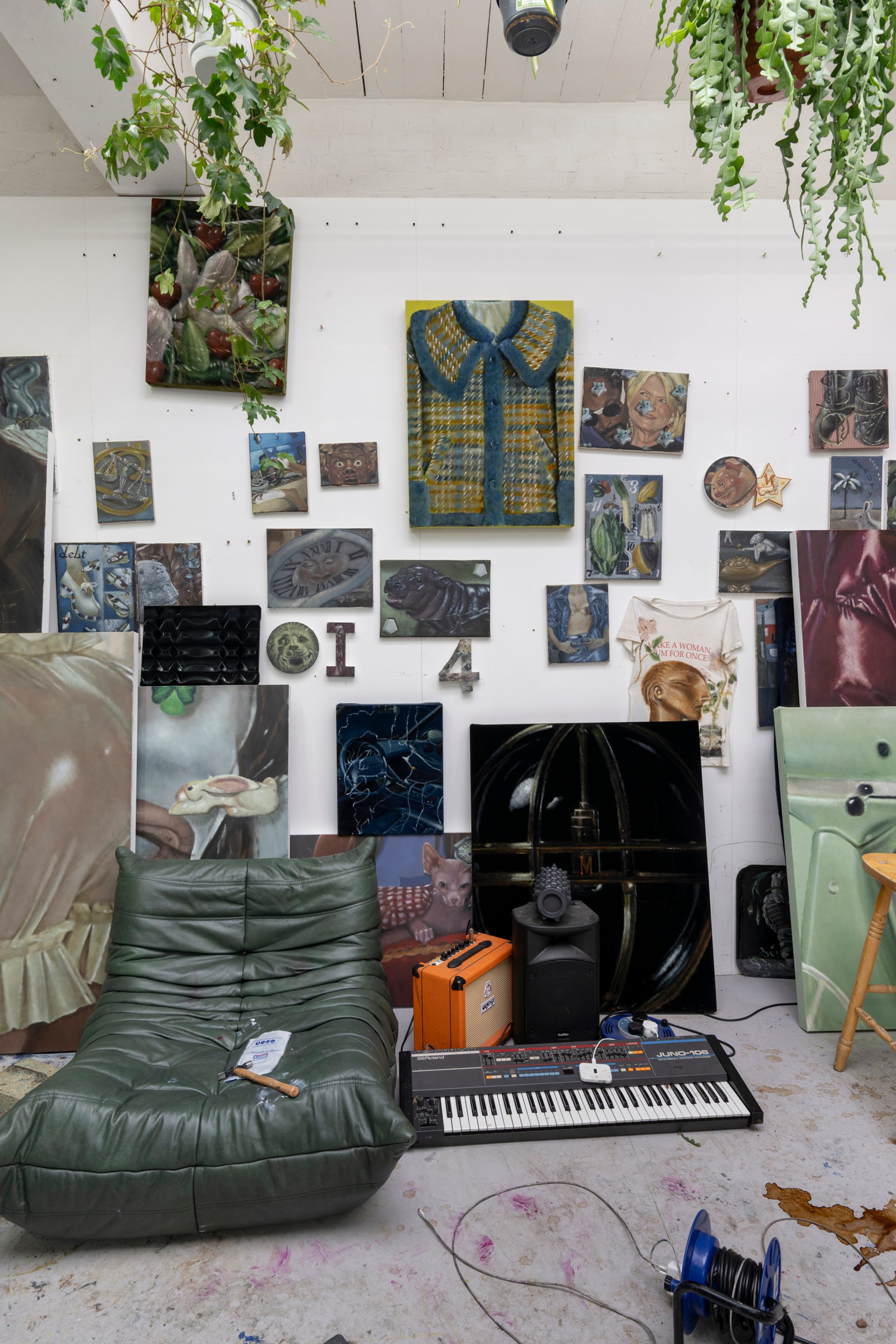
Wood’s studio in London. “That this is the way I spend my day, and it was the way that Rembrandt spent his day, is just too strange,” the artist says about life as a painter Photo: Damian Griffiths; © Issy Wood 2026; courtesy the artist, Carlos/Ishikawa, London, and VeneKlasen, New York and London
And now at the National Portrait Gallery your self-portraits are being inserted into the history of Western portraiture stretching back to the Tudors.
It’s so bizarre. I feel like I was given a little bit of an on ramp in the form of the National Portrait Gallery acquiring three of my small self-portraits in 2023. In my world of galleries that I show with, it’s one of the few art places that my family really recognise, and they have already had a field day in the gift shop with the postcards made when they showed those first three paintings. Maybe a few years ago that would have made me gratified to be able to show an element of my success that my family can read and go, like, “Ha, I told you!” But now it’s more just a warm feeling of this idea that there’s something my family can go and physically see and be proud of. And this makes me incredibly happy in a new way. I’m being forced to lobby for the merch quite hard for the family: fridge magnets in the gift shop this time would be huge.
Your show is launching the gallery’s new Artist Focus programme for artists who push the boundaries of portraiture. In what way are you doing this?
I don’t really want to think about how much I am or am not pushing the boundaries of self-portraiture. With institutions that old, I feel that just by being still alive, you’re pushing the boundaries. But I do know that I’ve been lingering on the [National Gallery’s] Rembrandt painting where he is in his 60s since I was a child, whether I was being dragged through the place or going there of my own volition, and it’s too strange to be in that company.
• Issy Wood: Self Portraits, National Portrait Gallery, London, until 28 February 2027