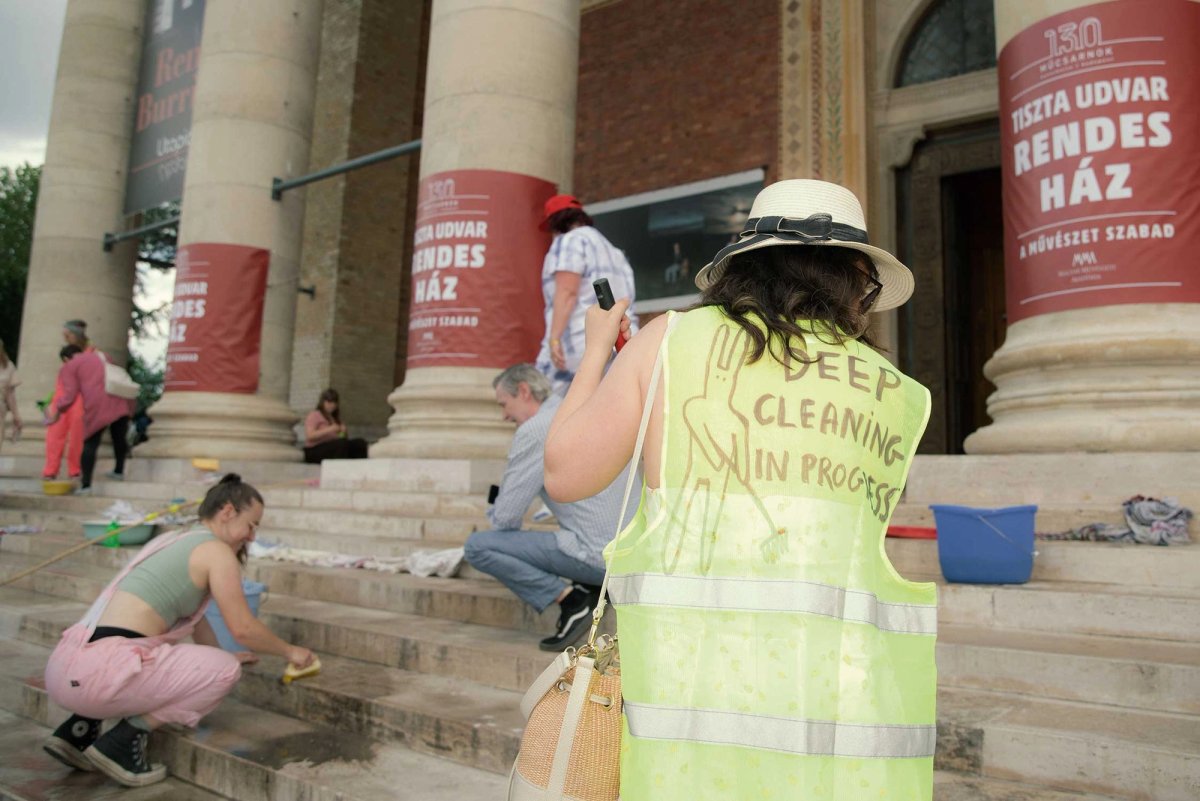
On 12 April 2026, Hungarians overwhelmingly voted Prime Minister Viktor Orbán and his populist Fidesz party out of power after 16 years. On 2 June, a small group of artists and curators organised a public cleaning of the steps of the Műcsarnok, Budapest’s neo-classical exhibition hall.
The Kunsthalle, as it is also known, had become the Hungarian capital’s signature contemporary art venue in the years after the fall of communism. Known for mounting shows of international figures, the space also featured innovative Hungarian artists such as Little Warsaw, the Budapest duo who made a splash at the 2003 Venice Biennale with The Body of Nefertiti in the Hungarian pavilion. Under Fidesz, the Kunsthalle had become the exact opposite: an outpost of arch-traditional, even frankly nationalist Hungarian art.
June’s symbolic action, Deep Cleaning in Progress, managed to be both hopeful and wistful, an attempt to break with the past and perhaps pick up where Budapest’s art scene had left off before the Orbán era began. There are signs that the government of Hungary’s new prime minister, Péter Magyar, is ready to address the various crises facing the art community. But the long Fidesz era, marked by an ever-tightening control of cultural institutions and a creeping indifference to culture generally, has taken its toll and a morning-after feeling prevails.
Within a few years of returning to power in 2010, Orbán, a previous prime minister then regarded as a centre-right politician, had created a template for what he later called “illiberal democracy”. Using Fidesz’s initial two-thirds majority in the Hungarian parliament, Orbán revamped the electoral and constitutional order by removing a range of democratic checks and balances and remaking the judiciary. The party also used a similar approach to reorder the country’s cultural establishment, says Katalin Székely, a curator affiliated with Budapest’s Central European University.
Fidesz was “very clever”, Székely says, and was able to “use the existing framework to occupy and co-opt institutions”, including the Kunsthalle and the Ludwig Museum, another important contemporary art venue where she had been working since 2008. By 2014, both spaces had new leaders and new exhibition programmes; many staff hired before 2010, including Székely, left or were sidelined by the changes. Meanwhile, the direction of new art was influenced through grants and fellowships administered by the newly conservative Magyar Művészeti Akadémia (Hungarian Academy of Arts).
Selective sponsorship eventually translated into a kind of voluntary censorship, says the Budapest-based collector Zsolt Somloi. Hungarian artists who wanted to get a grant or secure a prime exhibition spot in one of the larger national spaces came to realise that “a lot of topics that are very hot on the international level couldn’t be touched in Hungary”, Somloi says. As a result, he adds, “You didn’t talk about gender, you didn’t talk about immigration and you didn’t talk about climate change.”
Following Orbán’s 2014 re-election on a more aggressive populist platform, his larger plans became clear. Two gargantuan projects were devised to relocate several cultural institutions away from the city’s visually dominant castle district, built around the hilltop Buda Castle to, among other areas, a cluster of new buildings in a large city park, Városliget, on the other side of the Danube. The goal, it seemed, was to connect Orbán and his Fidesz officials to Hungary’s Habsburg monarchs by reverting what had become a cultural enclave into a largely political one.
Alternative spaces
Ballooning budgets, evidence of cronyism and corruption, and civic objections to the tearing up of the park mired both mega-projects in controversy. Meanwhile, other important cultural institutions—notably Budapest’s Museum of Applied Arts, housed in a landmark Art Nouveau building—were left in limbo.
Being largely kept out of prime venues like the Kunsthalle meant that more adventurous artists resorted to alternative spaces, says Zsolt Miklósvölgyi, a curator at Budapest’s acb Galéria. He cites the OFF-Biennále Budapest, held five times since 2014, and several artist-run spaces as recent torchbearers of the country’s avant-garde. “In an art field that had previously been shaped to a large extent by the state or state-funded institutions,” he says, “cultural foundations and organisations, private galleries and independent actors have gradually had to assume greater responsibility.” He stresses that his own gallery was open to showing “politically sensitive subjects that received little or only limited space” in more established venues.
The 2015 migrant crisis in Europe gave Orbán and his party, who were rapidly adopting a Christian nationalist stance, an international profile that inspired populist movements elsewhere in Europe and, crucially, among the acolytes and promoters of Donald Trump. But by the early 2020s, Fidesz had been in power for a decade and was running out of scapegoats.
As the 2022 election approached, Orbán “couldn’t really rail against the state of the country, because he was responsible for the state of the country”, says the Hungarian political scientist Lorinc Redei, a professor at the University of Texas at Austin. It no longer made sense to invoke the threat of illegal immigration, he adds, in a country with a minimal immigrant population.Like many earlier populist movements, Redei says, Fidesz started to create a new “scary enemy” out of the LGBTQ+ community, a development that had a strong impact on the art scene.
In 2021, Hungary passed a controversial child protection law that sought to prohibit the promotion of LGBTQ+-related content to minors. In 2023, the law was used as a pretext to fire László Simon, the director of Budapest’s National Museum, for refusing to restrict the admission of visitors under 18 to a photography exhibition that contained images of LGBTQ+ people. Simon had been a Fidesz member of parliament and had only been in his post two years.
“The passage of that law was a big deal,” says the Budapest-based artist Gideon Horváth. He says his work, which addresses issues related to queer subcultures, has faced various kinds of censorship, including a museum exhibition whose organisers “rewrote my texts that accompanied my installation”.
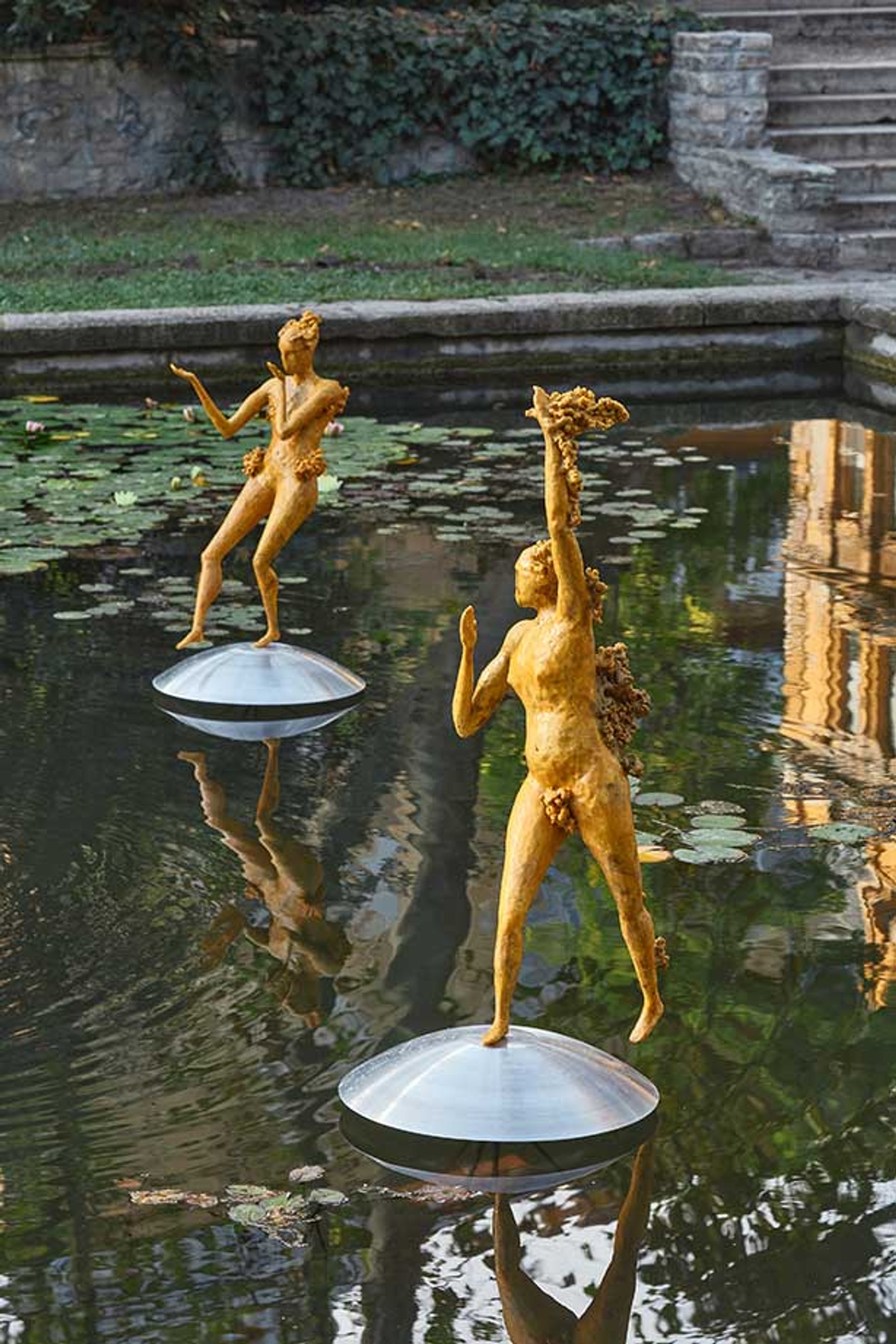
Budapest-based artist Gideon Horváth’s Memory that could have been (2023) Photo: Dávid Biró; courtesy the artist and Longtermhandstand
The government’s hardened anti-LGBTQ+ stance became a lightning rod. In 2025, after a revised law threatened to prohibit that summer’s Budapest Pride march, tens of thousands of people showed up in defiance—an event that many now see as heralding Fidesz’s election defeat the following spring.
A sense of ambivalence
Looking back on the Orbán era, many in Hungary’s art scene have mixed feelings. It was, for instance, a very productive period for Horváth and he is currently showing in the Biennale de Lyon and has work in the collection of Somloi and his wife Katalin Spengler.
Miklósvölgyi is quick to point out that Budapest’s Museum of Fine Arts managed a successful relaunch in 2018, after a three-year renovation. The museum’s curator of prints and drawings, Kinga Bódi, says she never felt any restrictions when acquiring new works by artists who might otherwise have been looked down on by Fidesz. This summer, after a few years of planning, the museum acquired a nude self-portrait by the LGBTQ+ Roma artist Robert Gabris, who has a show at the acb Galéria this autumn.
Horváth is sceptical about “systematic change”. The directors of the Kunsthalle and the Ludwig Museum are still in place, and Magyar’s party has views on immigration that can seem close to Fidesz’s. But he admits to a change in himself. After years of being embarrassed about the situation in Hungary, he says, “We can be proud of the way Orbán was voted out of power.”
Miklósvölgyi is not convinced “that what existed 16 years ago should simply be reinstated”. A way forward, he believes, would be the appointment of foreign professionals as directors of the Ludwig Museum and the Kunsthalle.
For now, the legacy of the Orbán years is most apparent in two museum construction sites on the Pest side of the city. The Museum of Applied Arts, closed since 2017, is still being renovated behind a ghostly scrim. In Városliget, there is a vast open pit that was meant to be the site of the New National Gallery. The project, to be housed in an eye-catching building by Japanese firm Sanaa, was cancelled this summer, and the area is surrounded by graffiti-covered fencing.
For Zsolt Petrányi, director of the Kunsthalle from 2005 to 2011, these are symbols of the peripheral role the arts played in the Orbán years, when sports “was much more important”. While many museums languished, Orbán and his allies built a host of new sports venues including, most notoriously, a 3,800-seat stadium in his home village of Felcsút—population 2,000.
József Mélyi, an associate professor at the Hungarian University of Fine Arts, is more hopeful than not about the new government, which, he points out, was quick to re-establish an independent culture minister, a position the Orbán regime had demoted. “Five years,” he says, may be just “enough to get us back to where we were 15 years ago”.