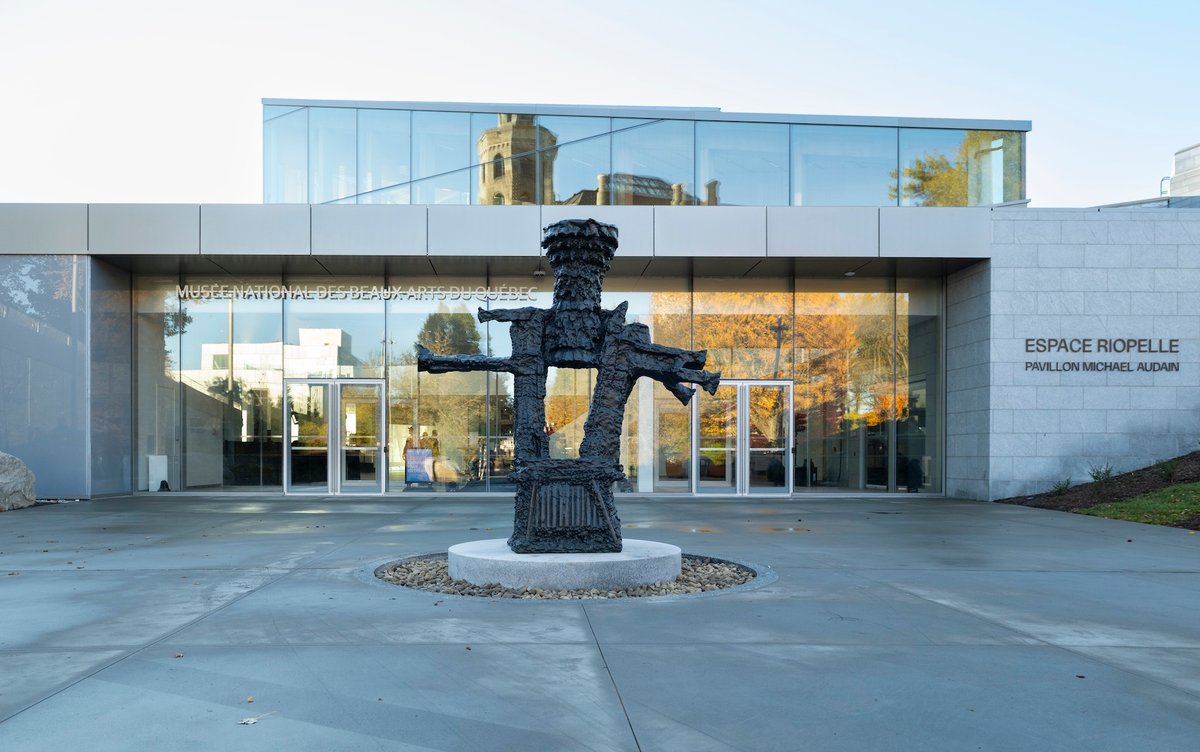
A new pavilion at the Musée National des Beaux-Arts du Québec (MNBAQ) opens tomorrow (22 October). The C$84m ($61m) Espace Riopelle-Michael Audain Pavilion is named for both Jean Paul Riopelle (1923-2002), the province’s most famous Modern artist, and Michael Audain, a philanthropist and co-founder of the Jean Paul Riopelle Foundation. The project was first announced in 2022, but the budget more than doubled since then—with the Québec government contributing more than C$40m.
Spearheading the project, the Jean Paul Riopelle Foundation (which has provided at least C$20m for the pavilion) was driven by a desire to realise the artist’s dream of establishing a foundation at MNBAQ. Audain and his wife, Yoshiko Karasawa, together with the mining magnate Pierre Lassonde, have donated more than 60 important works by Riopelle and his contemporaries for the new space. Including the value of the gifted works, Audain has contributed more than C$90m to the project. All told, the pavilion represents one of the largest philanthropic donations in Québec’s cultural history.
Designed by the Montreal-based FABG Architectes to evoke Riopelle’s rustic home studio, the three-storey pavilion spans more than 5,000 sq. m. It has room for four exhibitions, including a major survey exploring the breadth of Riopelle’s career—from his Automatiste works to his 1950s “mosaic” abstract paintings and prints inspired by Québec’s landscape. A specially built circular gallery is dedicated entirely to the artist’s 40m-long triptych L’Hommage à Rosa Luxemburg (1992).
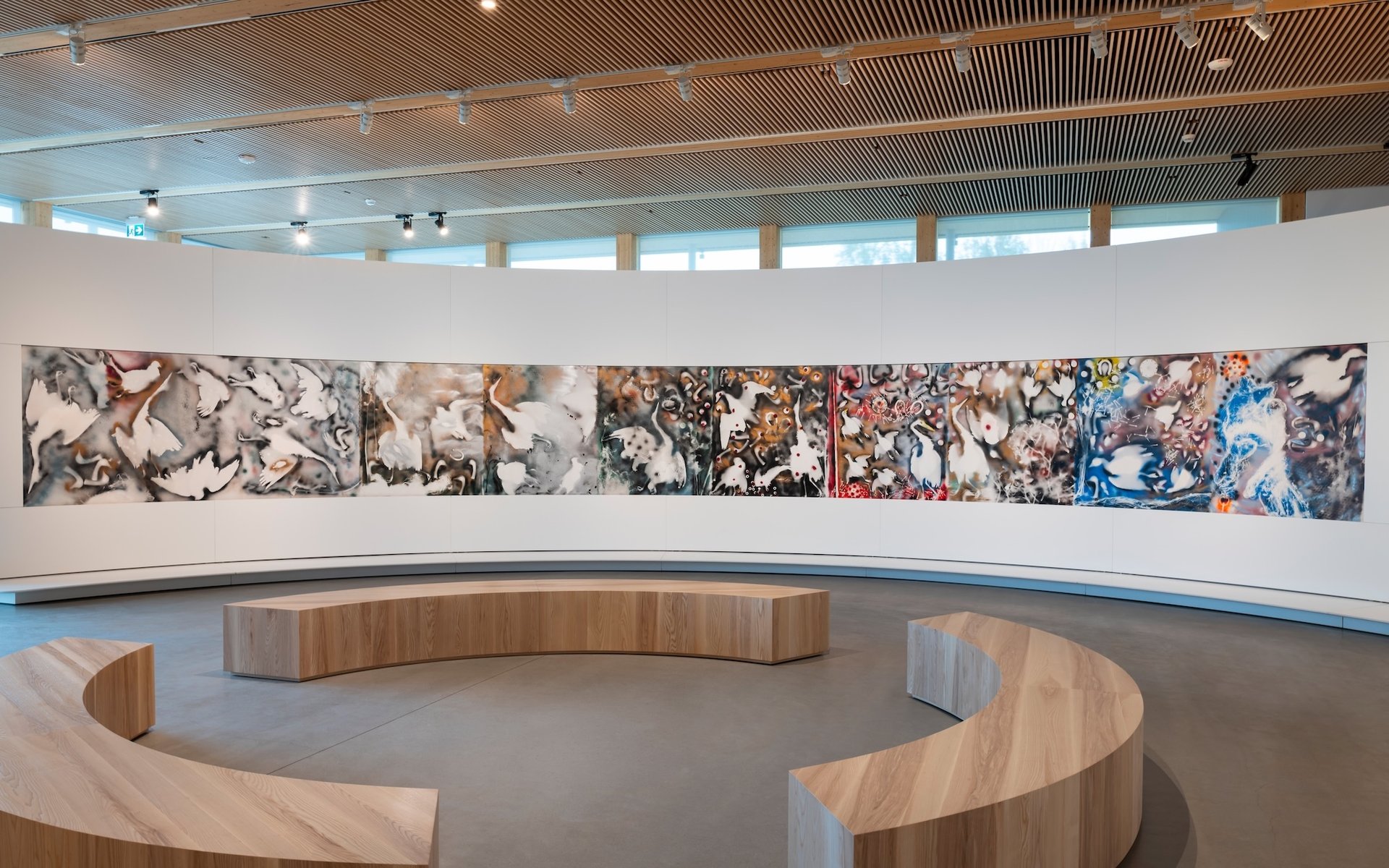
Riopelle’s 40m-long L’Hommage à Rosa Luxemburg (1992) is a centrepiece of the new pavilion Photo: Louis Hébert, MNBAQ
Communing with nature
In a nod to the artist’s focus on the natural world, the pavilion opens to expansive views of both the Plains of Abraham and the Saint Lawrence River. It also features two covered outdoor terraces. And its landscape design incorporates plants from the boreal forest, the rugged terrain of the artist’s native northern Québec.
Audain tells The Art Newspaper that Riopelle—whom he has admired since childhood and began collecting in earnest in the 1990s—is “arguably Canada’s most internationally known artist. He broke new ground by painting the landscape in a way that no one had ever painted it before.”

Audain compares Riopelle to Paul Gauguin, noting that the 19th-century Frenchman “only used a pallet knife on smaller works. Riopelle was the first to do entire landscapes using only a palette knife. I think the most important and innovative aspect of Riopelle’s work was disaggregating the landscape and reducing it to strokes of a palette knife.” Audain notes that the artist had a set of knives made especially for this purpose. “Riopelle became closer to the landscape than any other artist before him,” Audain adds.
“Riopelle finally has a space entirely dedicated to him,” says the MNBAQ’s director, Jean-Luc Murray. “The musée has long wanted to showcase his work while making it more accessible, and the Espace Riopelle-Michael Audain Pavilion does so brilliantly. We are excited to be welcoming the public to this magnificent new building, which creates a nuanced interplay between nature, architecture and the larger-than-life work of this influential Québec and Canadian artist.”