After Alison Kuo’s grandmother died, the New York-based artist inherited an unusual object—a costume beard her grandmother had worn during her time as a Cantonese opera singer in Hong Kong. “She would always perform the role of a military general,” says Kuo, adding that while gender-bending is common in traditional opera, the character of the general was often reserved for men.
In the years since she first came across the beard (alongside photographs of her grandmother in full stage getup), Kuo has been studying Cantonese opera—from its singing and staging to the costumes and set design. This weekend (22-24 October), her years of research and training culminate in a performance at the New Museum of a unique take on the 400-year-old tradition.
Titled A flame latches to a bit of straw 薪火相傳, Kuo’s take on Cantonese opera is named for a Chinese idiom similar in meaning to “passing the torch”. Channelling her grandmother, Kuo takes on the role of a general.
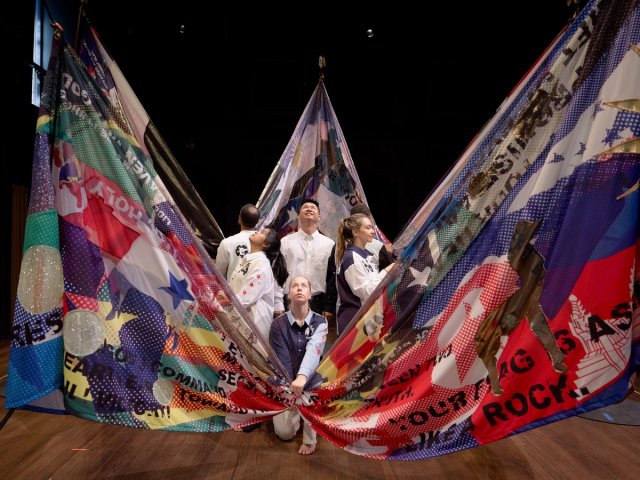
The other performers on stage include the artist’s cousin Anna Kuo, her next-door neighbour and former go-go dancer Mark Bolling, the teenage performer Mei Brunette and the Queens-based dancer and textile artist Annika Cheng. Also on stage will be local musicians playing traditional Chinese instruments and three Cantonese opera singers who regularly perform in Manhattan’s Chinatown—MeeMee Chin (Kuo’s mentor), Wai Wah Law and Ying Ying Zhu.
The story begins with the Kuo cousins looking through their grandmother’s photos and admiring her beard, before being whisked away to the world of Cantonese opera. The performance is a melding of traditional and contemporary cultures, represented not only in the cast but also in the music, staging and visual components. Kuo created the sets and several of the costumes herself; others she borrowed from local Cantonese opera performers. She even uses a few of her grandmother’s old dresses.
Although Kuo has been working on the performance for more than a year, it is a collaborative effort. Cheng helped design some of the costumes. And during rehearsals, the entire cast was encouraged to improvise and provide feedback, shaping the final result.

Alison Kuo Photo: Da Ping Luo, courtesy the New Museum, New York
Kuo’s work both as an artist and a community organiser has always been rooted in collaboration—with a particular focus on the Asian American experience, whether her own family’s or that of others. “I’ve been reading a lot of memoirs by Asian American women,” she says, “and books about what was happening at the end of the Qing dynasty.” The fall of China’s last imperial dynasty in 1912 marked the beginning of a decades-long wave of emigration and displacement, creating the rich diaspora communities that still exist today.
Although Kuo lives in Brooklyn, she often finds herself in Manhattan’s Chinatown. She remembers attending one of the very first events at the W.O.W. Project, an arts and anti-gentrification organisation founded in 2016, based out of the oldest continuously operating store in Chinatown. “I started getting involved from there,” Kuo says. Over the years, she has made a lot of valuable connections through the W.O.W. Project. She even attended Cantonese opera workshops there. A couple of her teachers join her on stage this weekend.
In 2021—while working full-time running artist residencies at the International Studio & Curatorial Program—Kuo co-founded Sisters in Self-Defense, a Chinatown-based self-defense and support group for Asian Americans. The other co-founder was the writer Ava Chin, whose daughter (Mei Brunette) features in Kuo’s performance.
Given Kuo’s proclivity for all things Chinatown, she was thrilled to become an artist-in-residence at the New Museum just a few blocks away. Since June, she has been working out of a 730-sq.-ft studio space on the museum’s sixth floor. In addition to setting up her practice there, she brought in bookshelves packed with research materials and family heirlooms. She set up a couch facing a giant window and often invites people to the space.

“It’s good to have friends in the neighbourhood,” she says. “We’ve even had Mahjong parties here in the studio.” Kuo, who helps teach art classes at a Chinatown school, even brought her young students in to see it. She says they asked her if she was a famous artist. Previously, Kuo had shared a studio in Brooklyn with her husband, who is also an artist. “I needed to be in Chinatown, I realised,” she says.
At the end of A flame latches to a bit of straw 薪火相傳, “there’s a transformation”, Kuo says of the character she plays (a version of herself). “I’m more confident, celebrating taking part in an art form that has endured for hundreds of years.” The torch has passed from Kuo’s grandmother and Chinatown’s Cantonese opera singers onto Kuo and her cousin, her friends and the teenage Brunette. A centuries-old tradition continues.
- A flame latches to a bit of straw 薪火相傳, 22-24 October, New Museum, New York