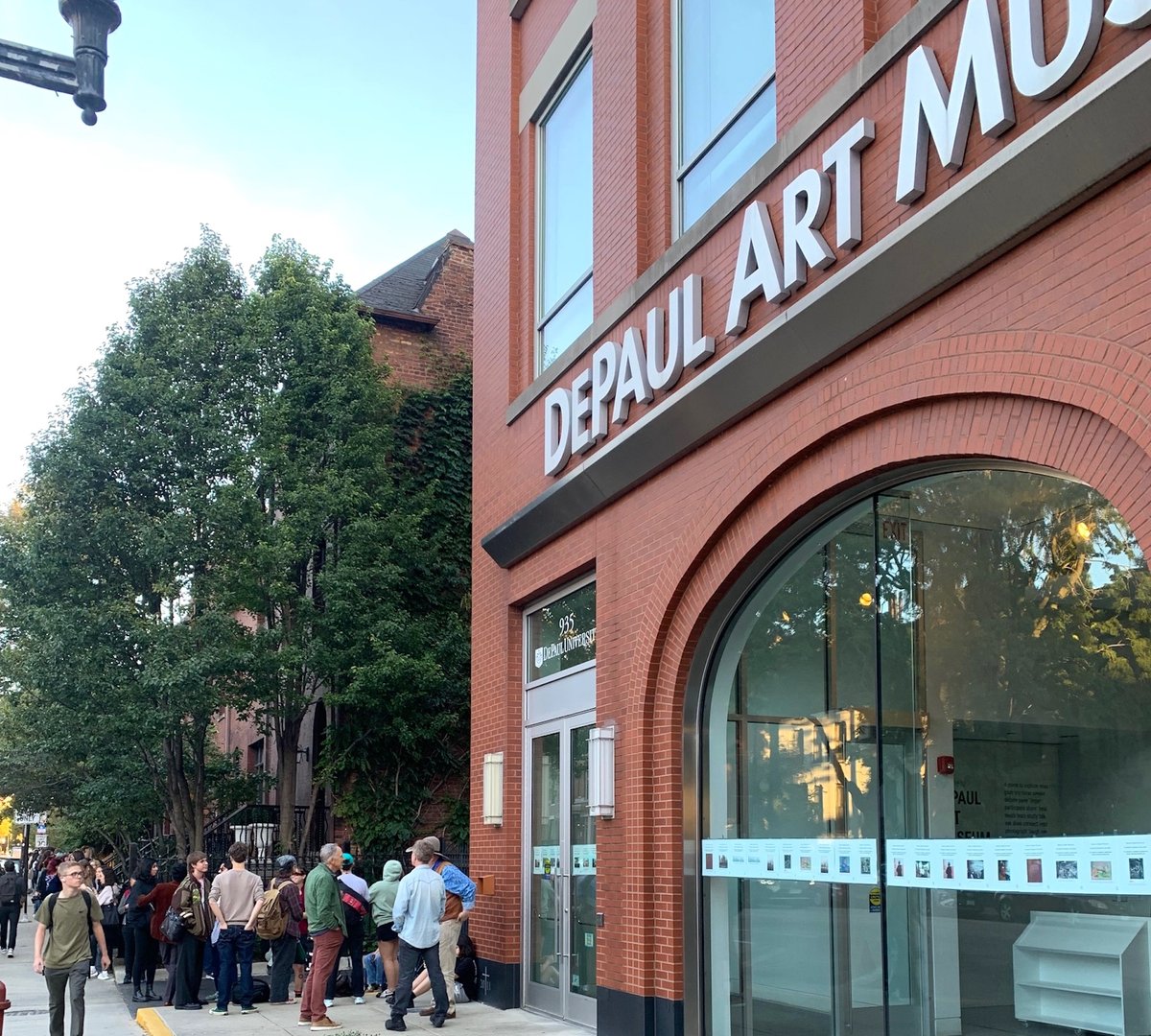
The closure in June of DePaul University’s esteemed DePaul Art Museum (DPAM) has rankled the arts community in Chicago. Students returning to campus this autumn responded to that loss with a communal piece of public protest art titled Waiting.
The format was simple: at 5pm on 8 October, a queue began to form at the front door of the shuttered museum. For the next hour, more than 100 people stood solemnly in the line stretching far down the sidewalk.
“The art department feels underfunded and forgotten by the administration,” said Ursula DeBray, a 22-year-old art student from Washington state. “Closing the museum felt like DePaul took ten steps backwards.”
This sentiment was shared by others who came to the protest hoping to convince the university's leadership to reconsider its decision to close the museum. “It’s showing that there was a community that got impacted by funding decisions,” said art student Jaret Ledford.
The DPAM had provided a cultural refuge for the campus community and surrounding neighbourhood of Lincoln Park, including educational and work-study opportunities. While the museum’s doors are now closed to the public, it remains minimally staffed to accommodate class visits and meet its obligation to a funded fellowship in museum studies.
The school responded to the protest the following day, saying in a statement: “DePaul University welcomes this peaceful demonstration in support of the arts in Chicago. The decision to stop operations at the DePaul Art Museum was a difficult one, as many institutions around the country are facing budgetary constraints. The arts are a critical part of DePaul’s community and academic offerings, and the university has no plans to sell the art collection or the building.”
The statement went on to say that university leadership was working with a faculty task force “to guide the next chapter of this space and collection” and expects to receive a report with recommendations from the group in December.
Most of the artists, students and faculty at the protest expressed frustration with the university’s partiality to sports. Just days before, the university had celebrated the groundbreaking for a $42m sports complex after demolishing four 1890s rowhouses. The building site is just around the corner from the museum, making the disparate spending decisions impossible to ignore.
“I don’t quite understand some of the funding priorities of academic institutions,” said Dana Boutin, an independent researcher and curator who held a handmade “I ❤️ DPAM” sign.

Boutin pointed out that another local college, the School of the Art Institute of Chicago (SAIC), recently sold the 19th-century home that once housed the Roger Brown Study Collection. Brown’s home and studio had been given to SAIC by the eponymous painter and collector in 1996, but its contents were later donated to the Wisconsin-based Art Preserve. Although the objects and art ended up in a more simpatico institution, SAIC had succeeded in dismantling a historic and culturally important experience for its art-school community.
“These are laboratories for students to learn and get professional experience,” Boutin said.
The mood in the queue at DPAM was wistful. Maybe it had something to do with the fact that the lights were still on in the museum, and that its collection will not be dispersed. DPAM’s director, Laura-Caroline de Lara, remains at the museum as the steward of its 4,000-piece collection. She said she has received many requests for external loans and is now in conversation with the Art Bridges Foundation about entering its collection-sharing programme.