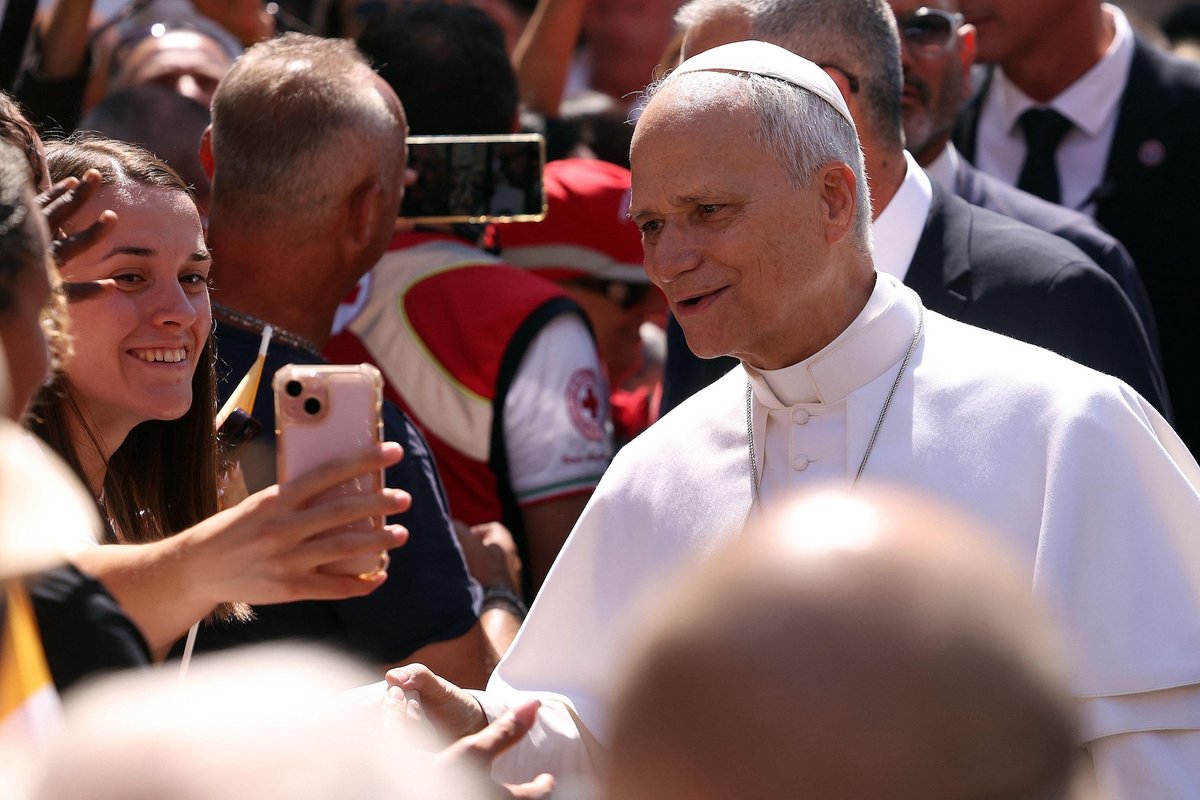

Your Holiness,
My name is Sarp Kerem Yavuz, I am a French Turkish artist, writer and curator. Having spent my most formative years of university and graduate school in Oberlin, Ohio, and Chicago, I am writing to you in the hopes that between two Midwesterners, there may be room for dialogue regarding artificial intelligence (AI).
Earlier this month, you wrote on social media: “In this era of artificial intelligence, it is becoming urgent to distinguish human art from what machines produce. There is an ontological difference, even before an aesthetic one, between art and what a machine can generate through statistical calculation based on millions of images created by others. Algorithms lack the spark of humanity. For this reason, the Church wishes to renew an alliance with artists and cultural institutions to safeguard our humanity.”
The world is already divided on AI. Fanning the flames without fully acknowledging what creating with AI entails is as reductive as dismissing Christianity on account of Leviticus 20:13. Your positioning of the Catholic Church as anti-AI, imposing a stark distinction between human artists and artists leveraging AI to generate work, creates a false dichotomy.
Humans have used tools to create art for millennia. Reframing AI as the latest addition to a long line of inventions that began with the brush is a much more constructive way to approach digital art today. We are simply artists interested in contemporary tools. Often, we employ these algorithms to illustrate the biases, shortcomings and limitations of AI. But an AI-generated work does not have to include self-reflexive commentary to be worthy of artistic recognition. Artists are uniquely positioned to create public ledgers of accountability, to demonstrate AI’s social, historical, moral, political and conceptual capacities and limitations.
Using problematic technologies to create art is not new. I often refer to Richard Mosse’s infrared photography series, which utilises film developed by the US military in the 1940s to turn all natural greenery magenta, in an attempt to detect camouflage. Planes with special cameras built into their floors would take surveillance images using infrared film to determine enemy positions and movement. Mosse used this film to take portraits of guerrilla fighters in eastern Congo, framing the rebels in a luscious sea of pink, assigning a theatrical queerness to civil war. The work relies on a surveillance tool to reframe contemporary conflicts while showcasing the intertwined relationship between photography and espionage, and how tools of oppression can be repurposed.
Jon Rafman’s delightful repurposing of Google Street View imagery to create a body of work composed entirely of screenshots, asking questions about the nature of ownership, authorship, photography and surveillance, also comes to mind. Based on your proclamation, since the cameras were programmed and operated by engineers to efficiently map streets and venues, and did not contain any artistic intention (that we know of), Rafman’s use of Google Street View imagery might also be categorised as ontologically lacking.
The misperception that AI-generated art does not require or contain human-derived labour, intentionality or craft, and is thus inferior (or lacking in human creativity), sadly ignores the reality of the digital art landscape. To be clear, AI tools at our disposal today can function without artistic intention or care. They can generate images without purpose or craft. They can serve as shortcuts or substitutes for skill. But we can also take blurry, over-exposed photographs with a digital camera on auto-focus. We choose to what degree we control our tools, and there are plenty of humans out there who use AI thoughtfully, intentionally and even masterfully.
To propose that when we do not exercise control over how these tools generate outputs, those outputs cannot be artistic, would also be incorrect. The history of art has long embraced chance, found objects and prompts, including in the works of John Cage, Sol LeWitt and Yoko Ono. Works based on prompted or delegated labour have been considered part of the canon for decades. From vague sentences encouraging the audience to do something to choreographies mapped out on an exhibition floor in the form of instructional arrows and footprints, we have had artists nudge, with very little final control, their audience into completing, activating or becoming an artwork.
When you add to that list Marcel Duchamp’s Fountain or Andy Warhol signing US currency, you can see that we have already wrestled with the implications of accepting found objects as artistic; with the notion that context, rather than output, could make something culturally significant; and with the idea that an artist could make an artwork without actually producing the underlying object.
If we live in a society that values the work of Cage, LeWitt, Ono, Warhol and Duchamp, then your assessment dismissing AI art that relies on images created by others also creates a double standard. It limits which artists get to benefit from found materials or delegated labour.
To be clear, I am not arguing about the ethics of how AI datasets are sourced. In instances where remuneration for an individual artist’s work is warranted, I fully support all public endeavours to establish payment mechanisms.
The spark of humanity that you claim is absent, I would argue, is actually omnipresent in AI-generated art. An AI tool’s approximation algorithm is ultimately human-made, and its data sets are human-derived, meaning the middle it pursues is irrevocably human. AI-generated art made today makes for a fascinating document of our (largely Western, mostly conservative) cultural and moral landscape, and the entire body of AI-generated output from the past three years will likely serve as a treasure trove for future historians.
But, to many of us artists, AI’s limitations are much more fascinating than its abilities, which is why we are using it today.
The artist Maya Man, who was recently named to the inaugural cohort of Dataland’s artist-in-residence programme, a partnership with Google Arts and Culture, uses AI to re-imagine elements of her own competitive dancing past, leveraging the tool to ask questions about performance in the age of social media, the culture of spectacle, and individual agency and memory. The iterative nature of AI is a fundamental part of Man’s work, not a hindrance, and where AI "fails" to deliver something accurately, it mimics the real-life failures inherent in performance and the fallibility of memory. The very real shortcomings of the technology contribute to her practice in ways that an accurate tool might fail to, making this precisely the right moment for Man to use nascent AI technology in her art.
I am in constant awe of Sasha Stiles’s AI-generated poems, recently exhibited at the Museum of Modern Art in New York, which she creates by training a machine on her work, tone and nuance, provoking questions about the implications of being seen by an entity so thoroughly that it can continue your work as though it were a part of you. Stiles’s work incisively interrogates the human condition by asking AI to serve as a mirror or echo of herself. Her use of AI tools is the point, and thus the technology is vital for her profoundly human work to exist.
Edward Burtynsky and Alkan Avcioglu’s imaginary landscapes offer a new look at the world through the eyes of two masters of their crafts—one who excels at understanding topography as portraiture, and the other who skillfully leverages digital tools to collapse depth, perspective and gravity in ways that create impossible vistas. Together they have tamed their respective tools and archives to bend to their will. It is wildly, delightfully inventive, a pleasure to behold.
In my own photographic works—one of which was recently named as a promised gift for the photography collection of your hometown museum, the Art Institute of Chicago—I leverage AI’s inability to accurately imagine the Istanbul I grew up in to create a new kind of Orientalism. I love its shortcomings, comparable to those of 19th-century painters more interested in presenting the Middle East as exotic—the wonderful architectural mistakes, the misplacement of tiles and floral patterns and rugs, the incorrect framing and erroneous choreography of rituals, such as the public bath. When the AI was unwilling to generate scenes from Turkish baths because, it suggested, something as casual as a visit to a public bath could only be a sexual encounter and therefore must be censored, it was as though I was attempting to take photographs with a camera that was wrestling with me. To create a scene that is as close to my reality as possible using AI tools became not just an act of defiance, but an act of sabotaging that invisible, inoffensive centre that most (Western) AI companies continuously pursue.
The linguistic back-and-forth involved in generating visuals with AI tools has become a new form of artistic practice. Language itself has become a paintbrush, which not only democratises art-making for a global community, but also instills new life in countless practices that were until recently bound by the limitations of the physical world. There is genuine skill involved in parrying with AI by using words.
Most of us agree that AI needs greater accountability. But when you denounce all AI-generated art as lacking the spark of humanity, you denounce our very human practices as well, and we just might be your greatest champions in the pursuit of a human-driven future. So when your Holiness proposed a renewed alliance between the Church and artists, I could not help but wonder: what would a Vatican artist residency focused on artists using AI look like?
Wishing you a speedy recovery,
Sarp Kerem Yavuz