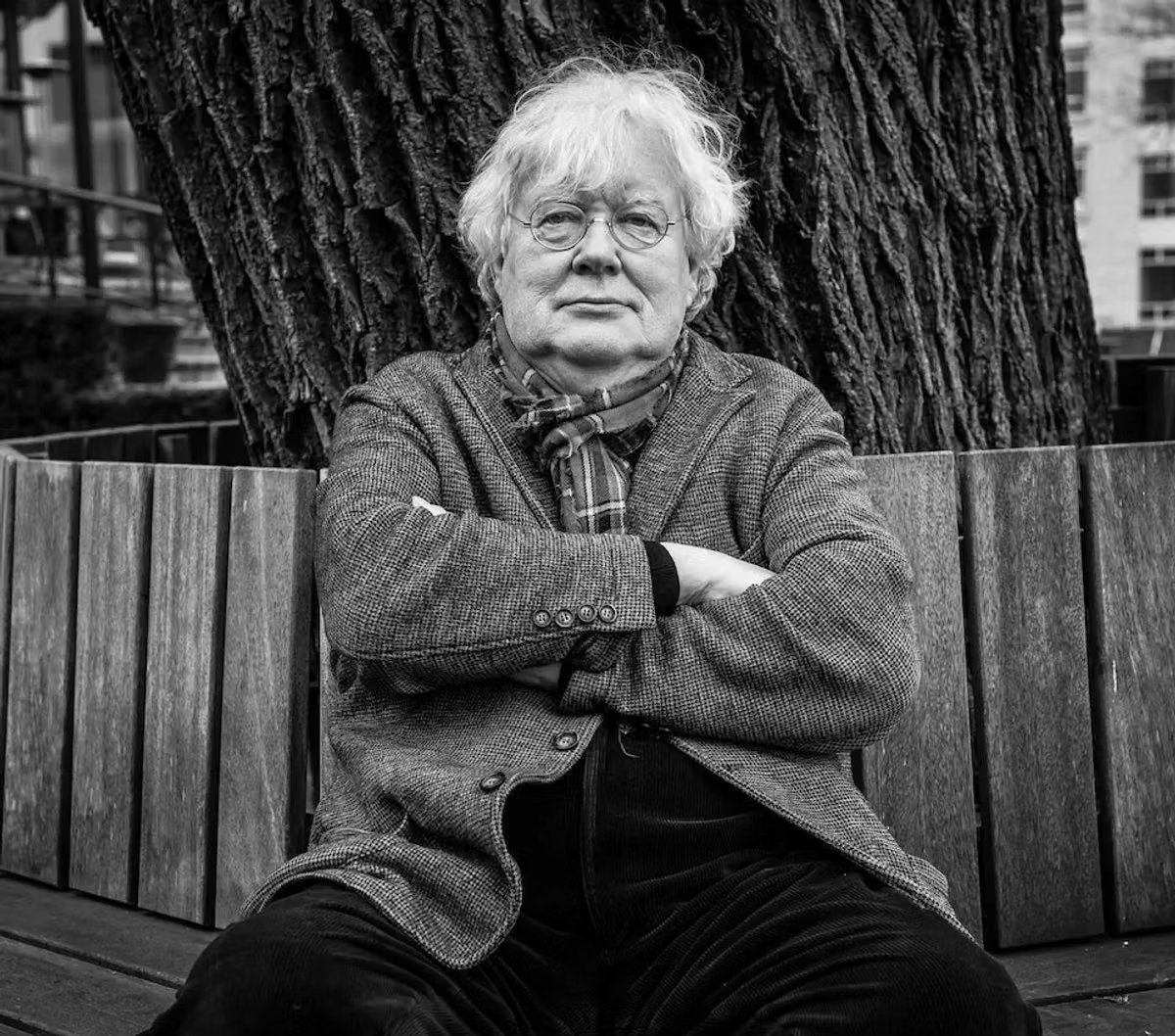
Rudi Fuchs, one of the most influential figures in the Dutch art world, died in Amsterdam on 25 October 2026, aged 84. “Throughout his working life, he dedicated himself to visual arts both at home and abroad,” his family said in a statement to the Dutch newspaper Het Parool.
Born in Eindhoven on 28 April 1942, Fuchs studied art history at Leiden University before becoming director of the Van Abbemuseum, in his home city, in 1975. He rose to international prominence in 1982 as the artistic director of Documenta 7 in Kassel, Germany, where he championed new painting, the show featuring established artists as well as young talents such as Jean-Michel Basquiat and Keith Haring.
In 1984, he became the artistic director of Castello di Rivoli, near Turin, Italy’s first museum devoted to contemporary art. Three years later, he took over the Gemeentemuseum Den Haag, now the Kunstmuseum Den Haag, which he directed until 1993. He then moved to Amsterdam to lead the Stedelijk Museum, remaining at its helm for a decade.
Alongside his museum career, Fuchs taught at the University of Amsterdam and wrote extensively on art. He authored studies of Dutch painting, the Saatchi Collection and artists including Jannis Kounellis and Donald Judd, as well as a book exploring the relationship between Anselm Kiefer and Rembrandt.
In 2016, the Stedelijk invited Fuchs back to curate Excitement, an exhibition that revisited his career through more than 100 works produced over the previous 50 years. Bringing together artists including Georg Baselitz, Jan Dibbets, Tracey Emin, Gilbert & George, Damien Hirst, Jannis Kounellis, Mario Merz, Piet Mondrian, Bruce Nauman and A.R. Penck, the exhibition offered an insight into acquisitions he had made that helped shape the museum’s collection.
“Hanging works of art close to one another highlights their singularity,” he wrote at the time. “Take the 1970s: there were so many radically different artistic movements that were—or appeared to be—in contradiction with one another. But if you looked at these works with an open mind, each one excelled in its own way. At least, that is how I perceived it. One could be biased—as many people were—or one could embrace this plurality as a source of richness, and adopt that particular vision of art. As early as 1980, Markus Lüpertz and Richard Long said to me: 'What matters is the quality of what our generation produces.'"
He continued: "There is no single 'right' way of doing things. There is such a thing as taste and personal preference—but that is an entirely different matter. In today’s world, no one is automatically the 'first.' In art, no one is the 'best.' That is what this exhibition is about—from my perspective, and using the works I have at my disposal.”
Paying tribute to his predecessor, Rein Wolfs, the Stedelijk’s director, said in a statement: “As director of the Haags Gemeentemuseum, he transformed the way Mondrian was perceived; and as director of the Stedelijk, he surprised audiences with unexpected juxtapositions and innovative modes of presentation. Fuchs brought a clear, uncompromising vision to Amsterdam, rooted in a fundamental belief in the autonomy of the artwork and the direct encounter between the viewer and the art. Through his acquisitions, presentations, and publications, Rudi made a significant contribution to the understanding of art; everything he did served as an encouragement to really look.”
- This article was originally published in The Art Newspaper France