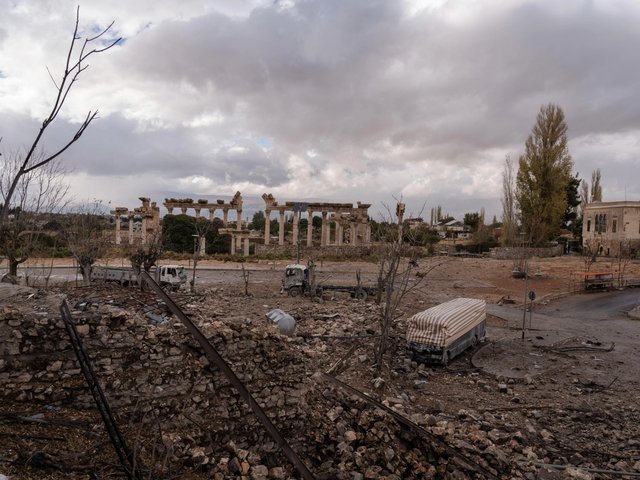
One of Lebanon’s most intriguing archaeological sites is the inspiration behind the inaugural Frieze Abu Dhabi Artist Award, given to the fast-rising Lebanese artist Dala Nasser to create her installation Qubbat Duris. The work takes its name from a 13th-century Muslim shrine near Baalbek, northeast of Beirut, which is composed from the ruins of two separate ancient Roman sites: granite columns from Baalbek’s Temple of Jupiter hold up limestone sarcophagi from a necropolis.
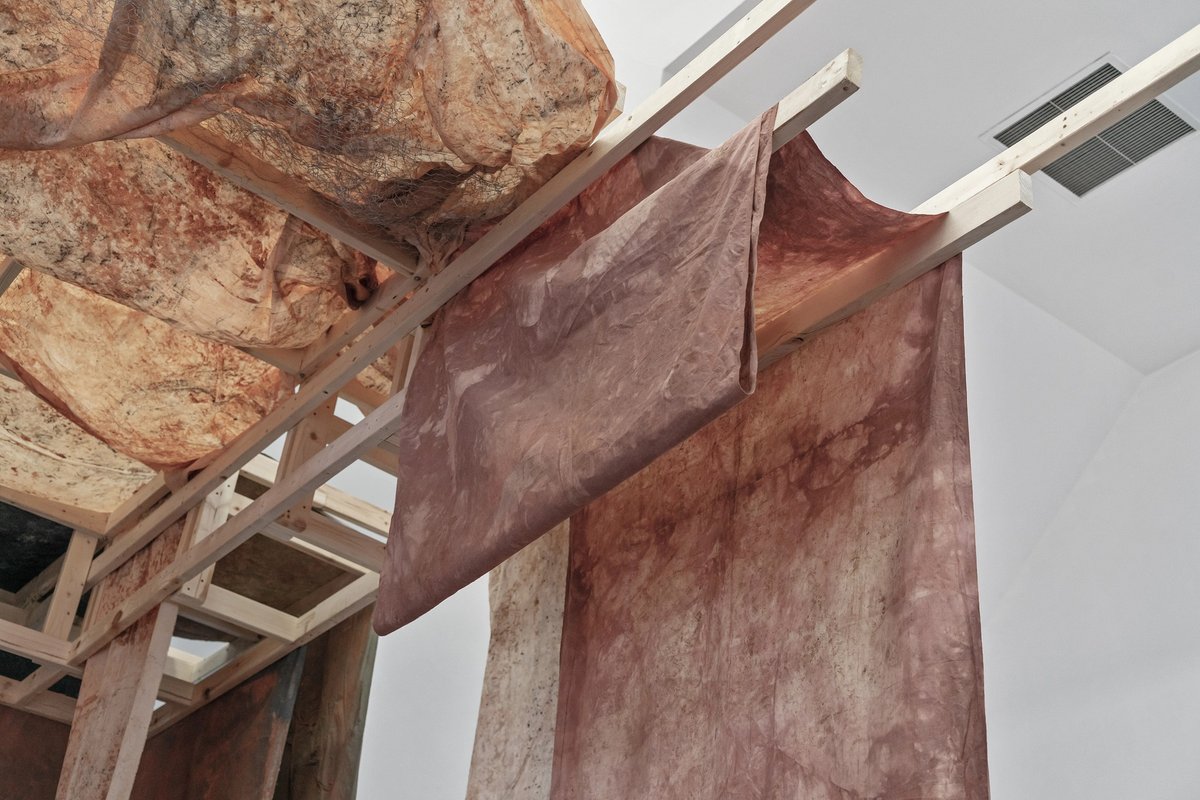
Placed in the atrium of the fair, the work will comprise a timber frame evoking Qubbat Duris’s structure, with fabrics covered in charcoal rubbings of the remaining ruins and painted with ash, raw clay and terracotta draped over it.
Nasser is best known for her archaeological frottage paintings—made using the surfaces of endangered historical sites—which consider the artist’s role in reproducing, and bearing witness to, history and landscape.
Though Nasser is not the first artist to engage with Qubbat Duris, she points out, many of her antecedents are problematic. “The site has already been extensively imagined and reimagined in art historical painting,” she tells The Art Newspaper. “From Orientalist depictions to the backdrop to one of Gertrude Bell’s most circulated photographs, taken in costume on horseback.”
Similar works of Nasser’s—such as Adonis River (2023) and Wedding at Qana (2024)—have also taken as their subjects “landscapes that loom large in historical painting but look nothing like the landscape itself in Western Asia, either overwhelmed by Orientalist tropes or painted as scenes of European countryside, betraying the artists’ lack of knowledge and limits of imagination”, she says. “I am trying to make paintings that are truthful to the landscape.”
The question of “truth” pertains to Qubbat Duris’s position as a site that reflects the layered cultural histories and religions of Lebanon. “It exists as a palimpsest from the second century AD until today, carrying all of the traces in between,” Nasser says.
Meanwhile, the role of evidence and recording in Nasser’s practice also considers the risks of erasure faced by much of Lebanon’s cultural artefacts, particularly from Israel’s longstanding and continued occupation of the country. On 15 October 2024, Qubbat Duris sustained slight damage from Israeli airstrikes; previously during the 2006 Israel-Lebanon war, an Israeli airstrike dislodged one of the shrine’s stones. “I’m interested in how a place like Qubbat Duris carries physical evidence of everything it’s endured, including scars of damage,” Nasser says.
• Frieze Abu Dhabi, Manarat Al Saadiyat, 19-22 November