Two of Johannes Vermeer’s rare paintings are not the real thing, according to Adriaan Waiboer, a former head of collections at Dublin’s National Gallery of Ireland. He is downgrading The Love Letter at Amsterdam’s Rijksmuseum and The Glass of Wine at Berlin’s Gemäldegalerie.
Although attributions are routinely questioned by art historians, what makes this case significant is that it is being done by a specialist with a deep knowledge of Vermeer. The Dutch-born art historian was responsible for caring for a Vermeer masterpiece in his own Dublin collection, Woman writing a Letter, with her Maid (around 1670-72). He was also the lead curator for the 2017-18 exhibition Vermeer and the Masters of Genre Painting at the Musée du Louvre in Paris, the National Gallery of Art in Washington, DC, and at the Dublin institution.
Waiboer has published his findings on the Rijksmuseum and Gemäldegalerie paintings in the latest issue of the Journal of Historians of Netherlandish Art.
Both The Love Letter and The Glass of Wine continue to be fully regarded as authentic Vermeers by their respective museums. The two paintings were exhibited in the pathbreaking Vermeer retrospective at the Rijksmuseum in 2023, which accepted that just 37 works are from the master’s hand.
Waiboer began his research by noting discrepancies between these two pictures and the rest of Vermeer’s oeuvre. “These initially took me by surprise but, over months of intensive analysis, grew in number and coalesced into coherent patterns,” he writes.
Relying on connoisseurship, Waiboer scrutinised the paint handling and stylistic features of the Rijksmuseum and Gemäldegalerie pictures with high-resolution images. He writes that “the human eye” may be more informative than technical research.
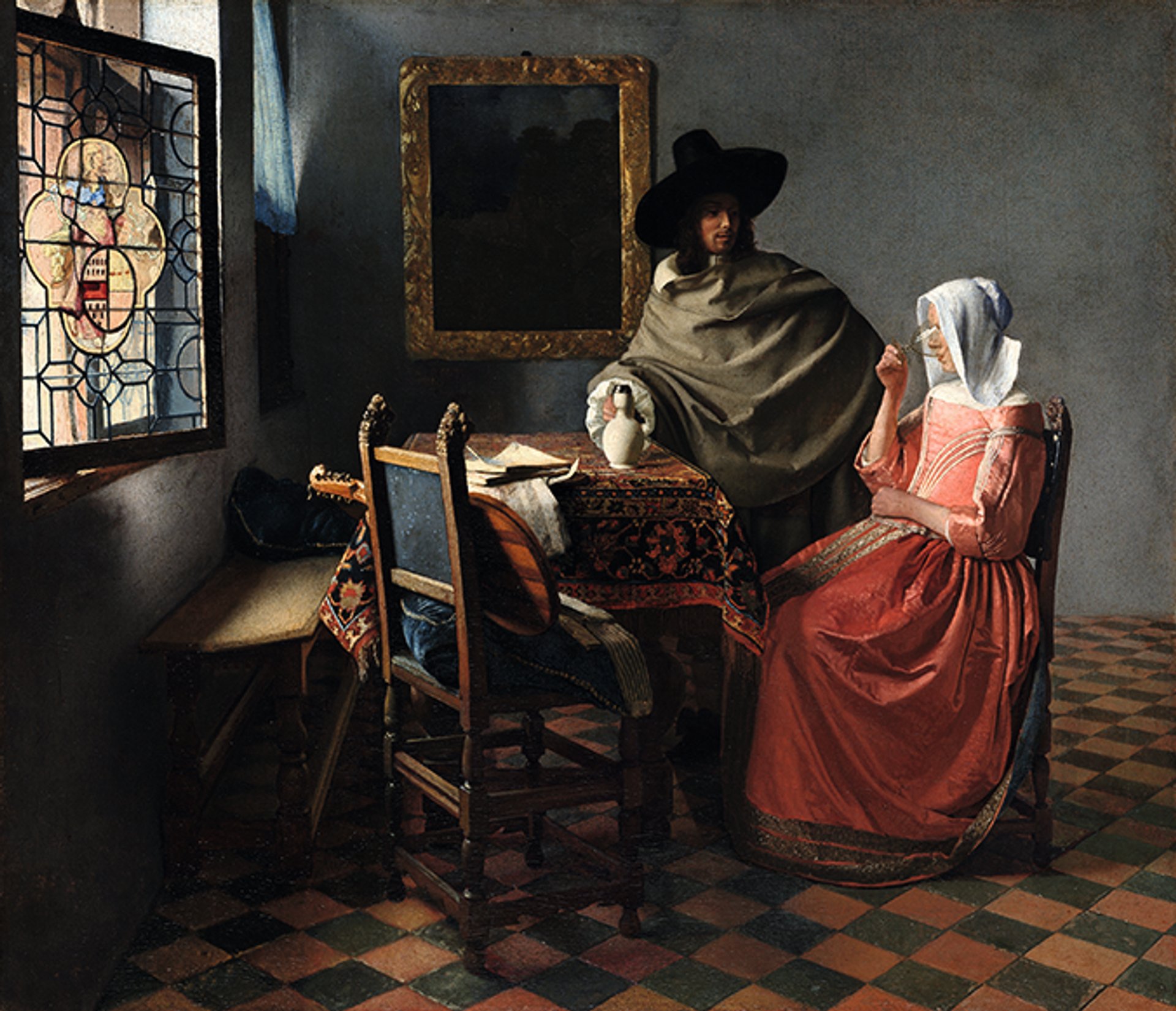
Waiboer says that, in The Glass of Wine, the man’s “passive demeanour towards his lover” does not mirror the suitor’s “assertive behaviour” seen in similar scenes in authentic Vermeer paintings Staatliche Museen zu Berlin, Gemäldegalerie/Christoph Schmidt
Reading between The Letter’s lines
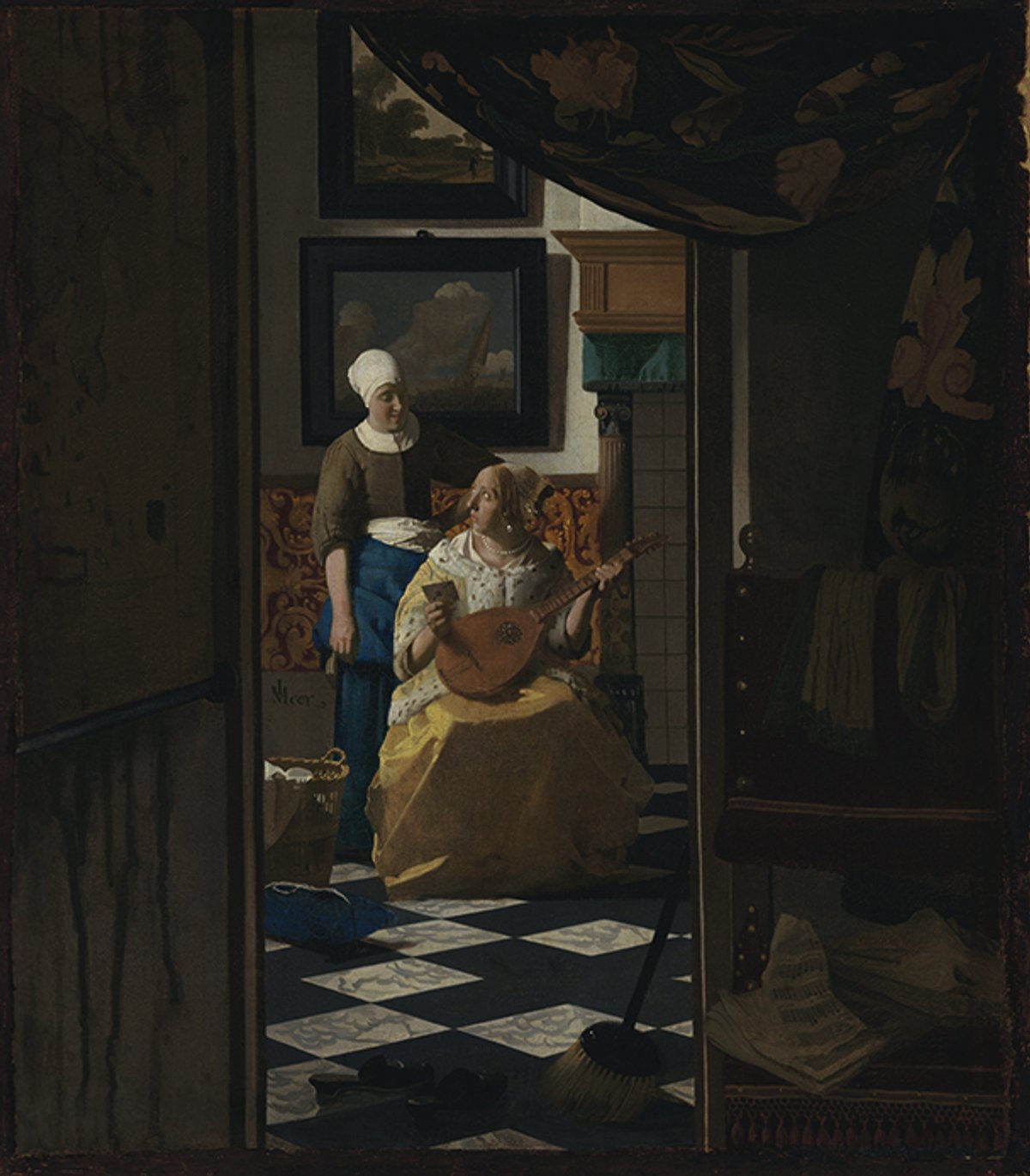
The Love Letter, which was dated 1669-70 in the Rijksmuseum exhibition, depicts a woman holding a cittern (similar to a lute). Her maid has just handed her a letter, which is apparently from a suitor. The painting lacks an early provenance, first appearing in 1892 in an Amsterdam auction. Waiboer points to its paint handling, which he describes as “marked by short, untidy brushstrokes and inelegant modelling of forms, materials and surface”. This departs from that of Vermeer’s paintings of the late 1660s and early 70s. This is particularly apparent in the facial highlights, the woman’s yellow jacket, the maid’s sleeves, the marble floor and the shadows cast by the two picture frames on the back wall.
Waiboer argues that “the crammed composition, anecdotal storytelling, peculiar shadows and clashing colours, patterns and shapes distinguish it from Vermeer’s work”. He concludes that The Love Letter is “an ambitious variation on several of Vermeer’s late works, reverberating a range of thematic, stylistic and compositional elements”. In addition, Waiboer sees ideas derived from works by Vermeer’s Dutch contemporaries, Samuel van Hoogstraten, Gerard ter Borch and Gabriel Metsu.
The Love Letter bears a purported Vermeer signature on the back wall, above the basket. Waiboer describes it as made with “conspicuously short, jerky strokes—possibly pointing toward an artist copying an example”. This suggests that the signature may have been added by another hand to mislead.
Lacking in lifelike textures
The other painting questioned by Waiboer is The Glass of Wine, which was also exhibited in the Rijksmuseum’s retrospective and is normally dated to 1659-61. It depicts a gallant young man about to offer a young woman another drink.
Waiboer argues that ‘The Glass of Wine’ is simply a pastiche, created to imitate a Vermeer composition
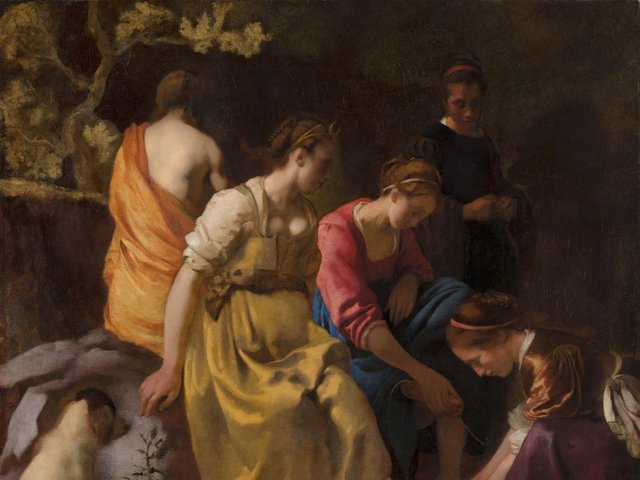
Waiboer argues that The Glass of Wine is simply “a pastiche”, created to imitate a Vermeer composition. He suggests the artist involved took elements from two authentic pictures: A Woman interrupted at her Music (1660-63, at the Frick Collection in New York) and A Woman with a Wineglass (1661-63, at the Herzog Anton Ulrich Museum in Braunschweig).
In The Glass of Wine, Waiboer points to differences with Vermeer’s authentic works: the carpet, compared with the more lifelike texture of that in A Woman Reading a Letter (1658-59, at the Staatliche Kunstsammlungen Dresden); the music book, compared with the more fastidiously depicted manuscript in A Woman Interrupted at Her Music; and the lion’s-head finials, again compared with the sparkling effect in the Frick painting.
Waiboer notes the man’s “passive demeanour towards his lover” in the Berlin painting does not mirror the suitor’s “assertive behaviour” in the Frick and Braunschweig works. He concludes that The Glass of Wine is “a skilful pastiche”, composed of elements derived from these two pictures, along with features from works by two other artists of the period, Ter Borch and Pieter de Hooch. However, the painter of The Glass of Wine did have a good knowledge of Vermeer’s work, so was probably someone in his studio.
In conclusion, Waiboer writes that The Love Letter and The Glass of Wine were made by different artists, who could have been active either inside or outside of Vermeer’s workshop. Whether Vermeer had studio assistants is the subject of another controversy. Until recently, it was almost universally assumed that he was a solitary artist, although the curator Marjorie Wieseman and her colleagues at the National Gallery of Art argued in 2022 that he did in fact run a studio.
The two museums that own the questioned Vermeers are taking Waiboer’s views seriously, although so far they are confident about their own attributions. Dagmar Hirschfelder, the director of the Gemäldegalerie, tells The Art Newspaper: “We will carefully examine the arguments put forward by Adriaan Waiboer.”
Hirschfelder points out that Waiboer’s assessment is based solely on a comparison of high-resolution images and a visual inspection of paintings behind glass. She adds: “No new, in-depth examination of the original picture has been carried out that takes into account technical findings and its condition. Rejecting the attribution of a work that has hitherto been regarded as securely attributed is problematic without a technically informed assessment of its condition, the development of the composition, and the techniques and materials used in its creation.” The catalogue of the 2023 exhibition is evidence of deep technical research undertaken a few years ago.
Pieter Roelofs, the head of the fine arts department at the Rijksmuseum, comments that it is “good to see continued interest in Vermeer and that his oeuvre is being questioned”. He adds that the Rijksmuseum, together with other collections, had conducted extensive research into nearly all of Vermeer’s paintings, including The Love Letter, in connection with the 2023 exhibition. “That research confirmed that The Love Letter is Vermeer’s own work,” Roelofs says.
Waiboer, now an independent scholar, is currently writing a book on Vermeer, for possible publication in 2028. The volume will examine the connections between the master’s work and two of his leading contemporaries, Ter Borch and Frans van Mieris.