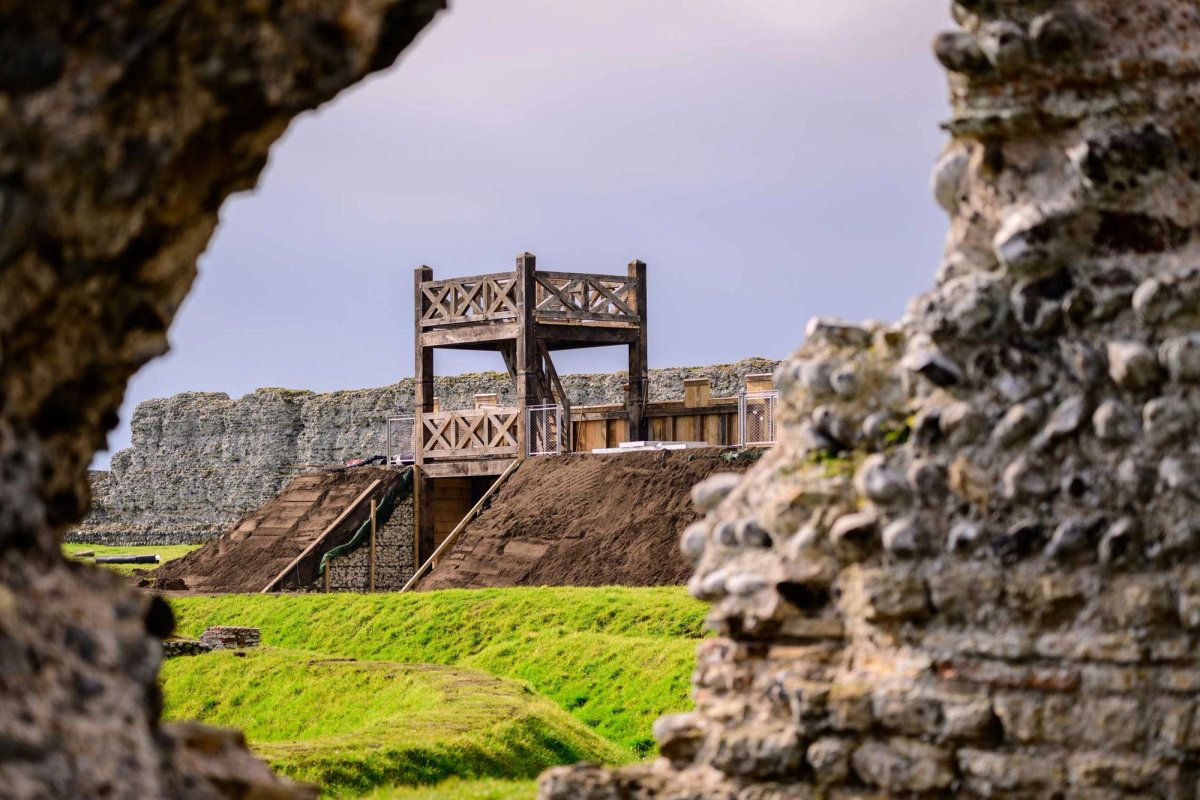
When a newly constructed gateway and tower, built using the evidence of 2,000-year-old timber post holes, opens to visitors on 19 April, it will help make sense of a puzzling Roman site: the “port” of Richborough in Kent, an island gateway to the Roman invasion of Britain, which now lies more than two miles inland.
The gate and tower, reconstructed from foundations uncovered in recent excavations, will help explain why the Romans chose the site—now in the care of English Heritage—as their base for the invasion of 43AD. The fort developed into a prosperous trading town, with an amphitheatre and a marble clad triumphal arch, but the only remains today are imposing stretches of the walls encircling green humps and bumps in the fields. The site was gradually abandoned as the sea channels silted up, and never rebuilt. Sharp-eyed passengers on the trains that edge the fort can see a massive chunk of Roman wall, which collapsed and slid down the bank into the river.
The view from the top of the gate tower reveals a flat landscape still patchworked with ditches and creeks. It looks like an unpromising site for an invasion, but when the Roman galleys arrived in 43AD, the River Wantsum was navigable for ships as far as Richborough island. There, a shallow gravel shore gave a safe landing place protected from the infamous shoals and sandbanks off Ramsgate, known as the “ship swallower” and still studded with thousands of shipwrecks. The high windy ridge of the islet gave a commanding view of the surrounding area, with enough land to establish a fort that grew into a prosperous trading port. From Richborough their ships could reach the Thames at Reculver. Marching men could also press far inland: visitors can still walk out through a gap in the walls onto a farm track that marks the beginning of Watling Street, one of the most famous Roman roads once leading north through London and St Albans and on to the Roman town at Wroxeter.
Archaeologists found the foundations of the timber gate and tower in 2021, and the eight-metre-tall reconstruction, built in oak using Roman woodworking techniques and handmade nails, is based on one depicted on Trajan’s Column in Rome.
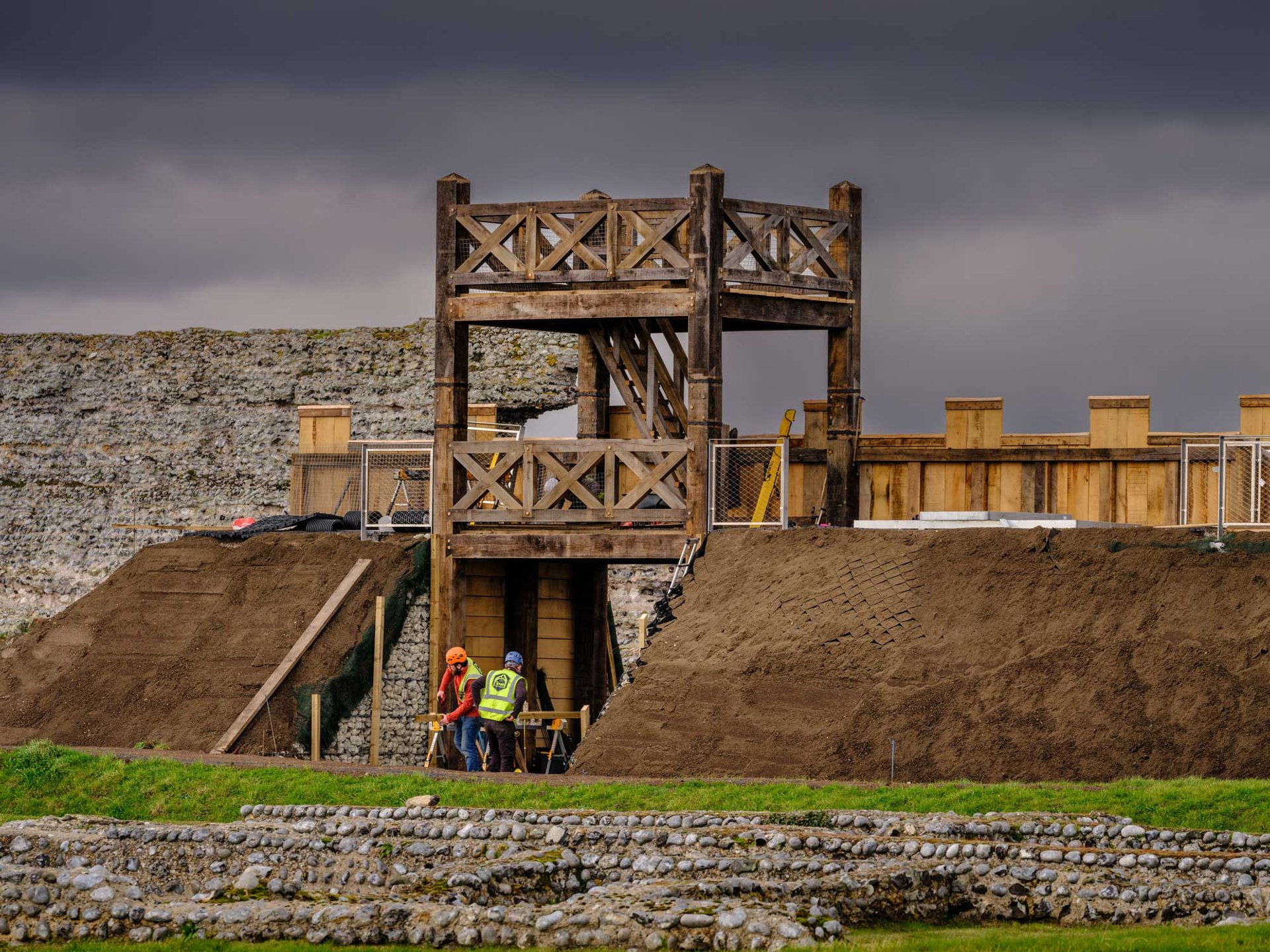
Richborough Roman Fort and Amphitheatre in Kent, England Photo: Jim Holden. Courtesy English Heritage
Paul Pattison, senior properties historian at English Heritage, described the reconstruction as remarkable: “The Roman invasion was a major milestone in our history. We know that Richborough witnessed over 360 years of Roman rule—from the very beginning to the bitter end—but standing atop this eight-metre-high gateway, looking out and imagining what the first Romans might have seen, is quite an experience.”
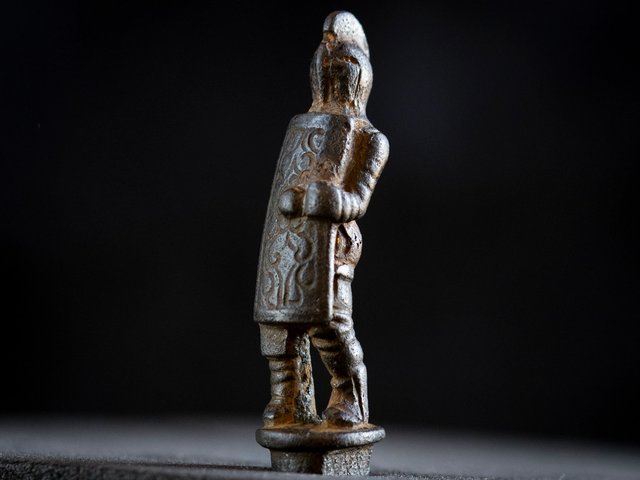
Since it was first excavated in the 1920s, the site has yielded some of the richest finds from any Roman site in Britain, including 56,000 coins, 460 brooches and more than 1,000 hairpins. The site museum will display recent finds for the first time, including a glass cup made in the Middle East testifying to luxury imports through the town, hairpins including one in gold and a crude local copy, and a set of scales in the form of Harpocrates, the god of silence—a unique example in Britain.
• Richborough Roman Fort and Amphitheatre and the newly constructed gateway open on 19 April