The year began with the art world—like much of the rest of the world—holding its breath, waiting to see what America’s newly re-elected president, Donald J. Trump, had on his Washington to-do list. Meanwhile, on America’s other coast, a series of wildfires in and around Los Angeles burned up around 60,000 acres, killing hundreds of people, displacing thousands more, and consuming architectural landmarks as well as untold works of art.
A political earthquake and localised apocalypse quickly gave way to months of jaw-dropping executive actions by the US president, and the art world was hardly immune. In a matter of months, Trump and his administration set their sights on everything from Washington’s National Portrait Gallery—whose long-time director, the Dutch art historian Kim Sajet, quit her job after the president announced plans to fire her—to a Trump portrait in the Colorado State Capitol, replaced after he complained about it on social media.
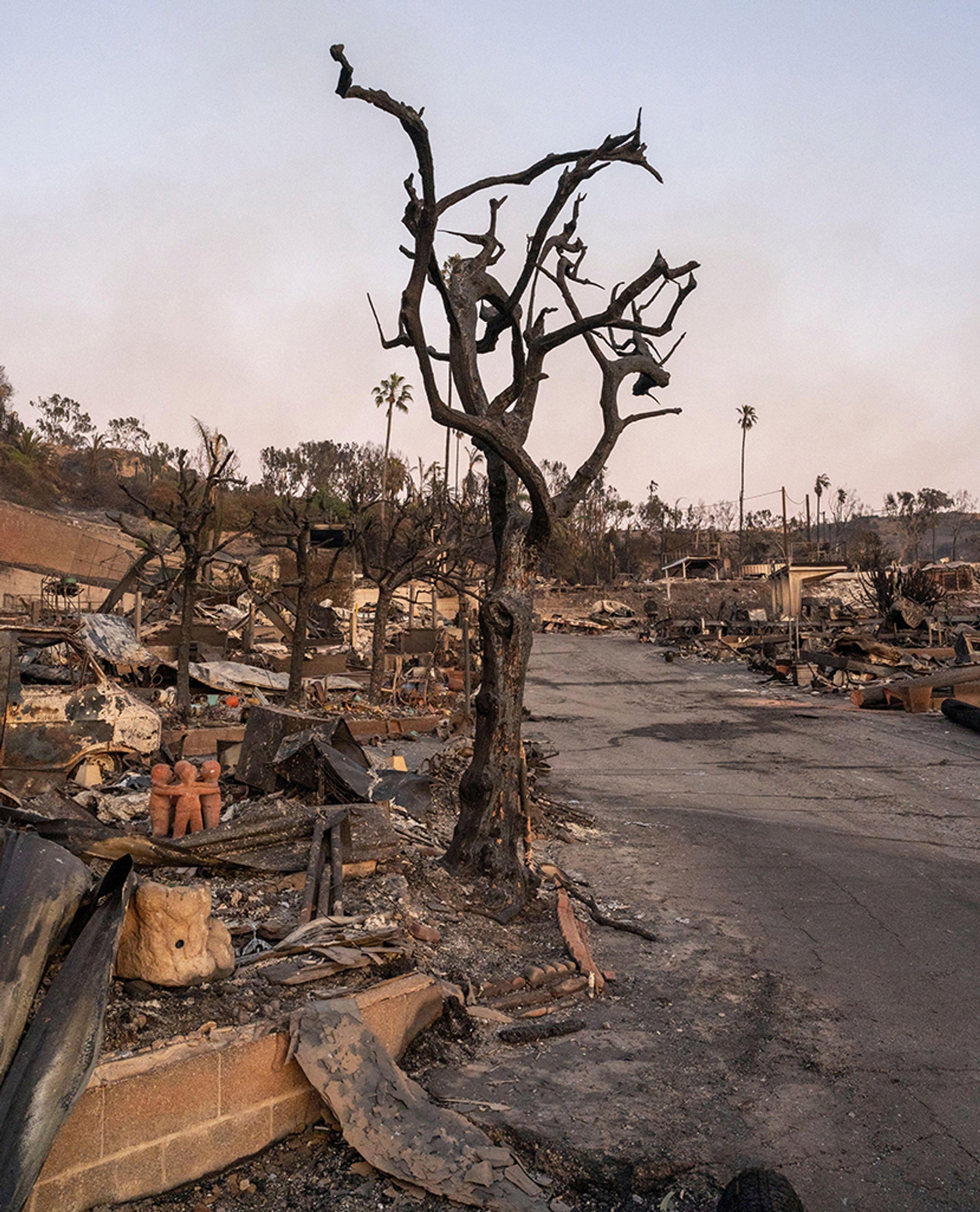
The year began with wildfires that devastated large areas of Los Angeles Julio Javier Vargas/Alamy Stock Photo
Militarised immigration enforcement, the prospect of tariffs on importing art, actual tariffs on furniture imports, and a crackdown on longstanding diversity initiatives in academia and the museum world blasted a sustained chill through the art and design communities. For many in the art world, the year came to be marked by “a kind of gloom”, says the gallery owner Thaddaeus Ropac.
The ongoing war in Ukraine and the massive civilian casualties in Gaza were a daily source of rage and despair, with artists, like non-artists, falling victim in the conflicts. Compared with previous eras, artists have seemed more resigned, or even docile, says the New York author Lauren O’Neill-Butler, who published a book in 2025 about the recent history of artist activism, The War of Art. People “are really afraid to speak out”, she says, comparing current levels of protest with the 1960s.
Passivity, however, proved anything but the rule in Venice, where residents turned out to demonstrate against the multi-million-euro summer wedding of Jeff Bezos to Lauren Sanchez—a symbol, for locals, of ordinary life at the mercy of luxury-minded tourism. The year in bling also saw the advent of President Trump’s gilded decorations in the White House Oval Office, followed by his demolition of the building’s discreet East Wing in order to build a gargantuan ballroom, drawing heckles from architecture and design experts, and thumbs-down poll numbers from the American public. For those who wanted some historical perspective on this burst of extravagance, a lavish exhibition at Madrid’s Museo del Prado about the Venetian painter Paolo Veronese, whose career coincided with the beginning of Venice’s decline, was a reminder that conspicuous splendour is often a smokescreen for decay.
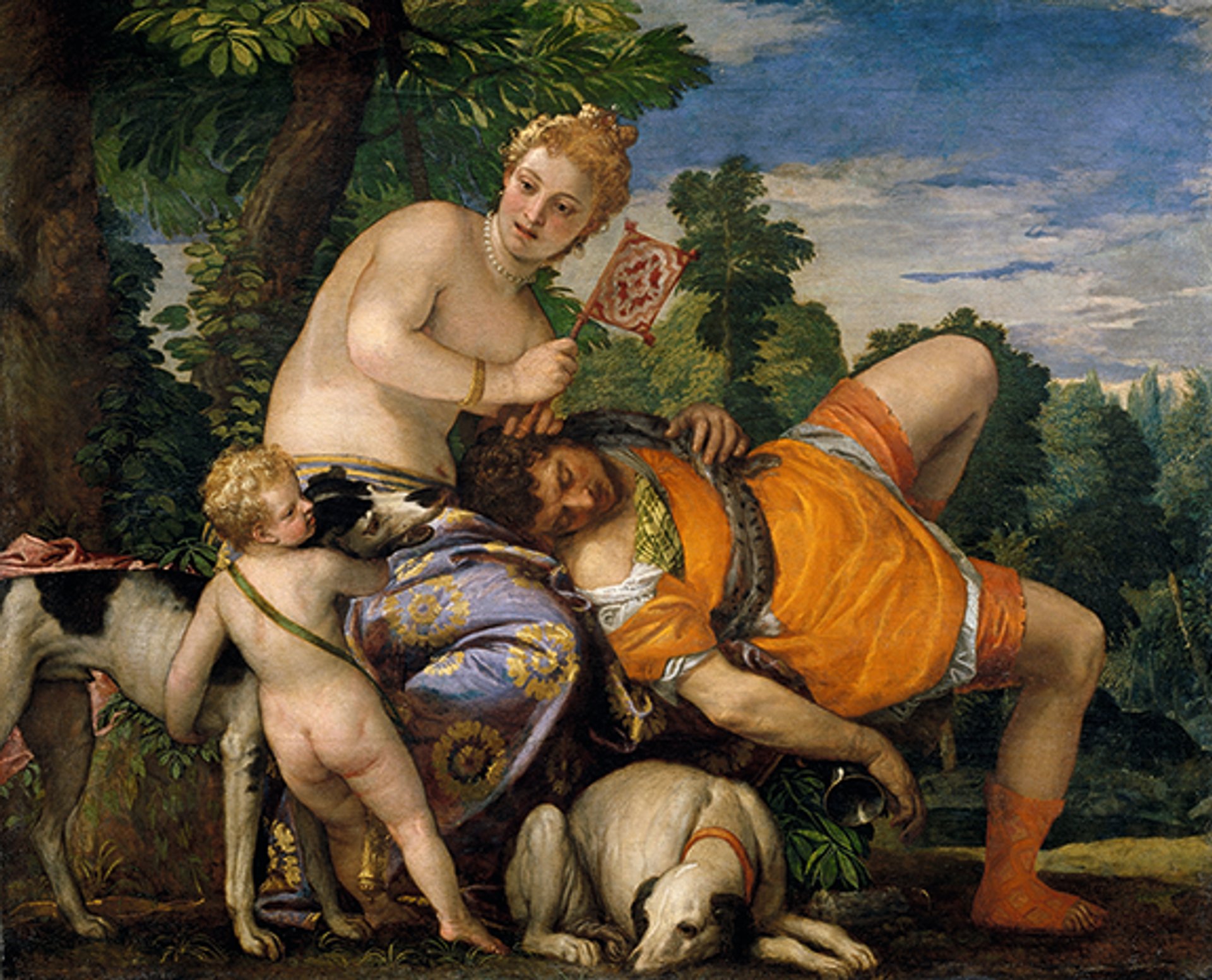
Paolo Veronese’s Venus and Adonis, part of a lavish exhibition dedicated to the artist at the Prado museum in Madrid © Museo Nacional del Prado
US artists cut back on travel
The US clampdown on immigration, illegal and otherwise, registered in much of the art world. Gala Porras-Kim, an artist who divides her time between Los Angeles and London, has noticed a pronounced reluctance of US-based international artists and art professionals “to go to events abroad, because of the fear of not being able to come back”. And the US government’s demonisation of diversity, she says, has led to the outright cancellation this year of some of her own scheduled shows.
The various disruptions of the present have started to affect how we view the art of the past, suggests Joseph Leo Koerner, the chairman of Harvard’s art history department. People “would like something that takes them out of this self-evident condition that we’re all in”, he says. Koerner—whose prophetic book Art in a State of Siege appeared to wide praise this year—added that he is starting to sense “a shift in the overwhelming centrality of contemporary art” among his students.
Those Harvard students were onto something: 2025 turned into a banner year for Old Masters shows, as well as museum openings and reopenings.
Koerner was wowed by the London version of Siena: The Rise of Painting, 1300-1350, which made it to the National Gallery from New York in the late winter. And “I loved the Fra Angelico show”, he adds, of the two-venue, once-in-a-lifetime reconvening of early Renaissance works in Florence.
In the spring New York saw the relaunch of the city’s Old Master citadel, the Frick Collection, restored and reimagined by Annabelle Selldorf. The architect also attracted wide-spread praise earlier this year for her sensitive remodelling of the Sainsbury Wing at London’s National Gallery.
Elsewhere in the world, the Museum of West African Art opened amid protests in Benin City, Nigeria, and, after years of delays, the massive and much-anticipated Grand Egyptian Museum in Giza, with 32,000 sq. m of gallery space and prized remnants of an ancient civilisation to fill it with, finally fully opened its doors. And in further evidence of the Gulf region’s growing influence in the arts, the Foster + Partners-designed Zayed National Museum, was due to open in Abu Dhabi as we went to press.
Just up the street from the Frick, in what testifies to the durability of great museum architecture, Sotheby’s has installed its worldwide headquarters in Marcel Breuer’s brazenly Brutalist 1966 former museum building, originally designed to house the Whitney Museum of American Art. And another Frick neighbour, the Metropolitan Museum of Art, reopened its Michael C. Rockefeller Wing, featuring a new installation of art and objects from Africa, Oceania and the Americas.
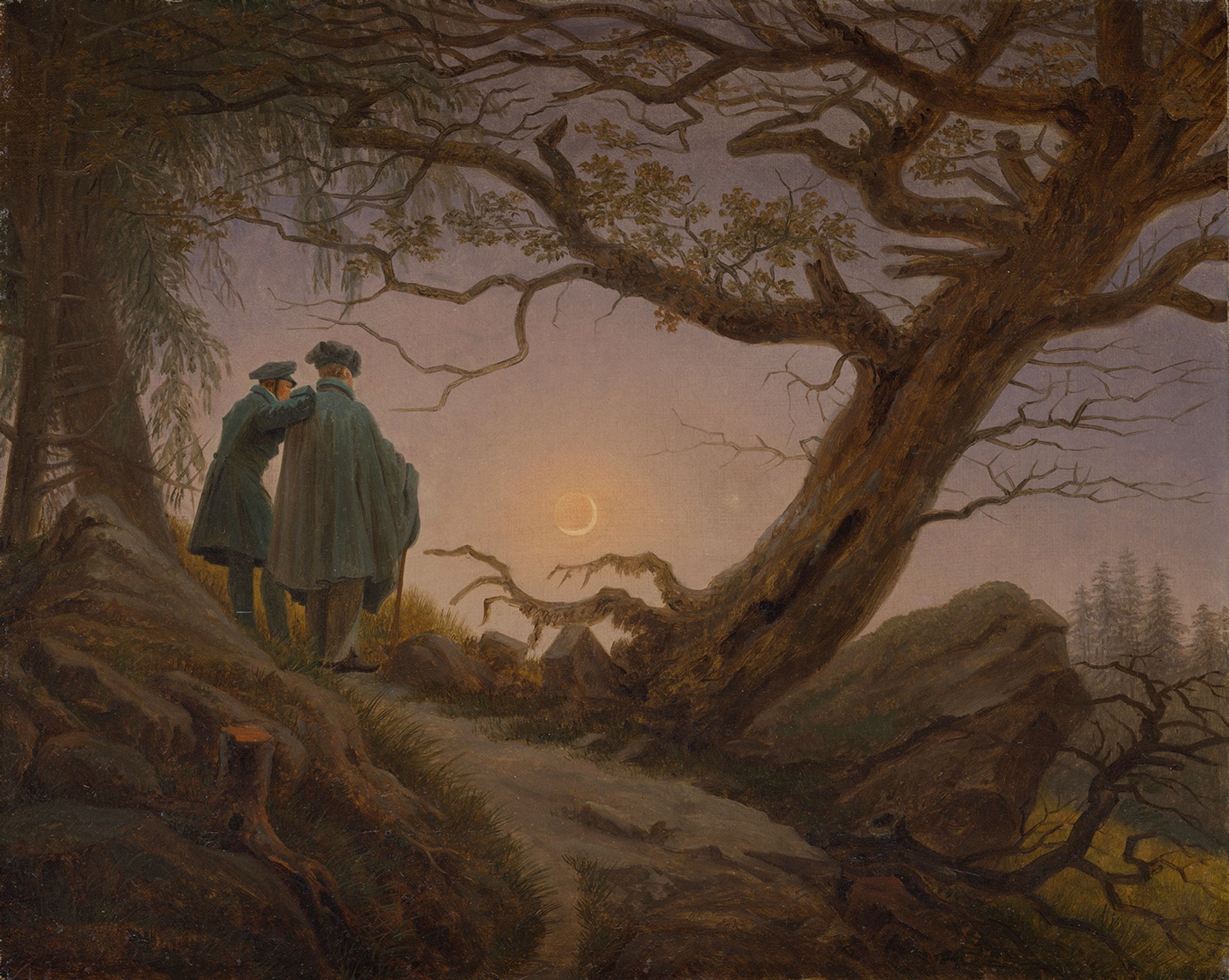
Caspar David Friedrich’s Two Men Contemplating the Moon (around 1825–30, below left) featured in the first US survey of the artist, at the Metropolitan Museum of Art The Metropolitan Museum of Art, Wrightsman Fund
‘New’ masters in the spotlight
At the Staatliche Kunstsammlungen Dresden, which this autumn celebrated the last phase of the rebuilding of the destroyed city’s royal palace, it is traditional to call artists of the 19th and early 20th centuries “new” masters. And it was one such figure, Dresden’s own Casper David Friedrich, who was the toast of the town in New York, when the Met mounted the first US survey of the artist.
Elsewhere in the new-master world, a New York judge ruled that the Art Institute of Chicago had to give up a 1916 Egon Schiele drawing to the descendants of its one-time owner, a Jewish cabaret star and art collector who died in Dachau. Commenting on the news, Christopher A. Marinello, a lawyer specialising in art restitution, is keen to observe that some of the most sensational restitution cases of the year likely went unnoticed by the art world, since they ideally happen entirely behind closed doors.
Restitution efforts took on a new mission in 2025 when the Museum of Fine Arts Boston decided to restore ownership to two works from the 1850s by the enslaved Black potter David Drake to his descendants. And the general repatriation of looted African objects continued apace, with the Netherlands agreeing to return 113 Benin Bronzes to Nigeria.
Among the darkest events of the year—and the one that attracted the most attention—was the sensational October robbery at the Musée du Louvre, where thieves made off during museum hours with close to $100m of France’s crown jewels. While dispiriting headlines came fast and hard from the Louvre this autumn, with blowback from the robbery extending to starkly negative appraisal of decades of museum stewardship, there were signs that the gloom might be lifting—and within walking distance of the Louvre itself.
Some cautious optimism
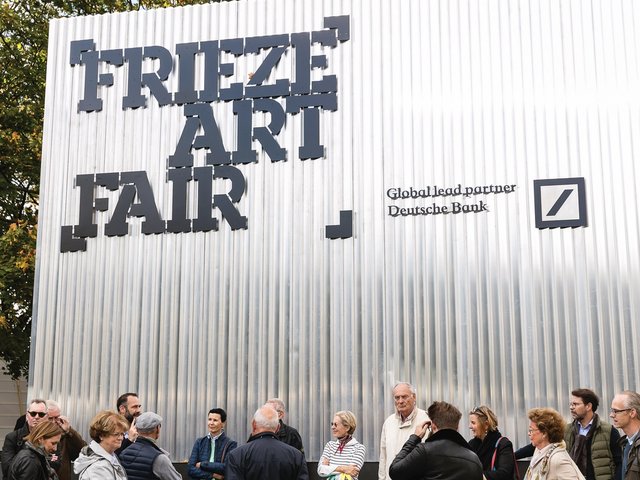
In October, a cautiously buoyant atmosphere set in, first at Frieze London, then at Art Basel Paris. The back-to-back events gave some hope that a two-year slump in the art market might be ending. And a matter of days after the Louvre heist, the reopening of the Fondation Cartier pour l’Art Contemporain, in a new building designed by Jean Nouvel, added to the French capital’s standing as an art centre that could give post-Brexit London a run for its money.
Money—in the form of gold—was much on the mind of Marinello, who believes the commodity’s sky-high price may precipitate further museum heists, if not quite as splashy as the Louvre’s. His solution: a move toward instituting what he likes to call “cultural-heritage terrorism laws”, which might counter thieves’ often typically light sentences for these dramatic crimes.
Elsewhere on the legal front, a group of artists filed a class-action lawsuit in northern California, charging several artificial intelligence (AI) companies, intent on creating AI-generated images, with copyright infringement and misuse of their work.
At Thaddaeus Ropac’s London gallery, the American painter David Salle tried to harness AI by training a computer to paint like Giorgio de Chirico and Edward Hopper, among others, then used the technology to create his own work. Over at Harvard, Koerner and his colleagues were increasingly on the lookout for AI-written papers. And while legacy media giants decry how AI is cutting down on their web traffic, Ropac himself has no worries. Before AI, someone might have Googled “David Salle” and landed on his gallery’s website; now they might be able to bypass it entirely. But his gallery’s web traffic is “constantly getting bigger”, he counters. And though many openly disparage or silently fear the effects of AI, Ropac is looking on the bright side. Convinced that AI’s glass is half-full, he contends that machine learning and the like are actually entering a “creative phase”.
Though it is often hard to see a silver lining, there is a sense among art professionals that some good may come out of this difficult time. Porras-Kim, who won a MacArthur “genius” fellowship this year, was heartened by the coming together of Los Angeles artists to help rescue and restore fire-damaged artworks. Koerner, meanwhile, thinks that the Trump administration’s besieging of academic freedom may result in universities discovering a new sense of purpose. And Ropac is leaning towards outright optimism—if only by comparison. “I think we’re in for a much better 2026,” he says.