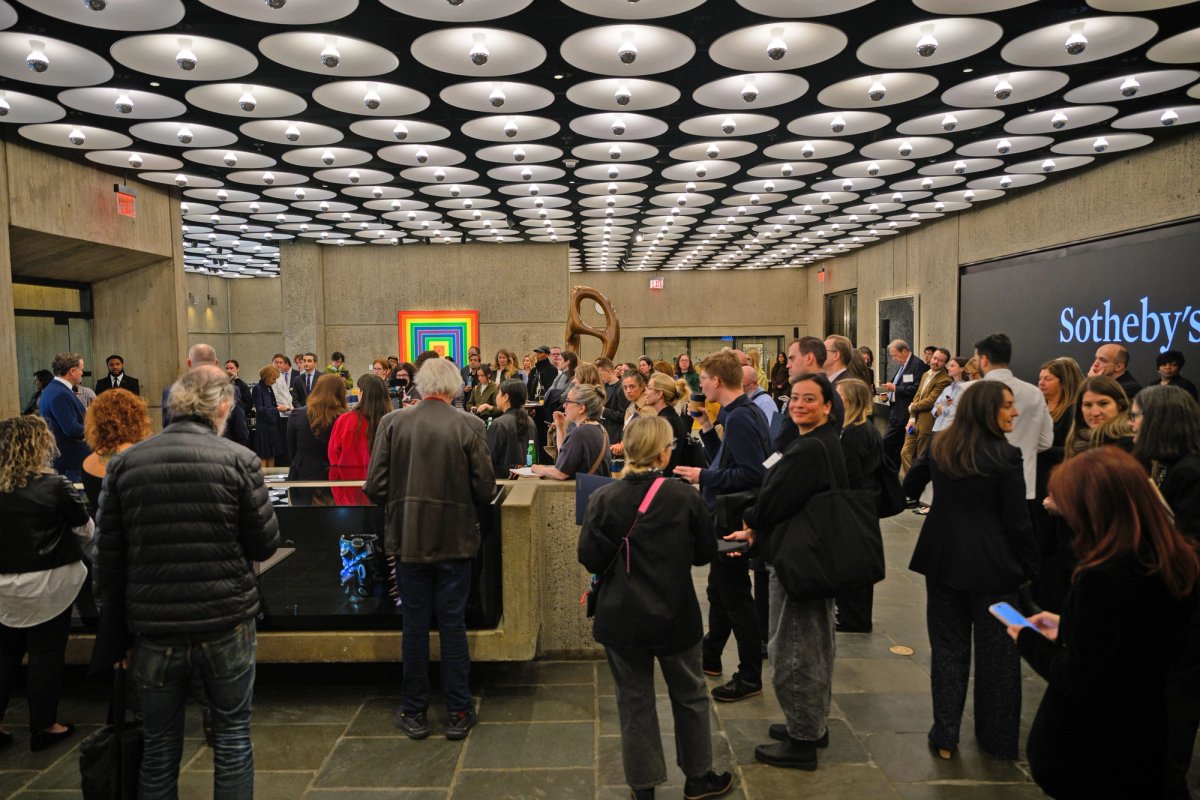
“I think the last week is going to bring a lot of confidence back into the market,” said Madeline Lissner, Sotheby’s global head of fine art and major collections, in an interview with the online magazine Puck in November, after a mood-changing $2.2bn series of Modern and contemporary art auctions in New York. “I’m talking beyond auction, to the landscape of dealers and advisors,” Lissner added, speaking the week before the Art Basel Miami Beach fair, where the biggest dealers reported strong enough sales to suggest a rebound at the top end might endure into the new year.
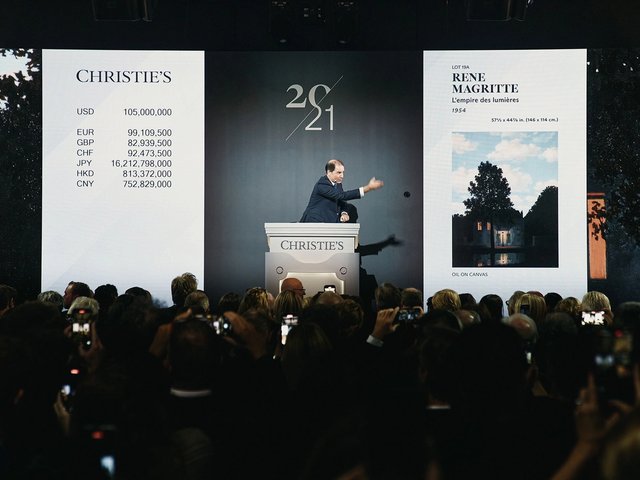
Some spectacular numbers were achieved at these New York sales, thanks to prestigious consignments of museum-quality 20th-century art. At Sotheby’s first series of major auctions at its new flagship Breuer Building, Gustav Klimt’s 1914-16 portrait of Elisabeth Lederer was the star lot of the $527.5m Leonard A. Lauder collection, selling for $236.4m, the second-highest amount paid for a work of art at auction. An 1887 Vincent van Gogh still life of books from the $109.5m Cindy and Jay Pritzker collection took $62.7m. A $103m collection of Surrealist art contained a 1940 Frida Kahlo self-portrait that made a record $54.7m. At Christie’s, the $218.1m Robert F. and Patricia G. Ross Weis collection included a Mark Rothko abstract from his key year of 1958 that raised $62.2m.
The overall total was still 30% down on the $3.2bn achieved at the equivalent sales in New York in 2022, but after a two-year slump, supply and demand were back in sync at the very top end of the art market. This upbeat auction week in New York followed some eight-figure sales of Modern and contemporary works at Art Basel Paris in October, and Sotheby’s $136m “white glove” auction of Surrealist works from the collection of Pauline Karpidas in London in September. Business looks brighter for big-name, big-ticket art. And yet 2025 also saw seen an ever-lengthening litany of contemporary gallery closures. If this is a recovery, how deep is it? And can it be sustained?
“From 2022 until now, we’ve been in a period of decline. Big collections don’t need to come to market when the market is in a dip. People will look at these sales and say the market has hit firm ground and there’s a V-shaped recovery,” says Anders Petterson, the founder of the London-based art market analysts, ArtTactic. “We’re likely to see the flow again in the $1m-plus market.”
But rather than a V-shaped recovery—a steep decline of an entire market, followed by an equally steep bounce-back—could we be seeing an uneven reset that mirrors the so-called “K-shaped” inequalities of the wider economy?
The rich get richer
Popularised by the US academic Peter Atwater, a professor at William & Mary college in Virginia, the “K-shaped” economy expresses the idea that the asset-owning wealthiest now dominate income growth and discretionary consumption, becoming richer and richer, while less well-off salaried workers become poorer and poorer, and less active consumers.
According to the authoritative World Inequality Report 2026, the richest 0.001%, comprising 60,000 centi-millionaires and billionaires (the sort of people who can comfortably spend $1m or more on a work of art), now control three times more wealth than the entire poorest half of humanity. The wealth of the 0.001% has grown at a rate of 8% per annum since the 1990s, twice the rate of the bottom half, according to the report. Yet somehow, relatively little of this inordinate affluence trickles down into the middle and lower levels of the art market, let alone the “real” economy.
“The market has become so dependent on the top end. We’ve seen how ultra high net worth wealth has been increasing in the last 25 years. The same kind of individuals are driving the art market,” says Petterson. He points out that over the last ten years, art that sells for more than $1m has contributed 77% of the total sales value at Sotheby’s, Christie’s and Phillips, based on 7% of the volume of lots. “That 77% is the driving force of the art market,” Petterson says.
The top auction houses and dealers are hoping that, now that market confidence has been regained, more ageing Boomer-generation collectors will put their most valuable Modern and classic contemporary works up for auction. At this heady level, there are enough members of the international 0.001% interested in buying big-ticket art to ensure it will make the right kind of price, either through auction guarantees, live bidding or private sale. True trophy works by names like Klimt, Van Gogh, Picasso or Monet have the potential to make nine-figure prices.
These are names that have global “brand recognition”, conjuring notions of enduring artistic and financial value. Klimt’s $236.4m portrait of Elisabeth Lederer drew six bidders. The artists and prices and names of possible buyers are even big enough to attract mainstream media attention. As Tina Brown, the former editor of The New Yorker, recently pointed out in her Fresh Hell substack, “wealth porn” gets plenty of clicks.
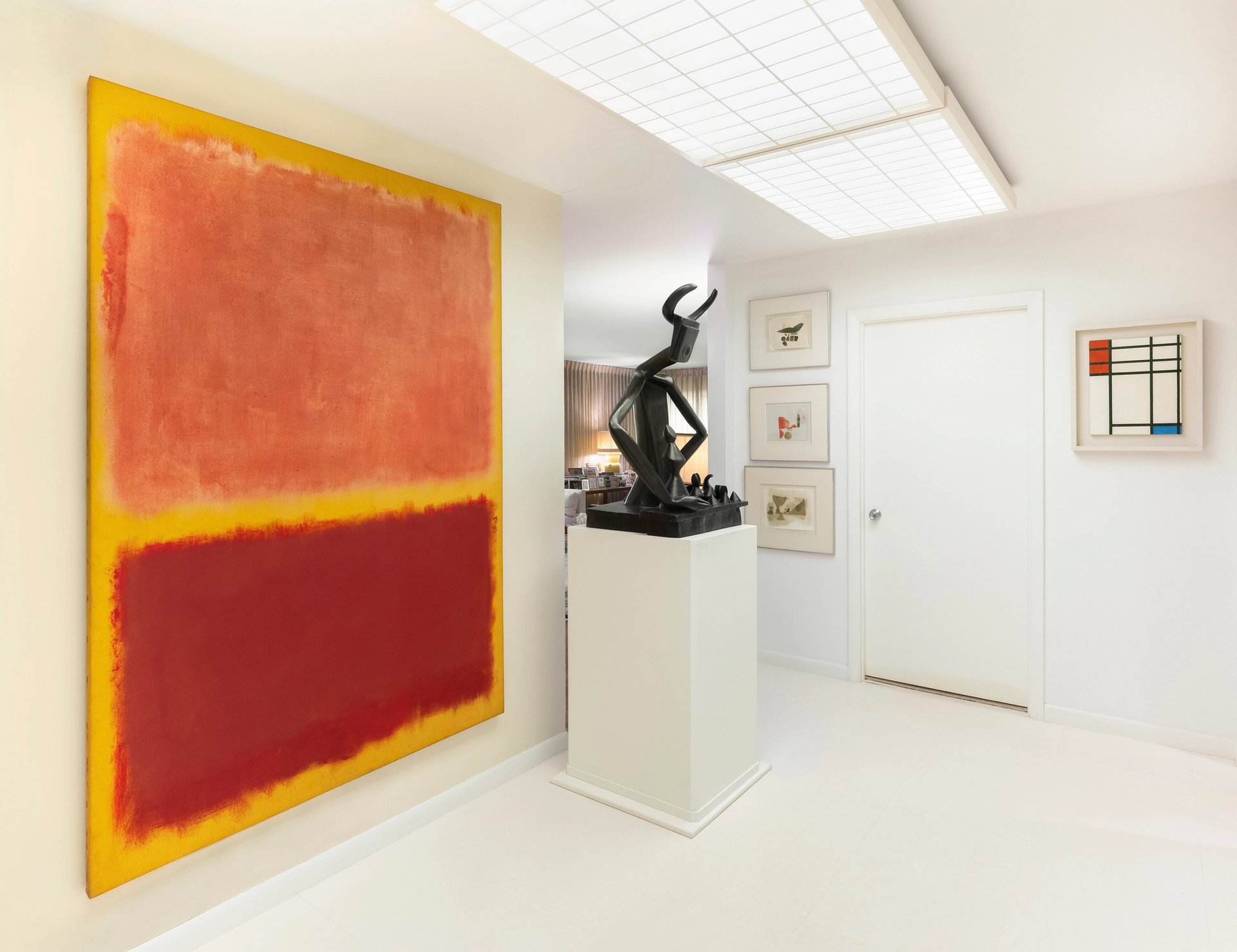
Mark Rothko’s No. 31 (Yellow Stripe) (1958, above left) sold for $62.2m at Christie’s © 2025 Vivian Marie Doering
But what about further down the price scale? Recent contemporary art is a clear pressure point, judging by some tell-tale results at the fall New York auctions. Despite a record 61% of the lots at the evening sales being guaranteed, there were some notable flops for living artists whose auction prices have recently been on a roll. Large canvases from 2022 by Cecily Brown and Jadé Fadojutimi, both of whom have been at the forefront of the booming market for abstract paintings by women artists, failed at Christie’s and Phillips respectively against estimates of $4m-$6m and $800,000-$1.2m. Since May only one of the four Fadojutimi works offered at auction with estimates of at least $300,000 have found buyers. From 2021 to 2024, 11 of her canvases sold for more than $1m, according to Artprice.
A painful contraction
“The speculative end of the auction market for young artists has retrenched. Poor auction results for living artists whose markets have been overplayed adversely affect consumer confidence. This vicious cycle causes a painful contraction in the gallery sector, but it won’t last forever,” said the New York-based adviser Wendy Cromwell, speaking during Art Basel Miami Beach. She added: “From my vantage point, I see the art market adapting, new gallery and advisory modalities are evolving, new art fair locations are mushrooming.”
In terms of new fair locations, 2026 will be all about the inaugural editions of Art Basel Qatar in February and Frieze Abu Dhabi in November. Organisers, exhibitors and commentators are understandably keen to discover whether the vast fossil fuel wealth of the region can nurture a collector base that can sustain three major international art fairs.
Sotheby’s, which is now part-owned by the Abu Dhabi sovereign wealth fund ADQ, tested the UAE’s potential with a $1bn Collectors’ Week promotion in December that coincided with the Abu Dhabi Grand Prix. Auctions of real estate, supercars, handbags, jewels and watches were held, and would-be art collectors were treated to a loan exhibition of 11 “icons” that had been sold at Sotheby’s. These included Klimt’s Lady with a Fan (sold for $108.4m in 2023) and Banksy’s half-shredded Girl Without Balloon (resold for $25.4m in 2021), as well as works by Dalí, Bacon, Magritte and Warhol.
The event typified the dream marketing mix for the top of today’s global art market. Trophy works by instantly recognisable “brand” artists seamlessly blended with exclusive luxury brands like Patek Philippe, Hermès, McLaren, Aston Martin and Ferrari.
But what of the hundreds of thousands of works being offered by smaller auction houses and dealers that are not by “brand” artists, that are not instantly recognisable, that do not get any media coverage and that are not obvious stores of enduring financial value?
“The market is much better than it was six months ago, but not better in every sector,” says Philip Hoffman, the founder of the London-based advisers, The Fine Art Group, who was in New York for those bellwether November sales. “Too many people have had their fingers burned by young art.”
Welcome to our current “K-shaped” art market.