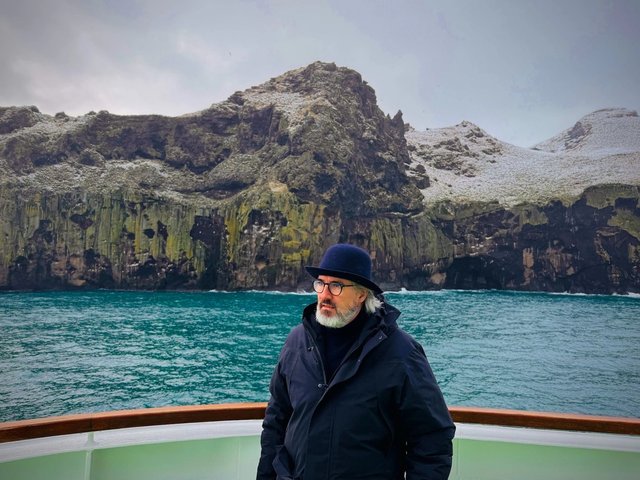
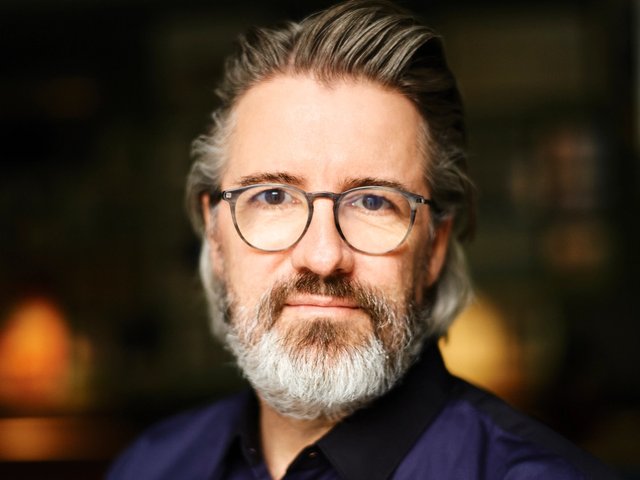
As 2026 begins, hope is on my mind. This follows my discussions at the end of last year with the artists Luc Tuymans and Olafur Eliasson, on the A brush with… podcast.
Eliasson has directly addressed the climate emergency in works like the photographic glacier melt series 1999/2019 (2019), which features 30 pairs of photographs of Icelandic glaciers, made 20 years apart, revealing the alarming impact of global heating. I spoke to him in the aftermath of what he described as the “catastrophic non-impressive result” of Cop30, the 30th United Nations climate conference in Brazil.
He admitted to feeling “terrified” after the conference. “If you want to mobilise and create a civic movement and all of that, that’s not what you say. But this is me being honest: it is not looking good. It is looking not just bad, it is looking horrible.” He admitted he was “past the point of hope”, and remembered Desmond Tutu’s famous statement that he was not an optimist but “a prisoner of hope”.
Great minds, new ideas
For Eliasson, it is more important to act: “It’s not going to bring you anywhere, to bloody hope for anything.” So he directly addressed the podcast’s listeners: “A lot of people are doing a lot of great things: find them and follow them and do what they do. That’s what I’m trying to do.” And around him on his studio walls, he told me, was the research of Johan Rockström, a professor at the Potsdam Institute for Climate Impact Research, who focuses on global sustainability.
But even that gesture is ultimately hopeful. Amid the abundant evidence of political and corporate negligence, Eliasson still continues to alight on great minds, new ideas. And his art is profoundly idealist: he projects hope onto his audience. Many of his titles feature a “you” to whom the work speaks, from the early work Your strange certainty still kept (1996) to the recent work Your truths (2025). This mode of address is about giving the viewer “a mandate… a sign of, ‘I trust you, you are the main protagonist here.’ Sometimes it’s also about a degree of hospitality and generosity… It is for you.”
This is a condition of all art, even if not expressed as explicitly as in Eliasson’s. In the tripartite communion between artist, work and viewer, each experience is unique, however tightly contextualised by artists’ utterances or institutional framing. Eliasson’s art foregrounds the individual experience and its multifarious mental, embodied and emotional parameters, as well as how we share it with others around us.
Art’s possibility
This makes me feel hopeful, even amid the most worrying political and environmental outlook of my lifetime. Tuymans helps here. He is one of the most intelligent probers of art’s possibility to react to historical and contemporary trauma. His latest exhibition, shown at David Zwirner in New York last year and from February at the gallery’s Los Angeles outpost, obliquely addresses the political situation in the US. In the exhibition is a riff on Théodore Géricault’s The Raft of the Medusa (1818-19)—a multi-canvas painting of the same dimensions depicting a fruit basket that echoes Géricault’s diagonal composition. “It is something that you give to somebody that is sick,” Tuymans told me, “and the United States [is starting] to resemble a fruit basket.”
As this shows, Tuymans can be among the most sardonic of artists. His process strips an image bare while making it stranger, more ambiguous. After selecting his motif he veils it through his painting process, so it can appear muted or bloodless. For him, he said, “the element of distance is the most important thing”. Viewers feel it, he said. “And therefore sometimes they will have the element of anaemia or the element of a lack of empathy… because there is this distance that is built in from the start.”
But Tuymans is aligned with Eliasson in giving his audience agency. “The important thing with the distance is... that the viewer is nevertheless the person that finishes the work off,” Tuymans told me. Through this device, we find our way into the work; it enacts, albeit through an unexpected route, the hospitality Eliasson describes. The Belgian artist wants to make us think, to reconsider issues and our position on them. Even for Tuymans—amid his despair at the sickness of Trump’s America—art can be, as he told me, “an element of hope”.