A museum always provokes questions, but should it also provide answers? When a visitor walks into a gallery, a hunk of metal or a combination of pigments on stretched fabric can become laden with meaning in front of their eyes. Even if a visitor knows nothing about the object, they can feel it. But sometimes it is necessary to read historical context or criticism to understand what is in front of you. Debates in the art world over how much wall text museums should provide are underlaid with the question: Is art meant to be understood, put into context? Or is it felt, wordlessly?
Some museums have entirely done away with wall text. The recently opened Calder Gardens in Philadelphia leans heavily on this in its branding, explicitly saying it is “open to interpretation” and rejecting the term “museum” entirely with an aim to be more accessible and less preachy to its visitors.
But other museums still use wall text and believe in its power to improve viewers’ experiences and provide accurate information about their collections, not packaged and regurgitated by the internet but curated by the museums themselves. “What is not being said in exhibition text is often just as revealing as what is being shared,” Dawn Reid Brean, the chief curator and director of collections at the Frick Pittsburgh, tells The Art Newspaper. “It feels more important than ever to invite multiple voices into the museum space. There isn’t one perfect solution for all visitors, but we strive to offer a variety of access points—whether it’s traditional labels, guided gallery conversations or prompts to spark reflection and dialogue.”
The Frick Pittsburgh has done that by inviting guest “labelists”—historians, artists and critics—from the local community to contribute their perspectives. Brean thinks of their wall labels as “walking through the galleries with an informed, informative friend”. As an example, for the museum’s 2025 exhibition Kara Walker: Harper’s Pictorial History of the Civil War (Annotated), Brean chose to include the name and photo of the individual who had written each wall label to connect visitors more to its content. One labelist, the University of Pittsburgh professor Shaun Myers, reflected on Walker’s Banks’s Army Leaving Simmsport (2005) by mentioning that her own third great-grandfather had escaped from a plantation in Simmsport to fight in the Union Army.
Juline Chevalier, the assistant vice president of interpretation at Toronto’s Royal Ontario Museum (ROM), says that during her career she has “seen museums work to study how people actually behave in museums and whether visitors understand the main message of an exhibition as the staff developed it”. She notes that the ROM has focused on “making text shorter, more scannable, and inviting visitors to come to their own conclusions rather than imposing a single reading or interpretation”.
Consider the word count
Chevalier serves on the board of the Association for Art Museum Interpretation (AAMI), a professional organisation dedicated to how installation choices—like wall text—affect viewers’ experiences. Museums in multilingual countries like Canada also face the obstacle of needing multiple versions of the same text.
“We write in very strict word limits because we must present all our content in English and French, and we don’t want to overwhelm the objects with text,” Chevalier says. “We write knowing that visitors are distracted as they read in museums. They are usually standing up, navigating a new environment, chatting with friends and family, keeping track of a toddler, considering what to have for lunch… We write text to grab and hold their attention.”
Attention is a resource in short supply, though, with a commonly cited statistic stating that the attention span of the average adult is only 8.25 seconds. “Ultimately, we write text to facilitate meaning-making between visitors and an object,” Chevalier says. But when you have only eight seconds to do that, what you give visitors really counts.
The Cleveland Museum of Art (CMA) presents its exhibitions with an in-house interactive app called ArtLens, which allows visitors to save photos they take and learn about the museum’s collection. Stephanie Foster, the lead interpretive planner at the CMA, says that, with ArtLens, “labels don’t necessarily have to carry all the weight”. ArtLens came out of the feeling that, as the museum’s chief digital information officer Jane Alexander told Artnet in 2019: “We’re not competing with other museums. We’re competing with Netflix.”
Museums are also competing with TikTok, Instagram, iMessage, the 24-hour news cycle—all in a piece of metal in visitors’ hands. While these all existed in 2019 as well, there is a real sense in 2026 of both information overload and a lack of trust in the information that is already out there, especially given how AI now aggregates data to create a confusing miasma of potential misinformation.
Grabbing someone’s attention and keeping it means the language of texts about art must be engaging and snappy but also informative and accessible, written for someone with little to no art-history background. “The label is the beginning of a relationship, not the end of an explanation,” Foster says.
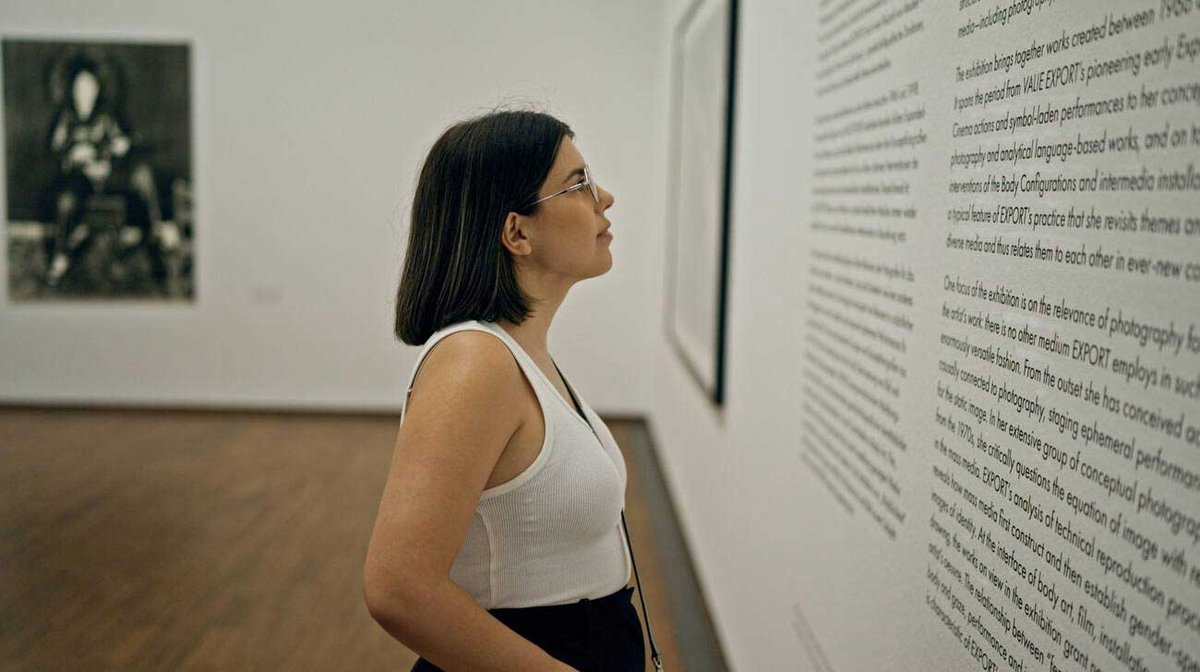
A 2021 study from the University of Vienna in Austria, conducted by art historians and cultural scientists, used mobile eye-tracking devices to determine whether visitors engaged with what was presented by wall labels after a reinstallation of the Belvedere Museum’s collection. The findings were unequivocal that visitors do read wall labels, but it is not so much what the labels say as where they are. Those at eye level are much more effective. But some works of art overwhelm attempts at labelling; Gustav Klimt’s The Kiss (1907-08) is a hard piece to label, for example, because any wall text is overshadowed by the size and grandeur of the painting.
The researchers in Vienna found the typical viewing pattern to be “art-label-art-label-art”, implying that visitors look at the art first, then look for context, then apply the context back to the art. There was also a correlation in eye movement from reading the title of the work and focusing on what the title depicts in the painting—like the figures in The Kiss. This shows that wall text is not inconsequential. It is actively shaping what museumgoers see in the art in front of them. Putting it in those terms highlights the need for the text to be written with care.
Of course, viewers can decide for themselves whether they want to read labels, and it is unlikely that wall text will go away entirely any time soon. Rather than decry it as preachy or overly intellectual, perhaps it is best viewed as an art form in its own right—with dedicated professionals like those at the AAMI behind it. If wall text is to survive in the digital age, it needs to stand on its own.
- Emma Riva is a Pittsburgh-based writer focused on the arts in post-industrial communities