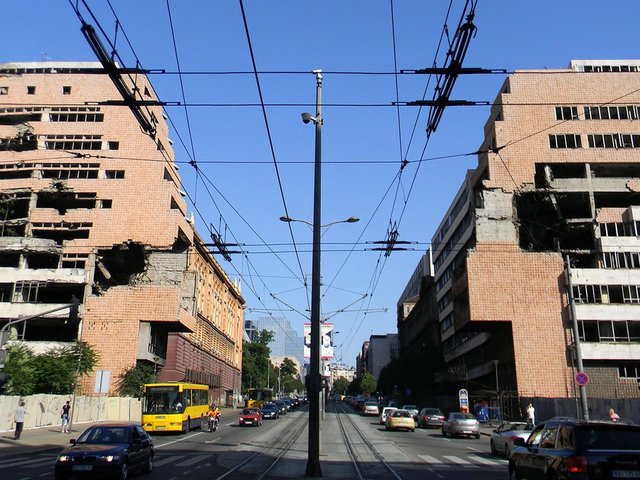
Controversial plans to redevelop Belgrade’s former Yugoslav army headquarters into a luxury complex featuring a Trump International Hotel have collapsed, following the indictment of Serbia’s culture minister and other senior officials.
Affinity Global Development, a company linked to Jared Kushner, the son-in-law of the US president Donald Trump, has withdrawn from the project. The decision came soon after Serbian prosecutors indicted Nikola Selaković, the country’s minister of culture, alongside Slavica Jelača, a secretary at the ministry of culture; Goran Vasić, acting director of the Republic Institute for the Protection of Cultural Monuments; and Aleksandar Ivanović, acting director of the Belgrade City Institute for the Protection of Cultural Monuments.
The officials are accused of two criminal offences: abuse of office and the falsification of an official document. There has been no suggestion of wrongdoing by Affinity Global Development.
Attempts to reach a representatives for Selaković, Jelača, Vasić and Ivanović for comment were not successful by the time of publication. Selaković had previously been questioned as part of the investigation and, in earlier statements to local media, denied any wrongdoing.
The Generalštab complex, a landmark of Yugoslav Modernism, was heavily damaged by Nato’s 1999 bombing of Yugoslavia during the Kosovo War. Towards the end of last year it became the centre of a fierce public debate after the Serbian government moved to override its protected status through a new lex specialis (special law), clearing the way for redevelopment.
The Serbian government first approved a contract with the company linked to the former senior adviser to the US president, Jared Kushner, in early 2024.
The case has become particularly charged because it sets a precedentfor overriding protected status. For many locals, the involvement of a US-affiliated firm in a site remembered for Nato bombings, widely associated with the US, has heightened tensions.
Concerns raised over other heritage sites
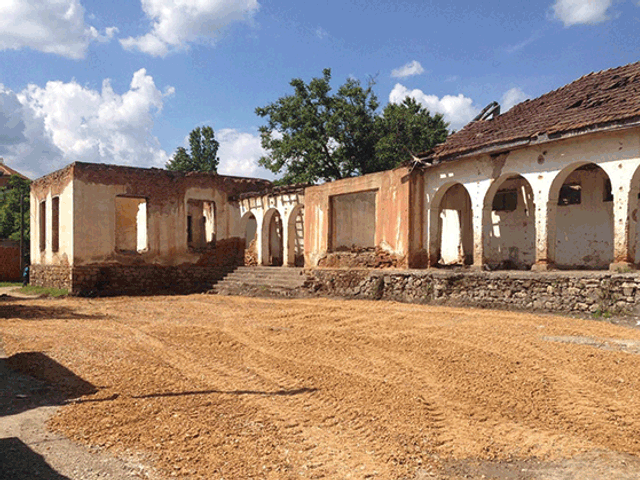
Meanwhile, concerns about the fate of other prominent heritage sites have intensified over the past year. In January 2025, the city’s Hotel Jugoslavija, a Modernist landmark of the Socialist era, was demolished to make way for a €500m residential and retail development; in Šabac, the 1962 Home of the Yugoslav People’s Army faces sale to private investors; and calls to protect the post-war Belgrade Fair complex from plans to undergo a “radical transformation” and large-scale demolition are accelerating. Reports of churches being built directly next to, and additions being made to, Socialist Yugoslavian monuments are prompting criticism, as with the church built next to the 1969 Monument to Fallen Soldiers in Ostra by Miodrag Živkovic and Svetislav Ličina.
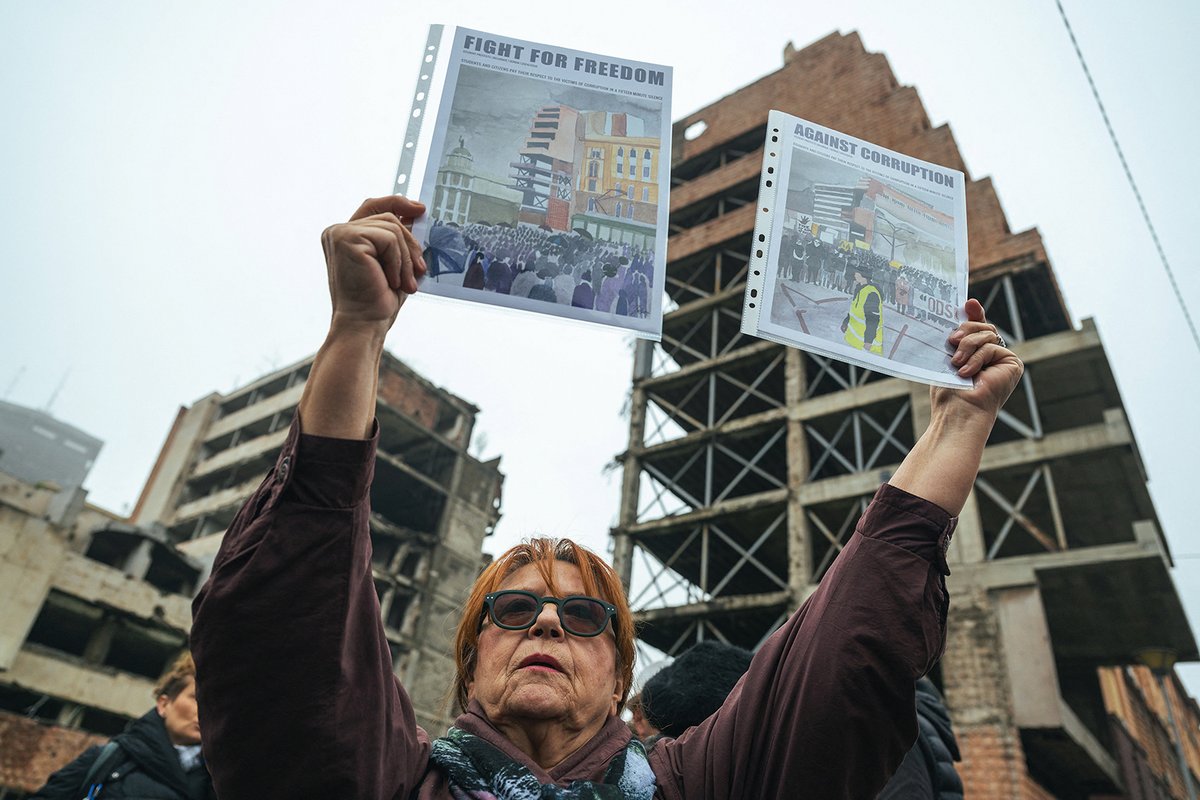
Many of the works and sites being described as “at risk” were constructed during Socialist Yugoslavia. Gruia Bădescu, a research fellow at Zukunftskolleg, University of Konstanz, and author of Making Sense of Ruins, suggests the concern is about more than just development. “For many, this ruined site is a testament to the bombing, a memorial of 1999, while others point to it as a key Modernist emblem of Yugoslavia,” he says. “What we are seeing on a wide scale is a government-led process of erasing Socialist Yugoslavia.” He adds that the Generalštab case is “emblematic of tensions between real estate development and the politics of memory of Serbia”.

The Serbian minister of culture Nikola Selaković denies wrongdoing
Photo: Jennifer Jacquemart © European Union, 2021
The Belgrade-based art historian Vladana Putnik Prica says people are feeling divided around Socialist heritage. “Some are anti-Communist and opposed to the regime, others feel nostalgic, others are concerned about documenting history,” she says. “There is also bit of a generational divide, with younger people generally proving more accepting, and intrigued by these buildings.” She adds that despite international interest in the sites and expressions of concern, it can be “quite triggering” when no help is visibly forthcoming.
International attention has grown. In late 2024, the International Council on Monuments and Sites (Icomos) issued a heritage alert, specifically over the Generalštab and the Belgrade Fair, but also called on the country’s leaders to develop “a strategic process to understand, recognise and protect Belgrade’s Modern 20th-century heritage”. “Our concerns are broad and ongoing,” says Nevenka Novakovic, a member of the executive board of Icomos Serbia. “We face a constant fear of the next detrimental step that will lead to further heritage destruction.” She describes professionals in the field as feeling “powerless given the decision-making environment, where critical concerns are often dismissed”.
Repression and punishment
Speaking out locally is risky. “Repression is significant—cultural institutions are frequently targeted because their work and personnel are often inherently supportive of free thought and public discourse,” Novakovic says, citing the temporary closure in October of the National Theatre in Belgrade, which was “widely seen as a punitive measure against actors who publicly supported student protests”.
Reports of pressure on colleagues at institutions like Serbia’s Republic Institute for Protection of Cultural Monuments, through threats of funding cuts and job losses, also align with the European Parliament’s recent joint motion filed in October regarding “polarisation and increased repression in Serbia”. The motion strongly “condemns the government’s retaliation against employees in the education and cultural sectors for supporting the protests, including job losses, salary reductions, the presence of police on university campuses and the withdrawal of funding for public universities”.