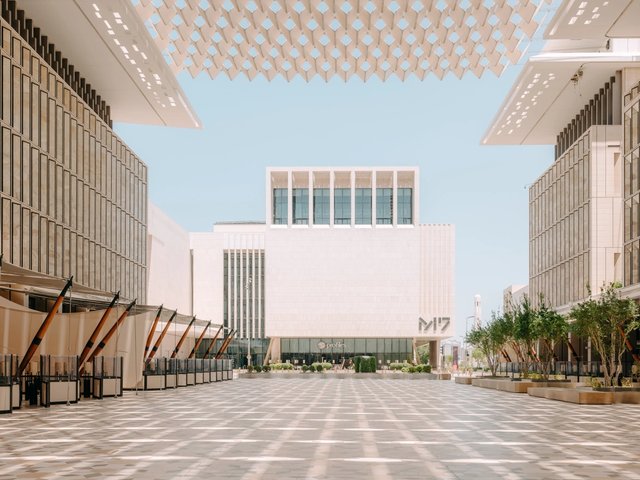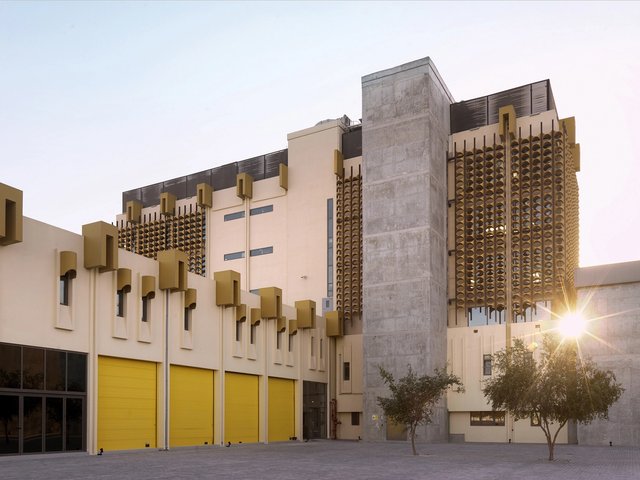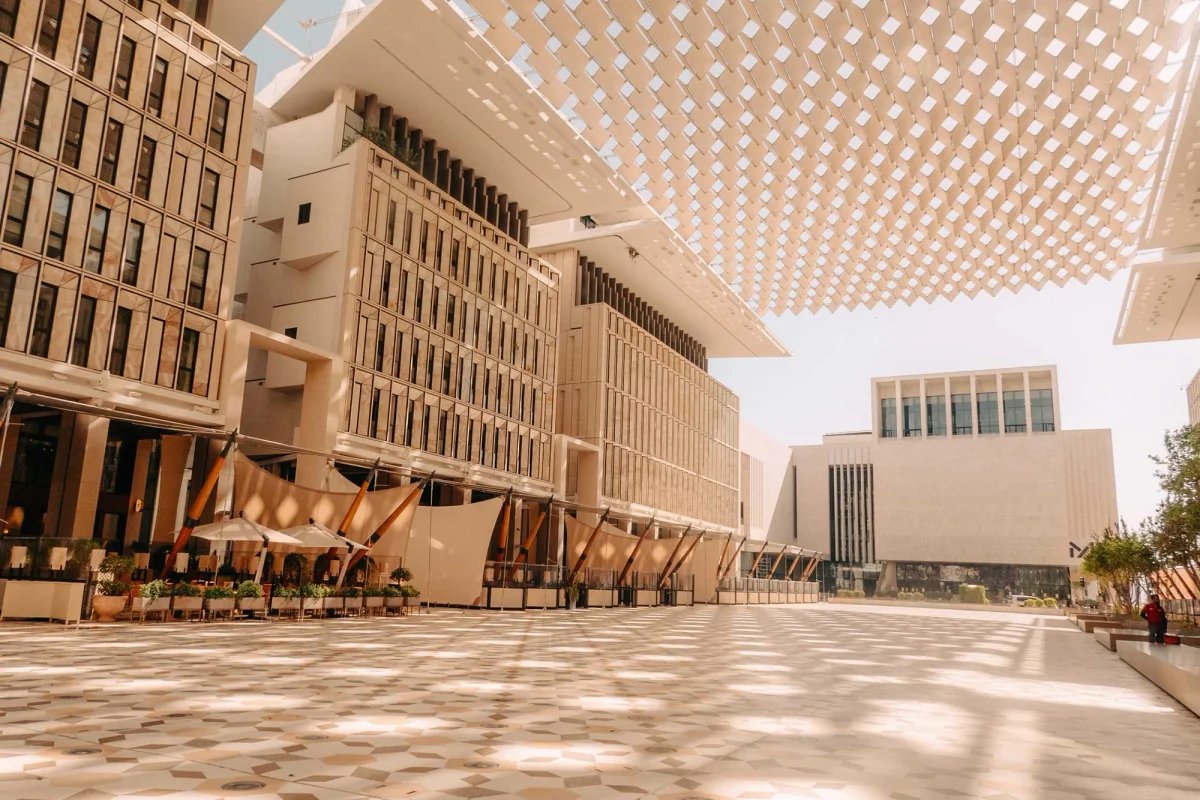
Art Basel has departed from convention for its first outing in the region. At 87 galleries, Art Basel Qatar is smaller than most and is spread across multiple venues. Galleries were asked to bring only one artist, and the presentation eschews stands in favour of a more open-plan, almost museum-like layout, with benches replacing the three-chairs-and-a-table set-up that has become the art-fair standard. The appointment of the artist Wael Shawky as artistic director underlines the impression of a fair that is projecting curatorial coherence over commercialism.
“We’re very happy with the format, because Art Basel tries to respond specifically to each place where we operate,” says Vincenzo de Bellis, the chief artistic officer and global director of Art Basel Fairs. “In this case, we wanted to have our first interaction with the region [via a fair] to be more focused, to dig more into the artist and his or her trajectory, and to allow a new public for Art Basel—including the public that follows us around the globe—to have a different experience.”
Institutional sales are also an objective. Almost across the board, galleries are bringing major historical artists and younger practitioners with serious bodies of work. Their hope, numerous gallerists who spoke to The Art Newspaper say, is that the works will go to one of Doha’s many museums, most of them run by Qatar Museums (a partner of the fair through its QC+ wing), or to other institutional collecting teams who are reportedly arriving from London, New York, Riyadh and elsewhere.
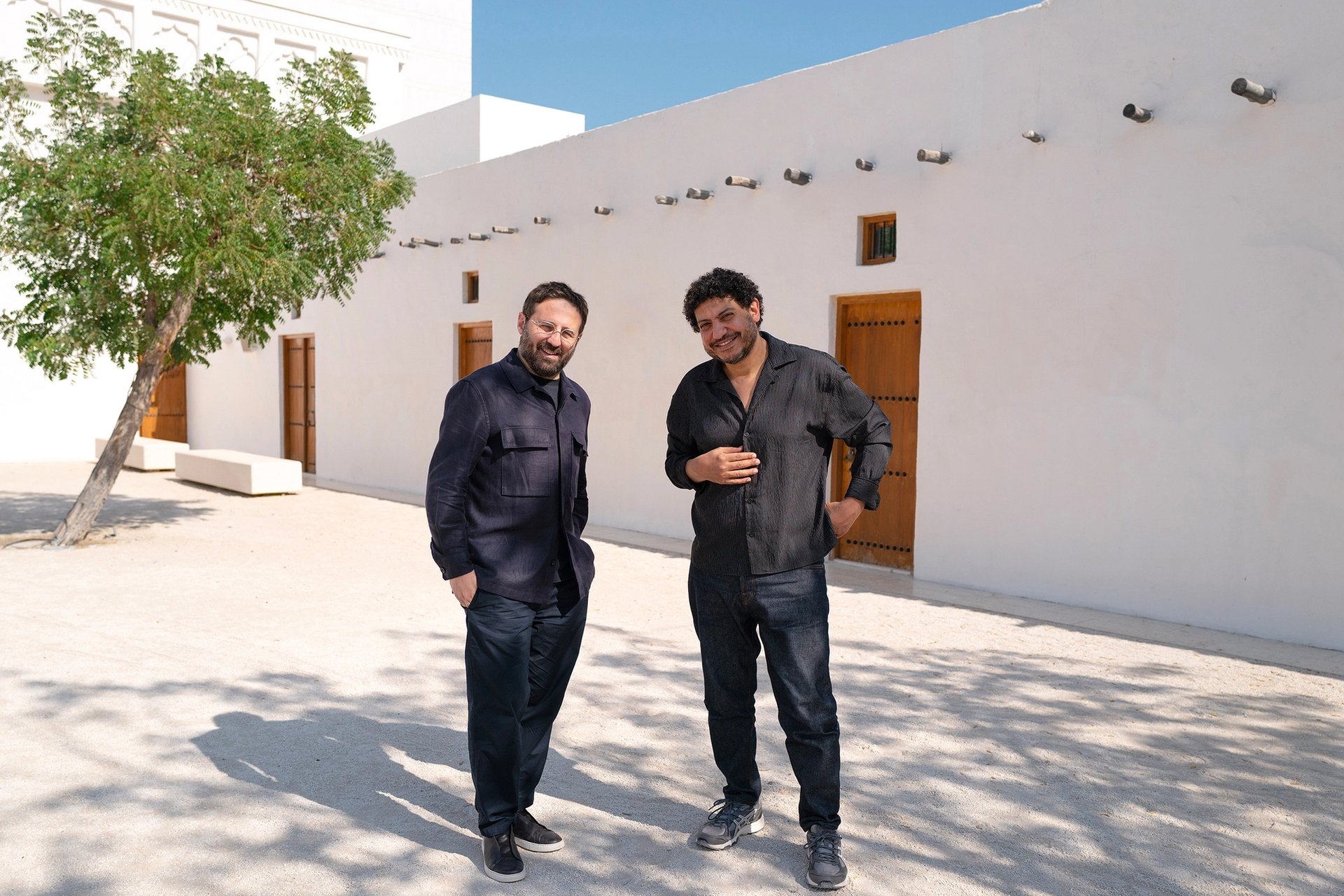
Vincenzo de Bellis (left), the chief artistic officer and global director of Art Basel Fairs, and Wael Shawky, Art Basel Qatar’s artistic director Photo: Jinane Ennasri; courtesy of Art Basel
“Art Basel aims for museum quality in everything that we do,” De Bellis says. “That does not mean a large or monumental work, but we define it in terms of its relevance to an artist’s career. So yes, we do that everywhere, but we have certainly tried to do it here.”
The fair occupies seven venues in the Msheireb campus, a cultural district in downtown Doha, including two principal sites of the M7 space—an innovation and start-up hub run by Qatar Museums—and the Doha Design District. A series of special projects commissioned and selected by Shawky and De Bellis are placed in the spaces between the venues, leaning into the idea of the courtyard as a gathering space in Middle Eastern cultures. Summaya Vally, the architect who was the artistic director of the first Islamic Arts Biennale in Jeddah, has created a vast majlis, or sitting area, between M7 and the design district. Rayyane Tabet, from Beirut, has produced a large-scale installation of interlinking near-circular steel structures, clad in palm leaves, that relates, De Bellis says, to two key aspects of life in the Gulf: landscape and oil extraction. And the fair is also projecting Bruce Nauman’s Beckett’s Chair Portrait Rotated (2025) in 3D and at 24m wide in an under-construction theatre in M7, in a neat parallel between the studio where the video was made and the site of production where it is shown.
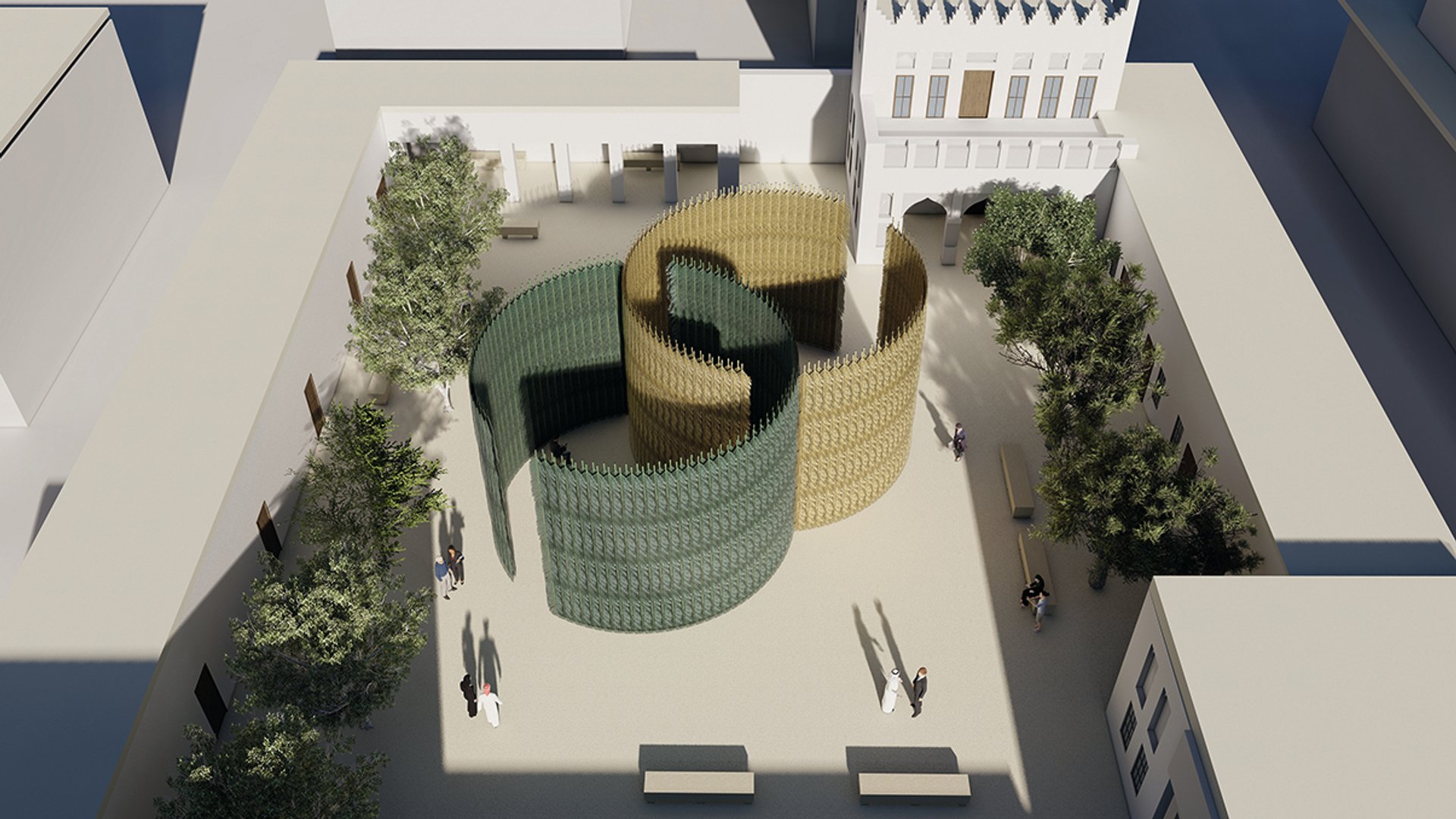
A rendering of Lebanese artist Rayyane Tabet’s pavilion, in the Special Projects programme Courtesy of the artist
“We wanted to have a very strong presence of artists from the region, and 80% of the artists in the special projects section are from the region,” De Bellis says. “The overall idea is that this is a fair where global and local are really mixed.”
This balance is also reflected in Art Basel Qatar’s gallery list, which went over well in the Arab art world; it was perceived as balancing blue-chip international galleries—David Zwirner, Gagosian, Hauser & Wirth—with a genuine focus on art from the Arab region. According to fair figures, more than half of the 84 artists represented come from Southwest Asia and North Africa and, perhaps more importantly, the selection is reflective of the artists who are active in the region.
Gypsum, from Cairo, presents Mohamed Monaiseer, whom Shawky mentored at MASS Alexandria, the art-led school he ran in his home city from 2010 to 2019. Monaiseer is showing a series looking at how children’s toys and board games such as Ludo and chess normalise military manoeuvres—which he contrasts with other iconography of war, from the animals that are used to symbolise armies to the jewels and artefacts that are its spoils.
“Because this inaugural edition feels very institutional, we wanted to use a cohesive body of work,” says Aleya Hamza, the founder of Gypsum. “The work is culturally specific to Egypt’s colonial history but also looks beyond to understand a wider framework of conflict and domination; part of this research was done at the Imperial War Museum in London during his Delfina residency.”
Asmaa Al-Shabibi, of the Dubai gallery Lawrie Shabibi, is showing Amir Nour, a Sudanese Modernist whose work she and her gallery co-founder William Lawrie first saw at the Sharjah Art Foundation. They are hoping that regional institutions might be interested in the work—but also that Nour’s sleek sculptures attract curators visiting from the US, where he lived from the 1980s until his death in 2021.
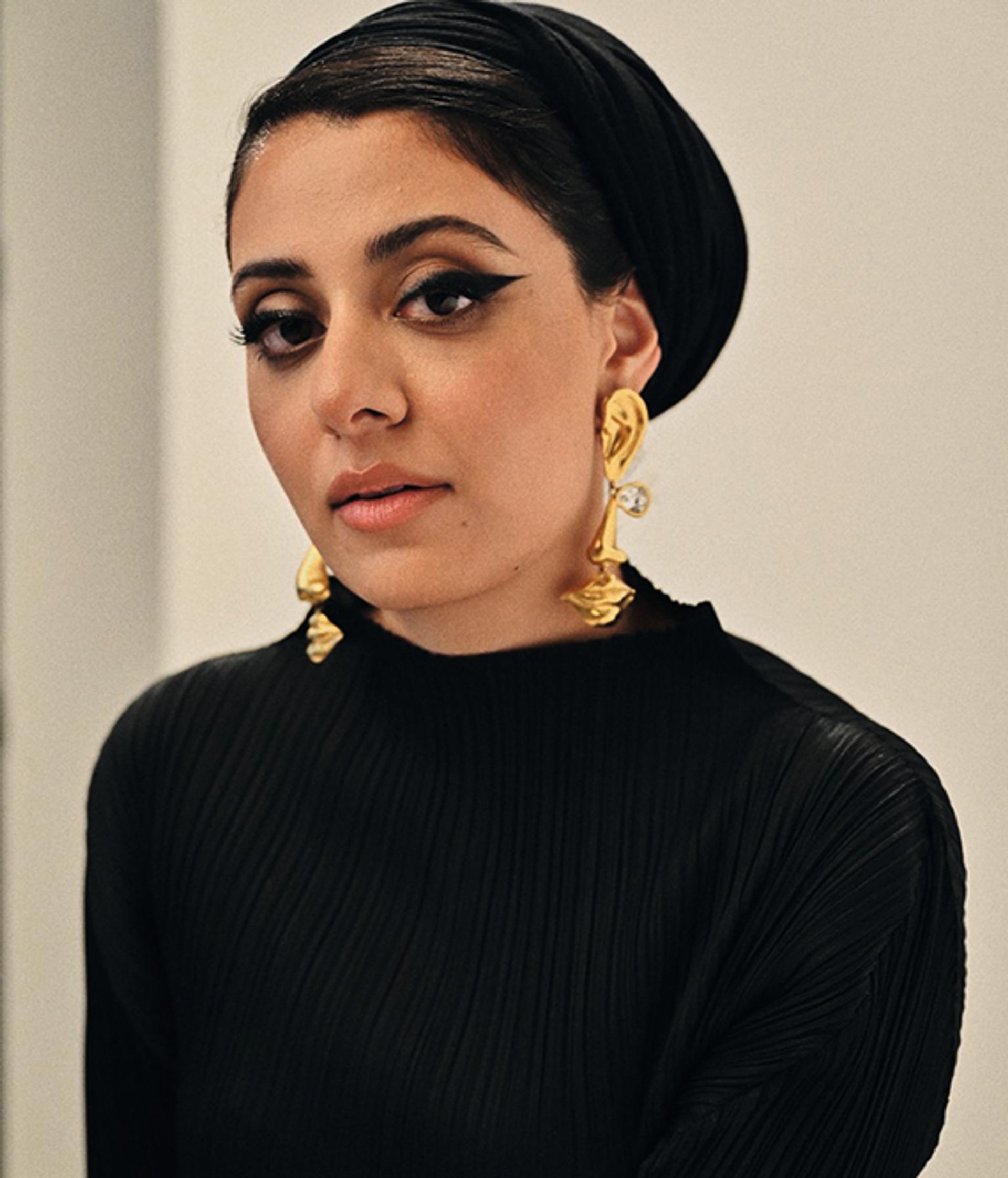
Summaya Vally, the artistic director of the first Islamic Arts Biennale in Jeddah, has created a sitting area at the fair Lou Jasmine
“Nour stood apart from the art market and even his contemporaries from Africa,” Al-Shabibi says. “This autonomy allowed him to develop work rooted both in minimalism and in Sudanese cultural memory. By presenting him at the inaugural Art Basel Qatar we hope to reposition him at the centre of a global Modernist discourse, where he really belongs.”
Generous hosting policies
As of press time, a number of major collectors and curators are understood to be going to the fair—helped, to be sure, by generous hosting policies for exhibitors and visitors alike. Gallerists’ accommodation is paid for by Art Basel Qatar, according to gallerists. Other art professionals have also been invited, with hotels and flights paid for. That is standard practice for fair VIPs but it is notable considering the high cost of a trip to Doha.
Art Basel Qatar also benefits from its timing, directly following the opening of the Diriyah Contemporary Art Biennale in Saudi Arabia. Alia Al-Senussi, who is a senior adviser to both the Diriyah Biennale Foundation and Art Basel, suggests that that combination has enticed American and Asian collectors whose curiosity has been piqued by the region.
“We’ve had an overwhelmingly positive response from collectors, institutions and figures of deep importance in the cultural world,” she says. “This has been incredibly heartening, because people want to genuinely engage with the content that has been announced—as it is very much about artists from the Arab world. People know what Sheikha Al-Mayassa [the chairperson of Qatar Museums] has done over the years, and want to come to Art Basel Qatar to learn and to engage with artists from the region and with those galleries who will be presenting them.”
The market landscape has changed even in the nine months since Art Basel Qatar was announced. Last autumn, Abu Dhabi Art announced that it would partner with Frieze for its 2026 edition, and Dubai’s Alserkal Avenue has joined with Design Miami to host a design fair in early 2027. (Exact dates were unavailable as we went to press.) Art Dubai—one of the last remaining independent outlets—will celebrate its 20th anniversary in April, while rumours continually abound about a Saudi fair. Buoyed by the substantial museums building in the Gulf, and its growing popularity for high-net-worth individuals fed up with rising taxes elsewhere, both the institutional and commercial sectors are eyeing the wealthy states of the Gulf as a much-needed growth sector.