On his deathbed in 1410, the wealthy merchant of Prato, Francesco Datini, resolved to atone for his sins by bequeathing the huge sum of 1,000 florins to the Florentine hospital of Santa Maria Nuova. Orphaned during the Black Death, he left explicit instructions that the money should be used to create a home “for those abandoned and cast away”. So begins the story of Europe’s first foundling hospital, the Ospedale degli Innocenti, examined afresh in this fascinating new book.
Founded by the Florentine Silk Weavers Guild in 1419 using Datini’s legacy, the Innocenti accepted the first of its gittatelli (“thrown-aways”) in 1445, taking in nearly 400,000 such children up to the 1970s. As Joseph Luzzi, a professor of literature at New York’s Bard College notes, it is often thought of as an orphanage, but it was not actually given this designation until the late 19th century after becoming a public charity. Although some of the children were indeed orphans, most were in fact abandoned by unmarried mothers compelled by poverty and/or the shame surrounding illegitimacy. Some left their infants with identifying tokens, such as halved coins, intending to reclaim their children when their circumstances improved.
Luzzi charts the Innocenti’s history across eight chronological chapters, covering the broad historical context and the major players involved, as well as detailing some of the heart-rending stories of individual children, preserved in the hospital’s extensive archives.
The first two chapters focus on its founding and construction, starting with Datini’s late-life spiritual crisis, and the commissioning of Florence’s star architect, Filippo Brunelleschi (1377-1446) to design the institution’s magnificent extended portico, or loggia. This dominates the piazza of Santissima Annunziata, the classically proportioned arches giving a sense of order that signalled, writes Luzzi, “a transition from chaos to harmony” for the children who entered. Chapter 3 examines the social backgrounds of the foundlings—often the offspring of sexually exploited female servants and slaves—who were initially left outside in a font within the loggia. This was later replaced by the famous ruota wheel, which transferred the newborns into the building as it was rotated.
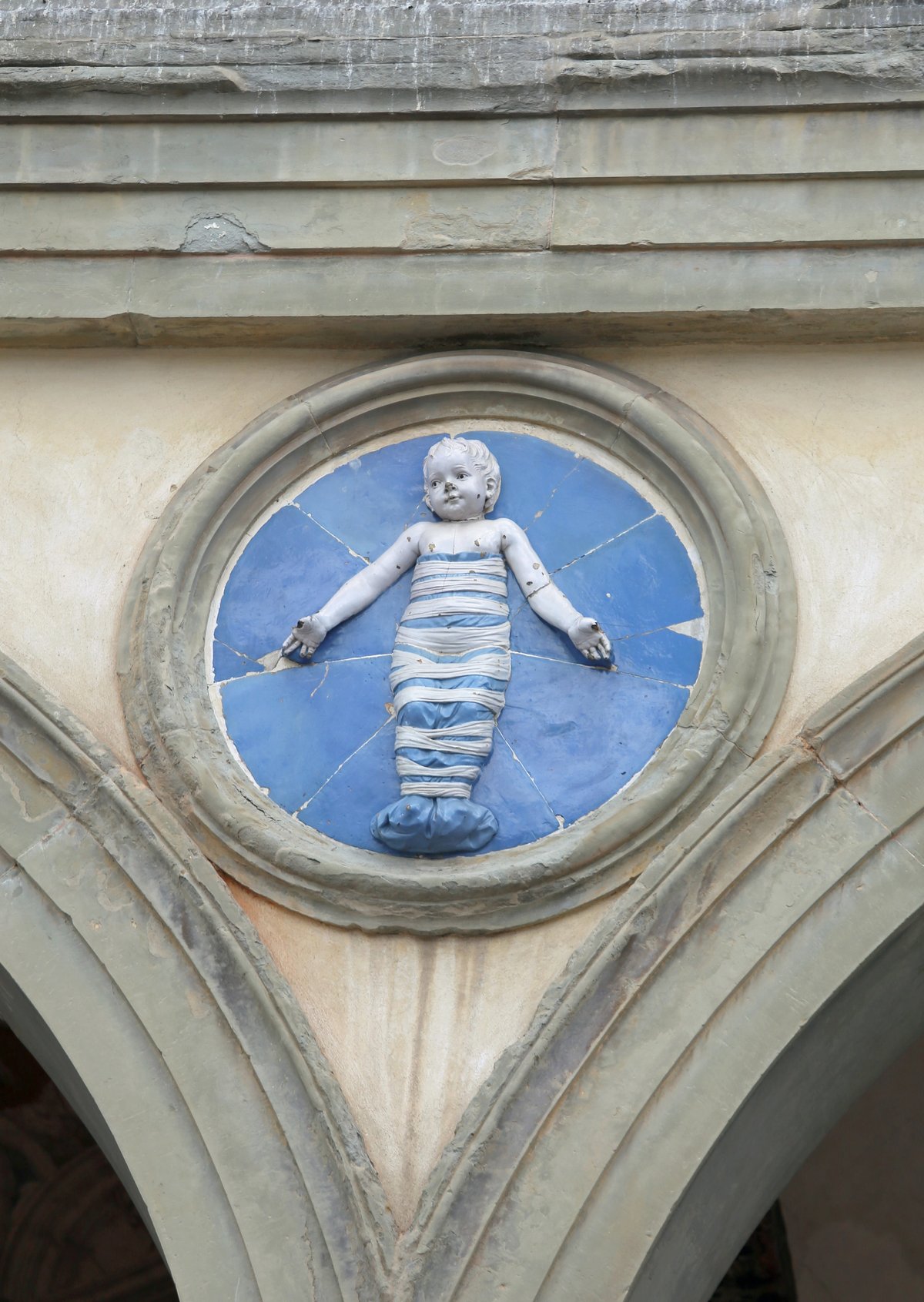
Chapters 4 and 5 consider the management of the Innocenti through the 15th and 16th centuries under the priorates of Francesco Tesori and Vincenzio Borghini. In this period, despite constant financial struggles, the Innocenti expanded its art collection to include Domenico Ghirlandaio’s Adoration of the Magi (around 1485) and Andrea della Robbia’s blue-and-white terracotta bambini roundels (around 1487), which to this day remain its distinctive emblem. Luzzi observes that the themes of the works commissioned were intended “to communicate the Innocenti’s mission” by emphasising the innocence of the children in its care.
Educational programmes for boys were broadened beyond basic literacy to encompass humanist teachings, music and classes in drawing and painting, the latter provided by former Innocenti who had been apprenticed to Florentine artists. Chapter 6 examines the plight of female foundlings against the backdrop of contemporary attitudes towards women. Although children of both sexes were sometimes adopted, their prospects generally depended on gender. While boys were equipped with skills to work in local trades, girls were left
with the options of entering domestic service, marrying (with meagre dowries provided by the hospital), or returning to the institution as staff or nuns.
Chapters 7 and 8 bring us to the present day, first by considering developments during the 18th century when similar organisations appeared elsewhere, including Thomas Coram’s Foundling Hospital in London, which was supported by prominent artists including William Hogarth, amid increasing moralist concerns that such facilities were simply enabling the anonymous disposal of unwanted offspring. Luzzi investigates the role of the Innocenti as a centre for the development of children’s medicine and maternity care in the 19th century and examines the influence of childcare practices and literacy in framing national identity after the unification of Italy in 1861. The final chapter considers the post-war period and the introduction of children’s rights legislation in the 20th century. During this time, the Innocenti moved to new premises and in 1986 the original building became a museum and research facility.
Luzzi concludes this thoughtful, engaging and concise account by emphasising just how revolutionary and influential the Innocenti has been, as “the first institution devoted exclusively to the care of abandoned children, a pioneer in surrounding its charges with beautiful art, and the site of groundbreaking discoveries in paediatric medicine”.
- Joseph Luzzi, The Innocents of Florence: The Renaissance Discovery of Childhood, W.W. Norton & Co, 240pp, 8pp col. insert + 8 b/w illust., $29.99 (hb), published 28 November 2025
- Sarah McBryde is an independent scholar and series assistant editor for Elements in the Renaissance (Cambridge University Press)