For more than two decades, Sheikha Al-Mayassa bint Hamad bin Khalifa Al Thani has spearheaded the development of Qatar's cultural institutions, leading them to world renown. Can her vision—and budget—now do the same for the region’s art market?
This question is central to the inaugural Art Basel Qatar, which opened yesterday (3 February) to VIPs. For all its avowed institutional and educational ambitions, the Doha debut’s commercial importance is keenly stressed. “It may look like a biennial—but don’t forget everything’s for sale,” Noah Horowitz, Art Basel’s chief executive, said at a press conference before the fair opened.
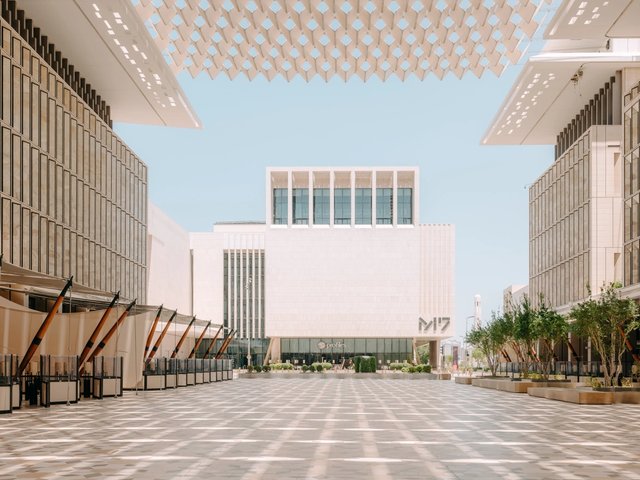
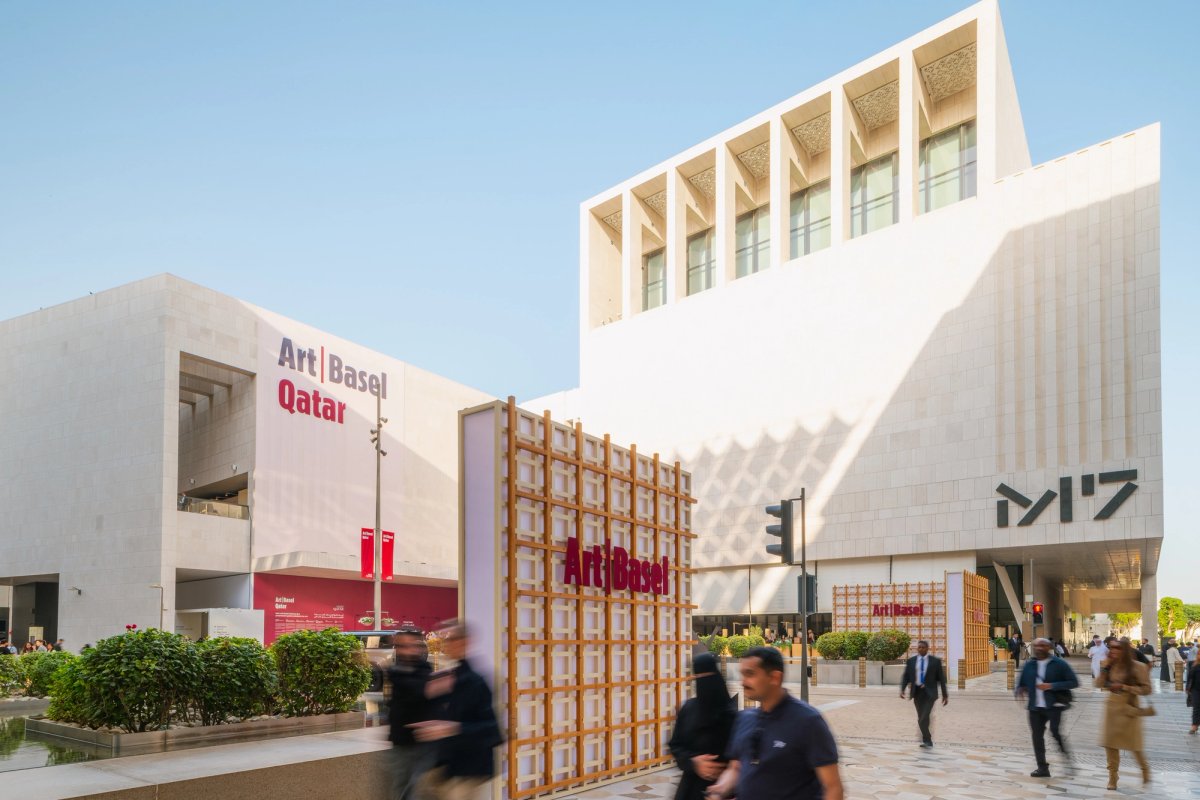
Horowitz refers to the unusual “boothless” format of the new fair. There are just 87 exhibitors (around one-third the size of a typical Art Basel fair), each of which is showing a solo artist presentation pre-selected by a curatorial team led by the artist Wael Shawky. These have been divided across two venues near each other in the upscale Msheireb district.
In the larger venue, M7, blue-chip galleries present mostly large-scale presentations of international and regional artists, likely aimed at institutional buyers. Certainly it is difficult to imagine many private collectors snapping up Meriem Bennani’s vigorously gyrating sculpture, jointly shown by Ludovico Corsini and Francois Ghebaly, or Maha Malluh’s hefty stacks of metal air conditioning units, offered by Krinzinger.
The second venue, Design District (where stands are slightly cheaper) hosts more of the emerging to mid-tier galleries. Some of these have never taken part in an Art Basel fair before, such as Cairo's Gallery Misr, showing Souad Abdelrasoul. Other regional galleries provide more accessible price points—like the textile works by the Mohamed Monaiseer, brought by Gypsum from Cairo, for under $10,000—to entice new buyers.
The concise, orchestrated format was roundly welcomed as an improvement to the overwhelming sprawl of most large fairs. “It deliberately goes against standardisation, which is good,” says Guillaume Cerutti, the president of the Pinault Collection. “The smaller format, and the choice to present only solo shows creates a much stronger framework for engaging with the works in depth.”
Other high-profile visitors on opening day included collectors from the region like Reem El Roubi and Elie Khouri, the Neue Nationalgalerie chief Klaus Biesenbach, the former MoMA head Glenn Lowry and the top adviser Sandy Heller. However, several gallerists said that some US and East Asian clients, as well as leading advisers, who had scheduled to attend the fair did not show up due to travel warnings issued for the region following widespread unrest in Iran.
Accompanying the praise of the event is a tacit acknowledgement that such a seamless experience and institutional quality is made possible by Qatar's largesse, having underwritten the event and helped Art Basel to provide “logistical support, transportation, storage, installation and de-installation, and condition reporting, as well as travel and accommodation support”, according to a spokesperson. Participation, including stands fees, cost exhibitors between $15,000 to $25,000—a fraction of other Art Basel events—while emerging galleries can apply for further discounts. Without these incentives, many voice doubts that the market is not deep nor sophisticated enough to hold an event of this calibre.
The reduced overhead costs certainly “lowers risk and encourages presentations that focus more on the education of a new market, rather than commercial transactions,” says Mauro Ribero, whose gallery Rossi & Rossi is exhibiting a $350,000 geometric metal sculpture by the late Iranian artist Siah Armajani.
For quite how long this unique level of support, or the intimate and focused format of the fair, will last is unclear: Art Basel’s director of fairs Vincenzo de Bellis says he expects these logistical decisions “to evolve with the fair over time”. He adds that Art Basel Qatar will eventually move to an expanded site on Al Maha island, a tourism and luxury hotel hotspot some 15km to the north.
It is not just the set-up, but the selling that functions differently at Art Basel Qatar. The end of the preview day was not accompanied by a deluge of eight-figure sale reports, as happens at other editions. Many were still waiting to hear back from Qatar Museums, which prior to the fair’s VIP preview had already drawn up a shortlist of purchases, mainly for the collection of its forthcoming Art Mill contemporary art museum, slated to open in 2030.
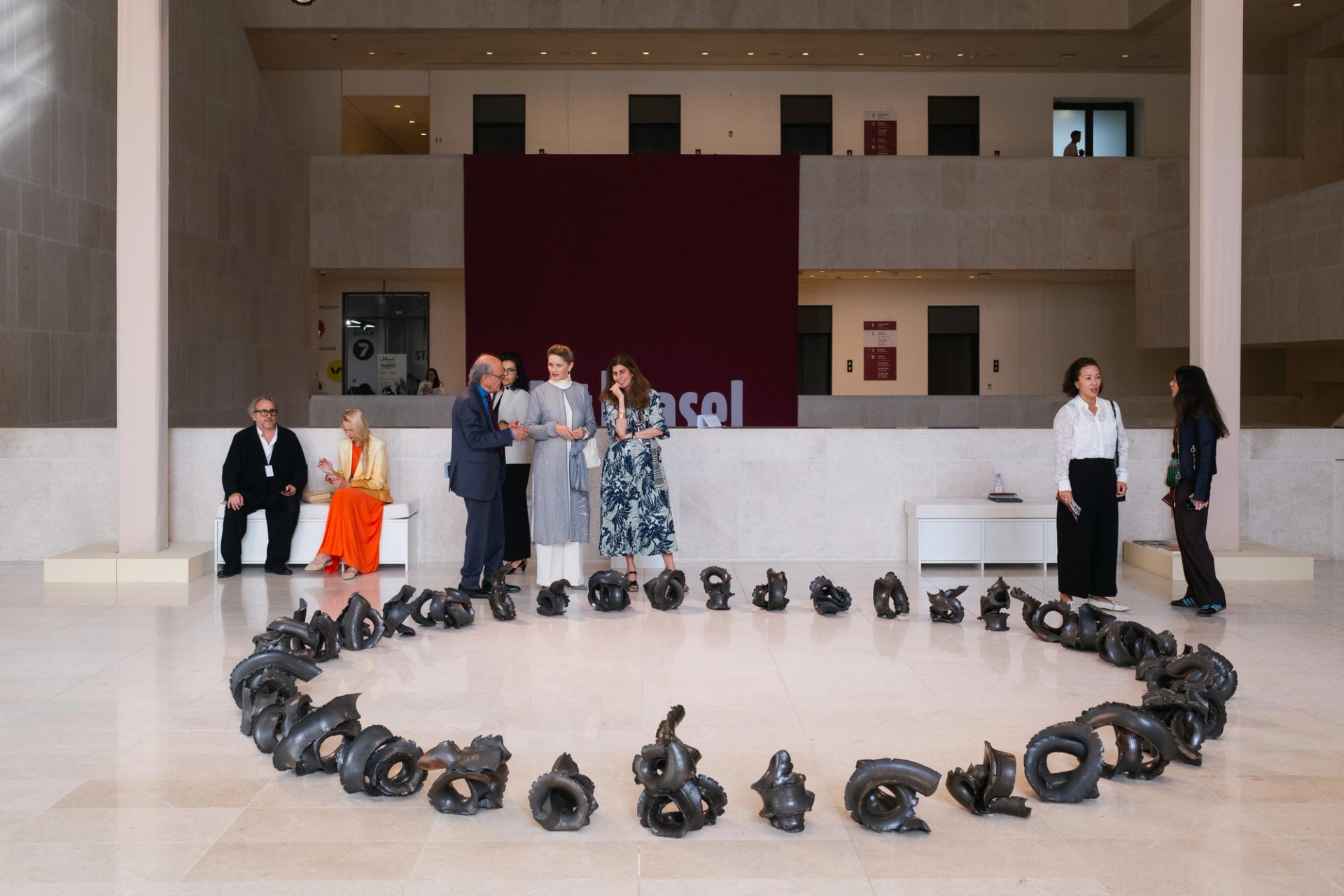
Pace's presentation of a Lynda Benglis sculpture
Courtesy of Art Basel
Among the works sources say Qatar Museums has reserved are a Marlene Dumas painting of an Israel-Palestine border wall, brought by David Zwirner for around $10m, and the entire presentation of sculptures and paintings by Olga de Amaral at Lisson, priced between $600,000 to $2m.
“The work brought to the fair was effectively preselected to be here, so we’re pretty confident,” said Pace's president Marc Glimcher on the opening afternoon, sat next to a Lynda Benglis installation of ceramics arranged in a large circle. “And the Saudis are coming on Thursday. I suspect many galleries will be happy.”
Nonetheless, the priority given to Qatar Museums at this fair has led to reports of disgruntled private collectors unable to access prime works at the opening, raising questions as to how sustainable its reservation system is if it deters visitors from future editions.
Certainly, one concession appears to have been made to larger galleries and their clients in the form of a private viewing room, which is filled with high-value works including a Yayoi Kusama pumpkin sculpture, brought by Victoria Miro, and a Picasso brought by Acquavella, reportedly worth upwards of $40m.
However, “it’s about who will return to the second edition”, says Victoria Miro’s director Glenn Scott Wright. “Lots of people come to the first edition out of curiosity and sometimes don’t return.”
Buyers from the first day were predominantly regional private collectors, as well as museums from the US, Europe and Asia. The global dealership Mendes Wood DM sold two earth paintings by Solange Pessoa, one to a museum in the US and the other a Dubai-based foundation, and Nature Morte from India placed a $50,000 edition of its Imran Qureshi weaving installation to an Asian museum. For those allowed to bring wall-based works by market darlings, sales came quick: VeneKlasen (the rebranded successor to Michael Werner gallery) has sold most of its stand of Issy Wood paintings, priced between $160,000 to $180,000 “to new private buyers from the region,” Gordon VeneKlasen says. Numerous stands with more conceptual works however, like Rashid Rana’s photomontage of an Israeli airstrike in Gaza, shown at Mumbai gallery Chemould Prescott Road, have not yet found buyers.
For many from the region, the fair is a welcome rebalancing act. “At other major art fairs the global majority is the minority, here it is different,” says Samy Ghiyati, the co-founder of NG advisory. One of Ghiyati’s clients he has brought to Doha represents a key target demographic for this fair: a young regional collector not yet engaged with the Art Basel brand. Hiba Nesr, whose Nesr Art Foundation in Angola supports Middle Eastern and African art, says she “came to Art Basel in Switzerland once before, but there was nothing for me there". In its Qatar edition however, “this region is central, not peripheral”.
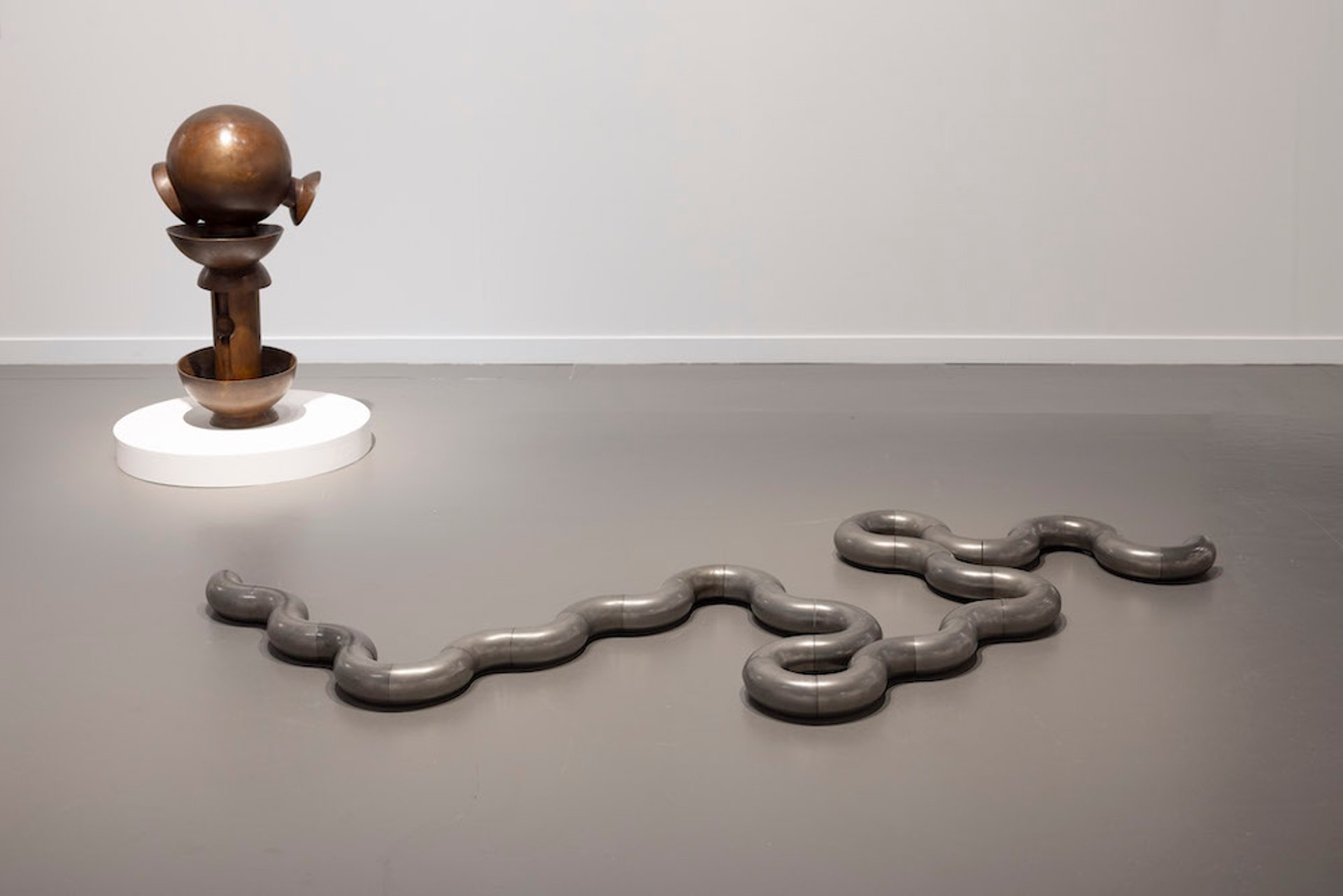
Sculptures by Amir Nour, brought by Lawrie Shabibi
© Estate of Amir Nour. Photo: Ismail Noor of Seeing Things. Courtesy Lawrie Shabibi
The push for institutionally focused solo presentations helps to counteract assumptions that this fair could be a goldrush moment for Western galleries hoping to cash in quickly on the region’s considerable wealth. Nonetheless, more than one visitor noted that works offered on the private market in the past months are now being sold at Art Basel Qatar with significant mark ups.
The Dubai-based adviser Salma Shaheem, however, feels such anxieties are now a thing of the past. "The buying here is not a shopping spree, it's become a lot more considered in recent years. After the success of the first edition, I have no doubt its organisers will build on what they started, fostering a collector base that will echo in the market and bring in new audiences."
Indeed, though its first edition has only just begun, many are speculating as to what the future holds for Art Basel Qatar. Asmaa Al-Shabibi, whose Dubai gallery Lawrie Shabibi gallery is showing a standout presentation of bronze sculptures by the late Sudanese-American artist Amir Nour, says that Art Basel must continue to cater as a regional fair and "remain accessible”, which is important in a nascent collecting environment.
Virtually all local voices encourage patience and long-term investment into this small but promising market, a sentiment apt in Doha where a gentler pace to life is observed. “Qatar’s strategy is a very successful one. It doesn’t rush the process,” Shaheem says. Certainly, as is evidenced by its impressive and expanding institutional framework, Qatar is capable of playing the long game. How many dealers are willing, and can afford, to wait?