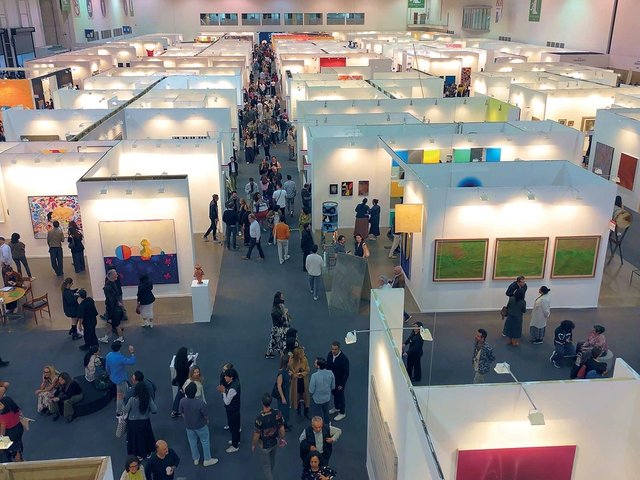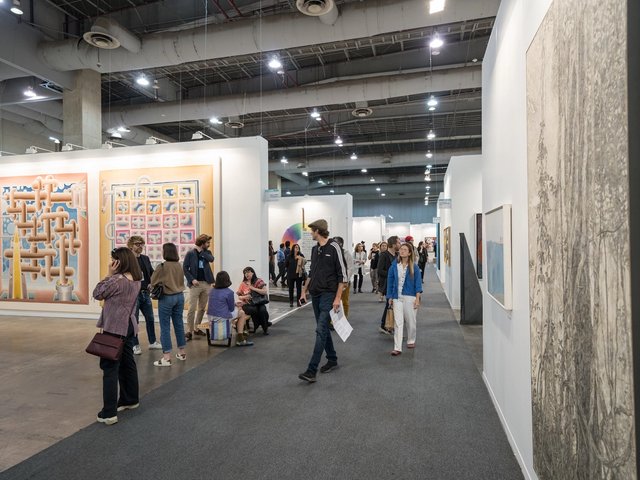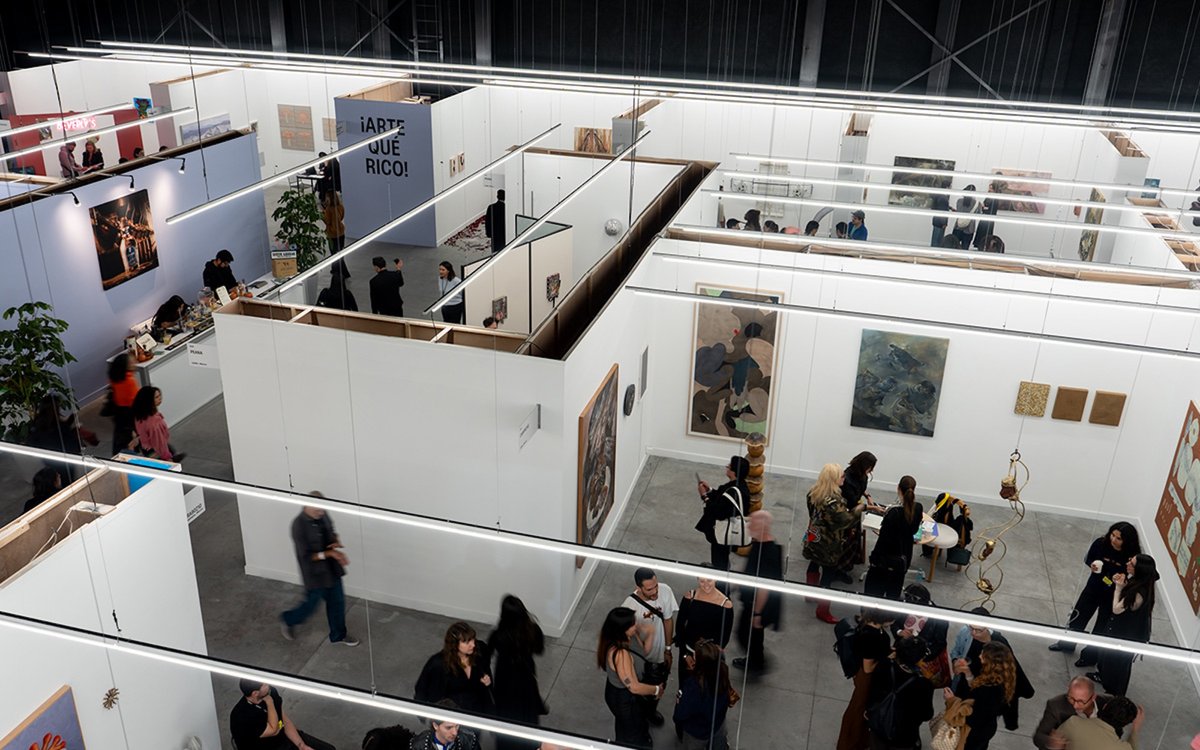
Mexico City Art Week’s foremost satellite fairs, Salón Acme and Feria Material, attracted thronging crowds of collectors, curators and art-curious visitors during their respective VIP previews on Thursday (5 February). Material reported its biggest opening-day crowd ever—helped in part by a move to a more expansive venue, Maravilla Studios, with large outdoor common spaces—and a long line formed outside Salón Acme within a half-hour of the preview’s opening as its picturesque venue, Proyectos Publicos, reached capacity almost instantly.
“The new venue has allowed us to develop the experience of the fair—it lends itself to being more of a destination,” Brett W. Schultz, the co-founder and director of Material, tells The Art Newspaper. The fair features over 70 exhibitors this year, with an especially strong contingent of Mexico City galleries that, like Material, have been around for a little over a decade. “We really want to represent galleries of a certain generation from Mexico City.”
Schultz adds that around half of this year’s participating galleries are from Latin America, with the rest from North America, Europe and Asia. “A lot of our galleries from the US, Europe and elsewhere are being very deliberate in thinking about the artists in their programmes who have connections to Latin America, whether through their family’s heritage, the type of work they make or the materials they use.”
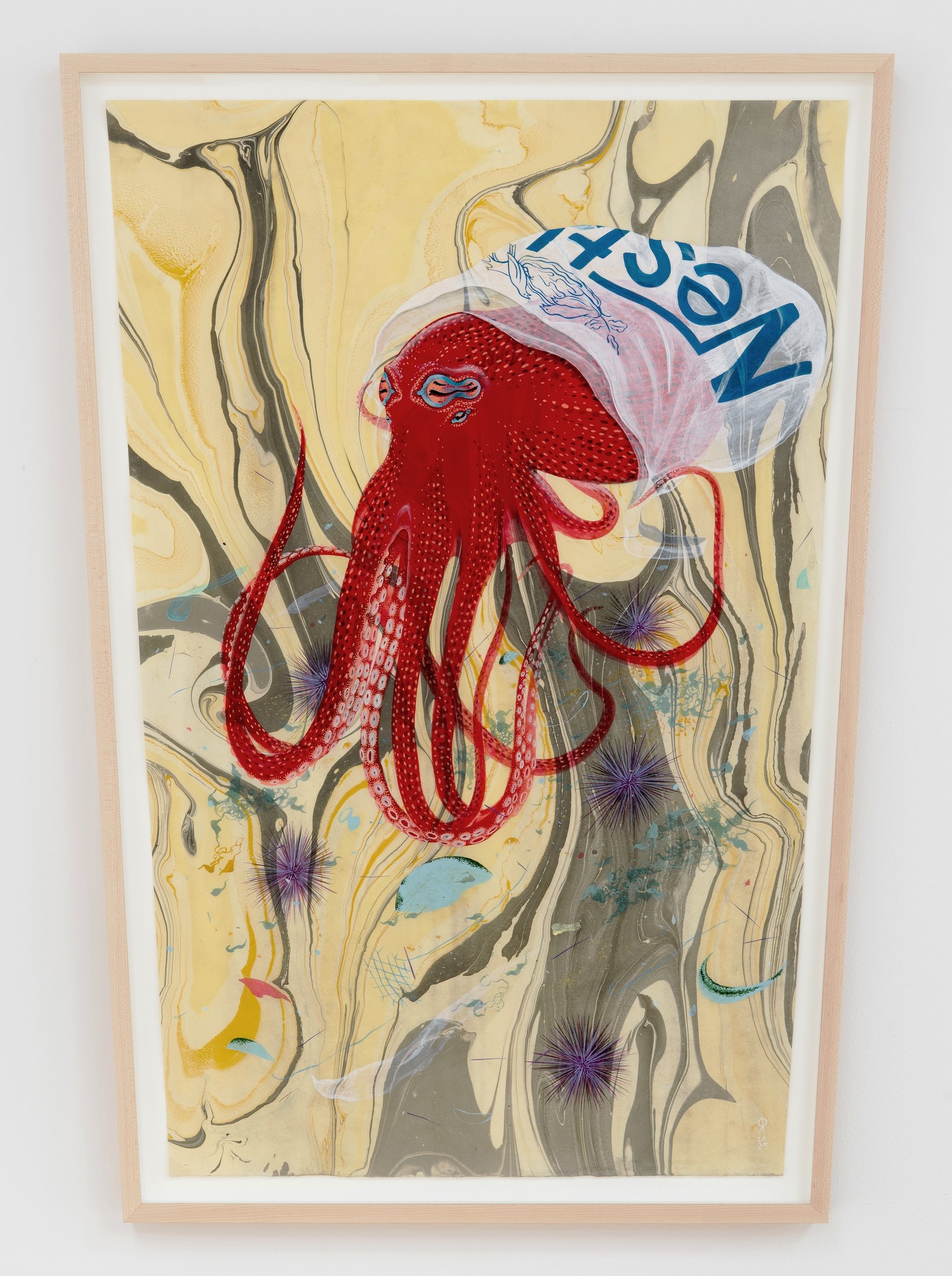
Rajni Perera, Nest (Phylogeny Series), 2025 Courtesy of the artist and Galerie Hugues Charbonneau
The Montréal-based Galerie Hugues Charbonneau, for instance, has devoted its stand to a solo presentation of works on paper and sculptures by the Sri Lankan Canadian artist Rajni Perera. The works on paper from her Phylogeny series, priced at $16,000, depict animals adapting to increasingly toxic environments, from developing additional eyes and limbs to making use of the trash littering their habitats—touching on legacies of environmental exploitation, colonial control and displacement that resonate with the histories of Mexico and Latin America more broadly.
“Rajni is interested in the colonial history of European explorer-scientists going into other environments and taking specimens without understanding their impact,” says the gallery’s director Hugues Charbonneau. “She is also looking at the style of illustrations and displays in the natural history museums where those specimens often ended up—how they portray nature by attempting to define and control it.”
The stand of the Buenos Aires-based Galería Nora Fisch features two artists wrangling with related questions, about environmental degradation and scientific attempts to safeguard against it. Gala Berger, an Argentine artist currently based in Mexico City, makes hybrid works incorporating collaged elements, ink and digital printing on traditional amate paper. The works on the stand depict peppers and anthropomorphised seeds inspired by the Svalbard Global Seed Vault, the facility on a remote Norwegian island safeguarding samples of the world’s seeds in the event of global crop failure.
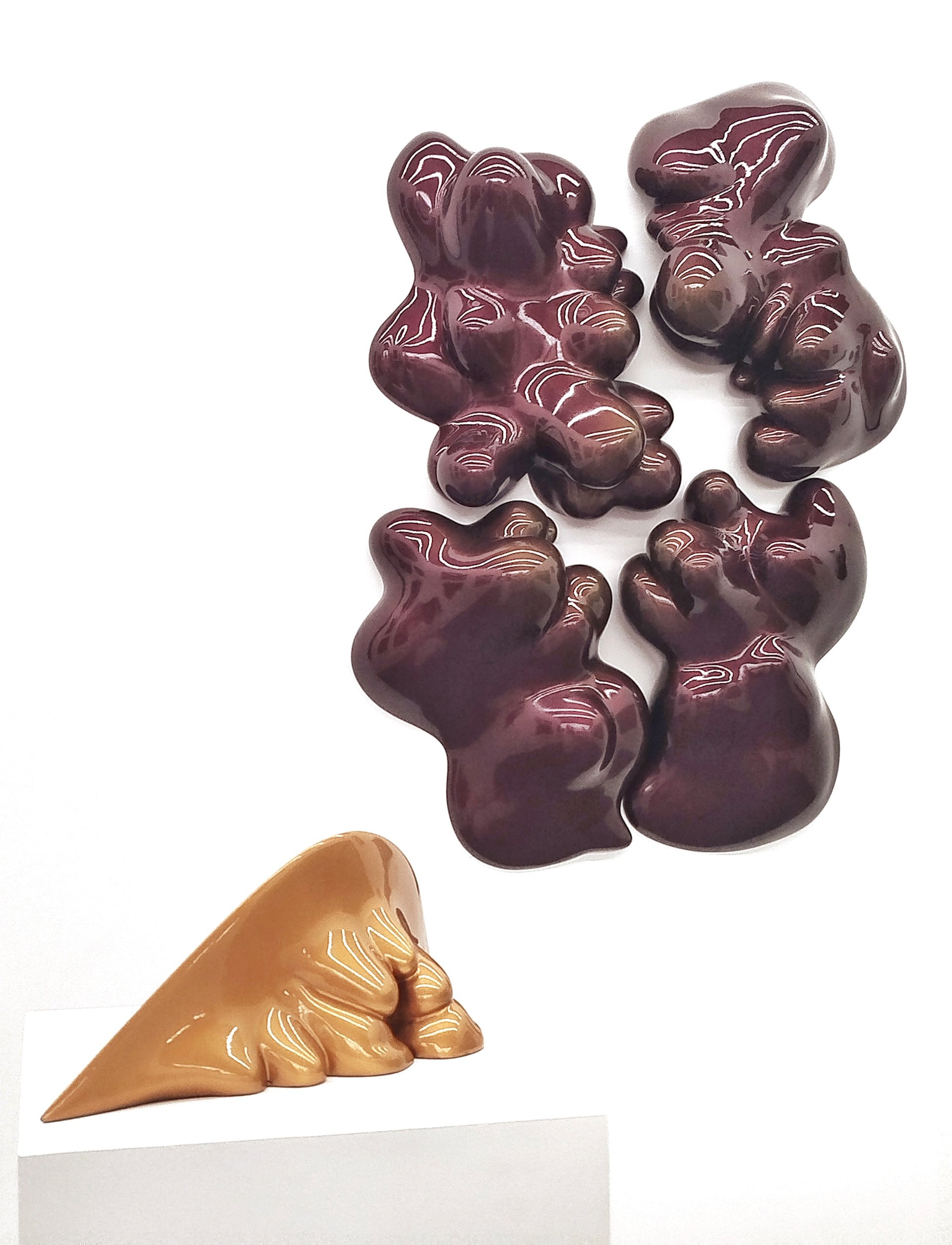
Works by Miguel Harte on the Galería Nora Fisch stand at Material, including Sin título (2026, upper right) and Aleta II (2016, foreground) Courtesy Galería Nora Fisch
The Argentine artist Miguel Harte, meanwhile, envisions a natural environment thoroughly overwhelmed and transformed by synthetic materials in his works on the stand. They feature exquisite surfaces of opalescent enamel and polyester resin that are interrupted by abscesses, growths and orifices, or seem to have sprouted bulbous pockets enclosing small natural dioramas. The works meld the glossy aesthetics of Finish Fetish artists like Billy Al Bengston with the abject grotesques of Paul Thek.
“Both Gala and Miguel are making art about nature, but it’s a nature in crisis,” says Nora Fisch. “Miguel is one of the most important Argentinian sculptors, but he has not received the international attention he deserves, which is why we are showing his work here.”
Nearby, the stand of the influential Mexico City gallery Llano is anchored by two large works on canvas depicting responses to environmental and political crises. The Hidalgo-born artist and film-maker Tania Ximena created the large diptych El Bosque I y II (2025) based on her research in a coastal region of Mexico where communities have been displaced repeatedly due to drought and flooding. Her landscapes of red, green and orange are punctuated by white tree trunks, a reference to the saltwater infiltration that is killing off the region’s vegetation. The 12-panel painting at the centre of the stand is Consejo Mayor (2024) by Giovanni Fabián Guerrero, an artist from the self-governing community of Cherán in Mexico’s Michoacán de Ocampo state. It depicts members of the community's council of elders overlaid with medicinal mushrooms used in the region.
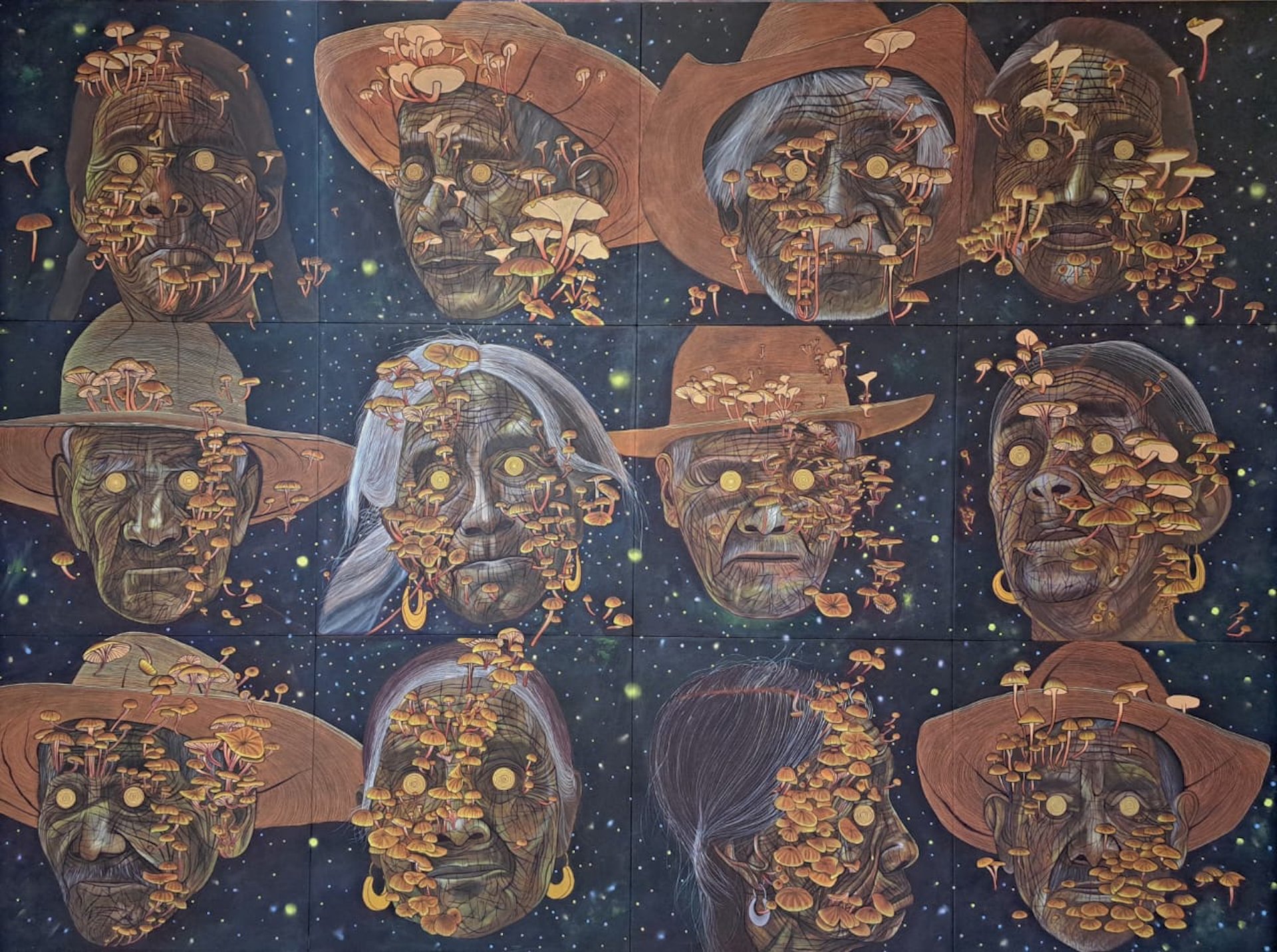
Giovanni Fabián Guerrero, Consejo Mayor, 2024 Courtesy of the artist and Llano, Mexico City
“Cherán has a strong street art culture, and Giovanni is part of a generation who came of age just as Cherán achieved independence, so his work is partly informed by his experience of creating street art at this pivotal moment for his community,” says Sergio Molina, a co-founder of Llano. Works on the gallery’s stand, which includes eight artists in all, are priced between $5,000 and $25,000.
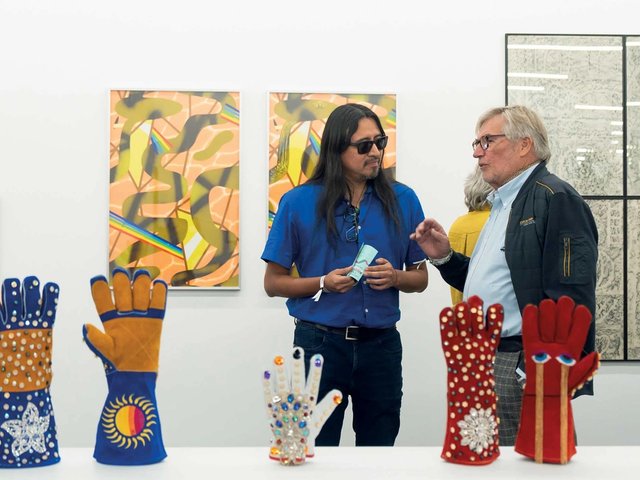
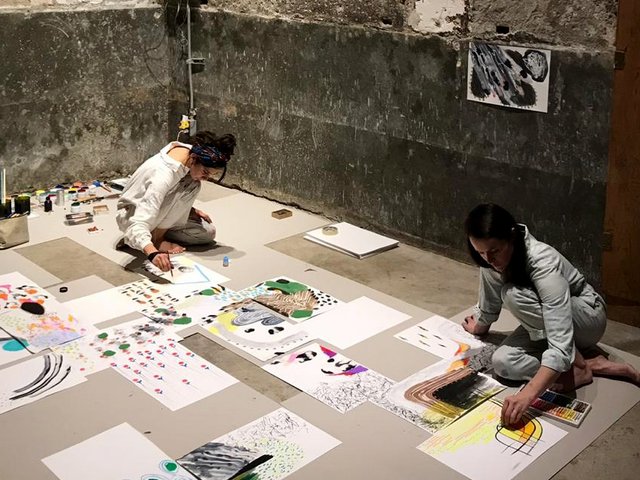
In Material’s Proyectos sector—which pairs emerging Mexican art spaces with mentors who help develop their programmes—the Oaxaca-based curatorial project Cimbra is showing Mano de Obra (Labour), a thematic presentation featuring works by Blanca Gonzalez, Guadalupe Vidal, Marco Velasco Martínez and Jysus Ramírez that address construction work, real-estate development and their impacts on the environment. Vidal’s wall-mounted sculptures, for instance, evoke half-finished or dilapidated concrete construction and are embedded with drawings depicting landscapes before and after they are developed. Martinez’s sculptures, meanwhile, render water vessels in wire and paper, reflecting the fragility of water resources.
“These artists are exploring topics like territory, identity and destruction in ways that are both beautiful and difficult,” says Nidia Rosales, one of Cimbra’s three founders. “Progress is not the same for everyone—not everyone benefits from what is done in the name of progress.” Works on Cimbra’s stand are priced between 20,000 and 50,000 Mexican pesos ($1,160-$2,900).
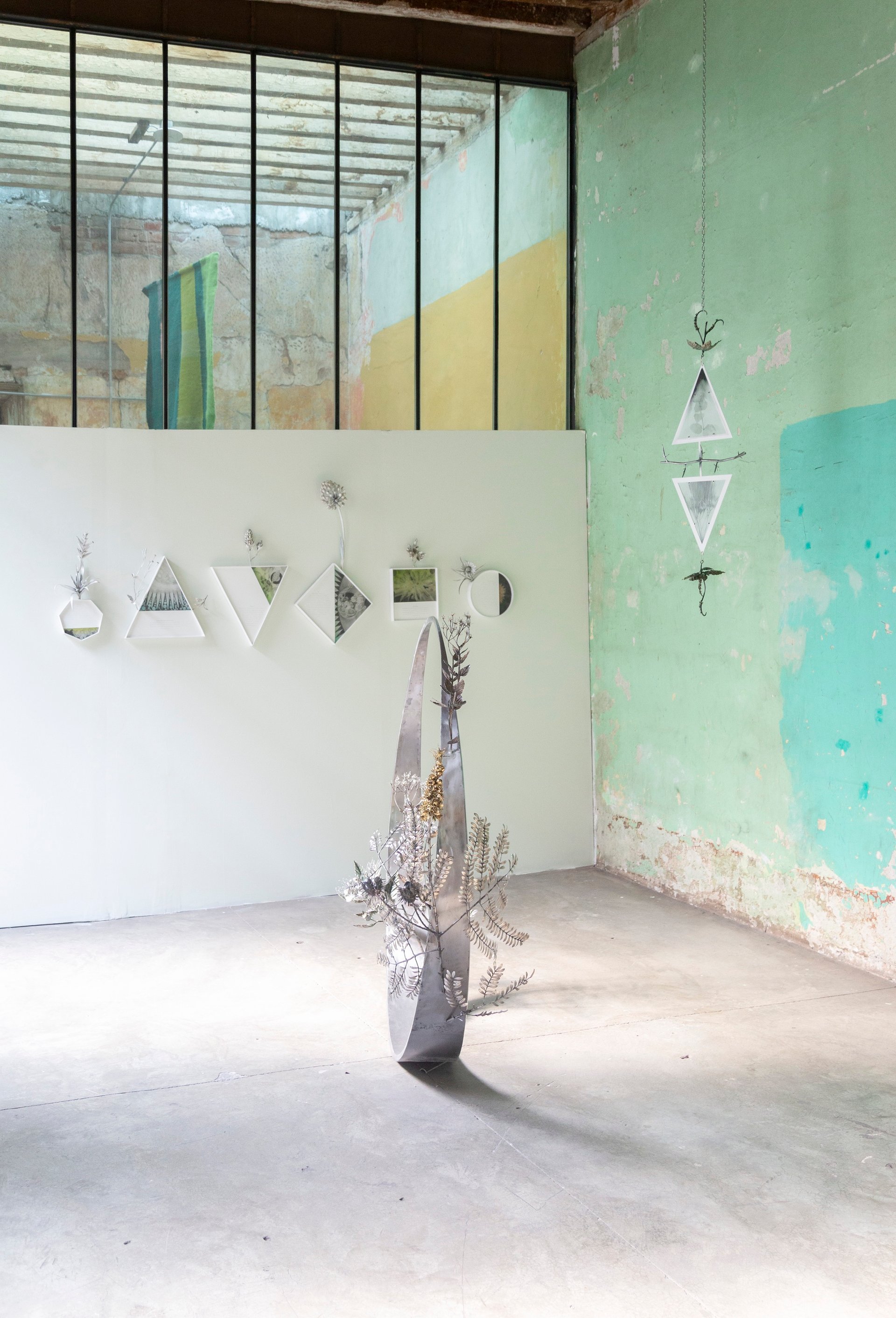
Saenger Galería's room at Salón Acme, with works by Juan Carlos León Courtesy of Salón Acme. Photograph by Alum Galvez
At Salón Acme, one of the stand-out presentations is by Mexico City Art Week’s hardest-working gallery, Saenger Galería—which also has joint stands at both Zona Maco and Material with the Kyoto-based gallery Cohju, plus pop-up projects at Casa Gilardi (by Gregor Hildebrandt), Museo Dolores Olmedo (by Yoab Vera) and Casa de Arte Limantour (a group exhibition). At Acme, the gallery is showing a solo presentation of works by the Ecuadorian, Mexico-based artist Juan Carlos León. His sculptures and works on paper depict plants used in rituals known as abrecaminos, intended to either create new possibilities or bring negative experiences to an end.
Works on view range in price from $2,200 for smaller wall-mounted works to $12,000 for the large metallic sculpture sprouting plants at the centre of the room. “This large circular piece, Objeto de monte para Abrircaminos, is a spiritual and botanical portal that for the artist represents a path into abundance,” a Saenger staffer explains.
Salón Acme is itself a kind of path to abundance, with art tucked into most available spaces in its photogenically dilapidated colonial-era mansion venue. The showstopping installation by the Mexican artist Enrique López Llamas in its main atrium, I Am the Resurrection and I Am the Life (2026), is a playful, monumental riff on art historical depictions of the crucified Christ. The suspended, deconstructed figure includes a spine made of giant cigarettes, pouncing dogs for legs and a face made up like a harlequin. The fair’s State sector, devoted to a different region of Mexico each year, is spotlighting artists from and based in the country’s fourth-largest city, Puebla, and curated by Nina Fiocco.
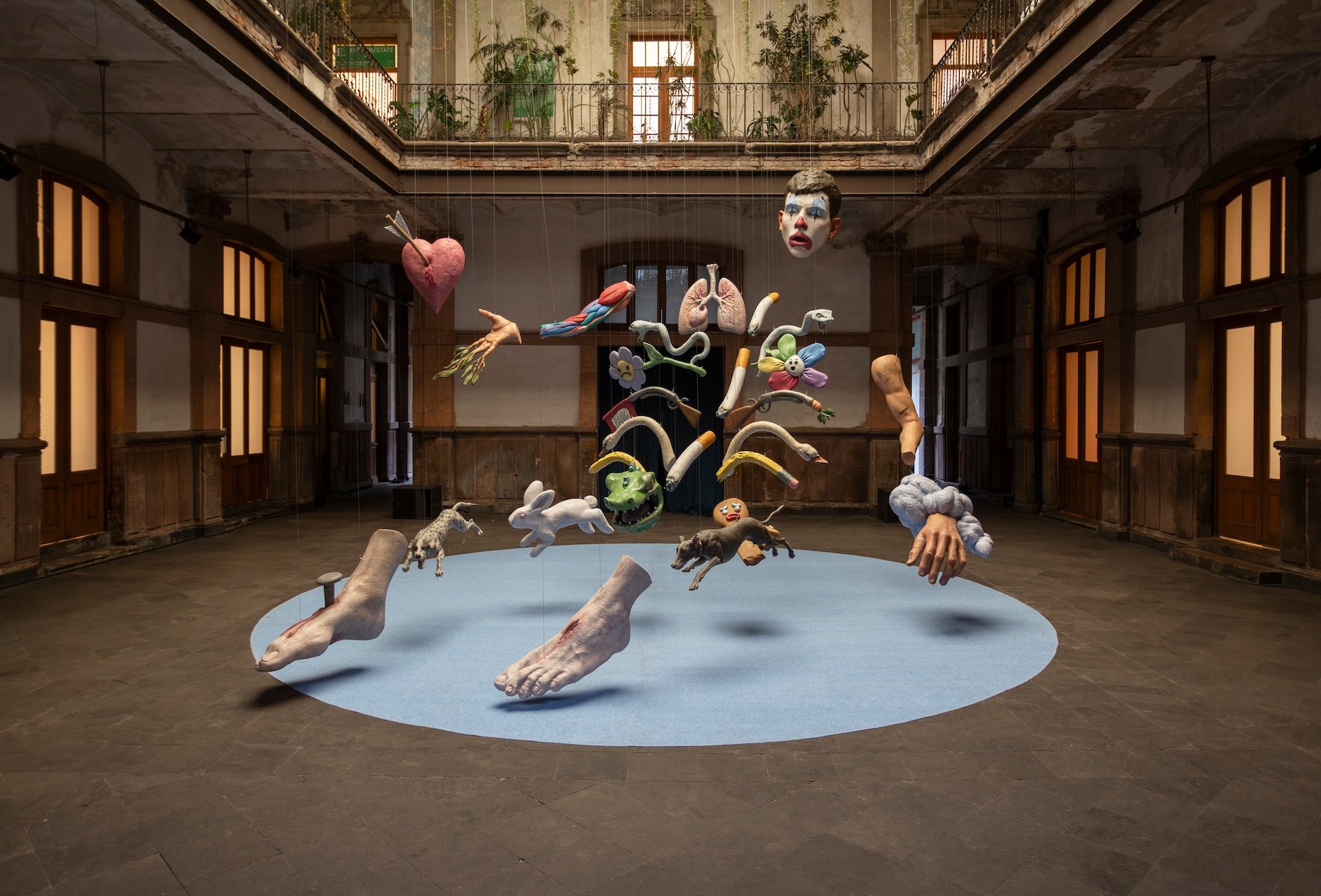
Enrique Lopez Llamas's I Am the Resurrection and I Am the Life (2026) installed in the Patio space at Salón Acme Courtesy of Salón Acme. Photograph by Alum Galvez
The trademark Open Call sector features 82 artists this year, and the fair’s director Ana Castella decided to move it to the first rooms most visitors encounter. “This is the first year I was really involved in Open Call,” Castella says. “This is really the main section, I felt it was important to make it more prominent.”
For Castella, the continued success and growing popularity of Mexico City Art Week in general and Salón Acme in particular comes with challenges, like how best to balance the enormous influx of visitors with the interests of curators and collectors.
“More and more, art fairs are about creating experiences and building community as much as they are about acquiring objects,” Castella says. “Experiencing art in a convention centre is sometimes necessary, but the experience does not contribute anything, you don’t remember it. But if you go to see art in a venue that has character, that can enrich the experience of the work.”
She adds: “Still, it’s important that the art professionals can come to Salón Acme and connect with the work. The audience from North America in particular keeps growing, and they are our exhibitors’ main clients.”
- Salón Acme, until 8 February, Proyectos Publicos, Mexico City
- Feria Material, until 8 February, Maravilla Studios, Mexico City