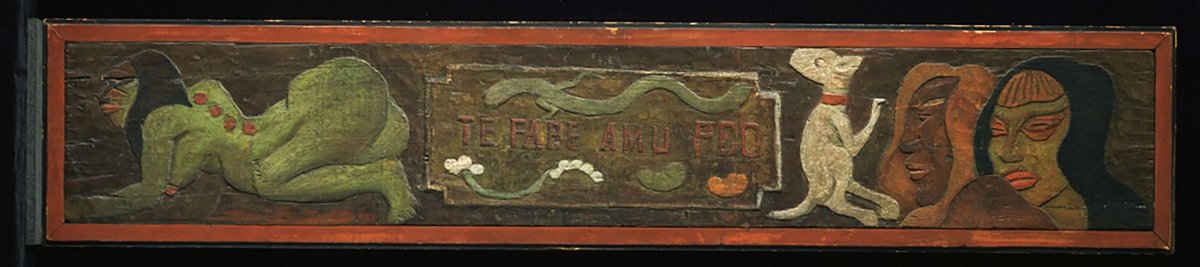
An erotic sculpture by Paul Gauguin, partly painted over in order to import it into the US in the 1950s, is now likely to be transformed again through conservation work. This would involve removal of later overpaint on the figure of a naked woman, to expose the artist’s original image and colour palette. The polychromed wood panel, inscribed in Tahitian Te Fare Amu, is a promised donation to the Brooklyn Museum in New York.
The crouching woman was carved in relief on the left side of the panel. Gauguin painted her body green, but coloured the genitals red. When the American collector Henry Pearlman bought Te Fare Amu in Paris in 1954, he disguised the oversized genital area with green overpaint to avoid the work being seized by US customs as obscene. In his published reminiscences he wrote that he believed the Gauguin sculpture was “quite sensual” and would need to pass through US customs, “which could have refused admission on account of its indecency”.
Painting or sculpture?
The sculpted relief of the panel is so shallow that Lynda Zycherman, a conservator at the Museum of Modern Art (MoMA) in New York, once suggested that it could be “thought of as a painting on wood rather than a relief sculpture”. This makes it even more of an issue that some of the artist’s original vermilion paint has been hidden. She criticised the overpainting as a “serious editorial suppression of Gauguin’s original concept”.
The inscription Te Fare Amu is generally translated as “the house of eating”, although Pearlman insisted on naming the sculpture The House of Joy. As he explained, the sculpture included the “image of a prostitute, with her genitals exposed and red buttons running up her spine denoting passion”. These were the thoughts of the collector, not necessarily those of the artist.
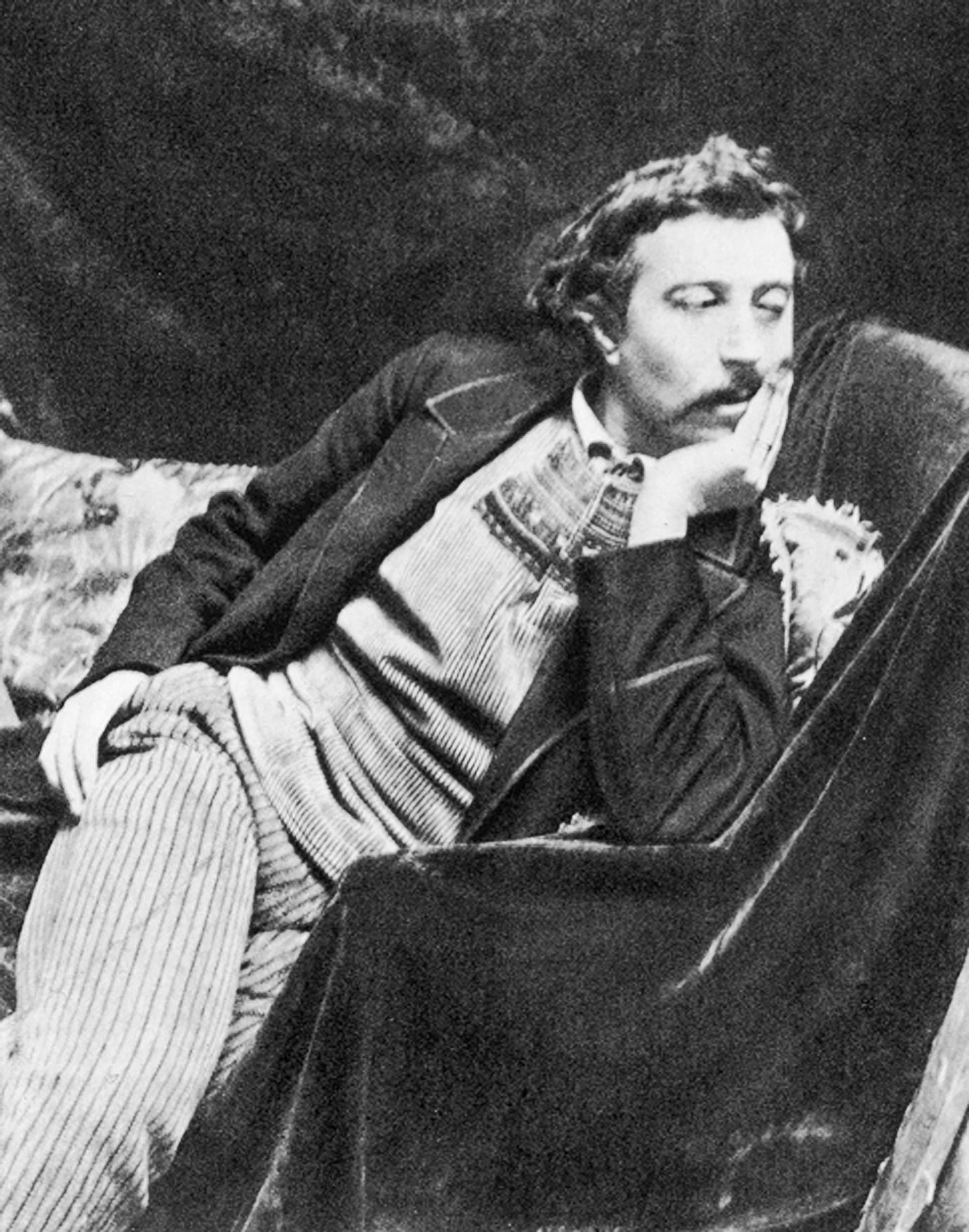
Gauguin, whose attitude towards women and Polynesian people has been criticised
Photo: Louis-Maurice Boutet de Monvel
Up until then the sculpture, owned by a French private collector, had been considered quite acceptable. It was shown in Paris, at the Orangerie, in the prestigious 1949 exhibition that celebrated the centenary of Gauguin’s birth.
Te Fare Amu remained with Pearlman’s family foundation after his death in 1974. Last year it was among 63 works Pearlman promised as a donation to three US museums: the Los Angeles County Museum (Lacma), MoMA and the Brooklyn Museum. Brooklyn is due to receive 29 works, including Te Fare Amu (which the museum is translating as “the house for eating”). The loan is expected to be converted into a donation in October.
In 2017, when the sculpture had been lent to the exhibition Gauguin: Artist as Alchemist at the Art Institute of Chicago, it was examined by that institution’s conservators. Daniel Edelman, a grandson of Pearlman, tells The Art Newspaper: “The original red paint underneath had adhered to the added layer and removal wasn’t possible with currently available techniques. I am sure that this will be re-examined in the near future.”
Removal of overpaint ‘will be looked into’
Now that Te Fare Amu is being acquired by the Brooklyn Museum, the removal question will indeed be reconsidered in the light of the latest techniques. A museum spokesperson says that they “will be looking into this with our conservation team”.
The sculpture went on display in late February at Lacma, in the exhibition Village Square: Gifts of Modern Art from the Pearlman Collection to Brooklyn Museum, Lacma and MoMA (until 5 July). It will then go to Brooklyn, for the opening of the travelling Pearlman collection show there on 2 October. Brooklyn’s conservators are expected to examine Te Fare Amu, with a view to removing the overpaint, after the exhibition.
A closer look at Te Fare Amu
Gauguin carved and polychromed Te Fare Amu to place it above the entrance to his hut in Polynesia. Its date has been subject to discussion, with most specialists now believing that it was done in either 1895 or 1897, when the artist lived on the island of Tahiti. Some think that it dates from 1901 or 1902, following Gauguin’s move to Hiva Oa, in the Marquesas Islands. They cite Gauguin’s comment in his Hiva Oa manuscript Noa Noa that “close to my hut there was another: the “fare amu (house for eating)”. Hopefully the curators and conservators at the Brooklyn Museum will soon be able to research the dating.
Carved in a rough style on sequoia wood, and nearly 1.5m wide, the text “TE FARE AMU” is followed by “PGO”, an abbreviation for Paul Gauguin. The artist enjoyed the fact that in French these letters would be pronounced “pego”, a slang word for penis.
As with so much of Gauguin’s art, the message of the sculpture is ambiguous, with layers of meaning and no simple interpretation. Gauguin has been widely criticised for his attitude towards women and Polynesian people and culture. Even so, his art is complex and open to varying interpretations. Beneath the text “TE FARE AMU”, Henry Pearlman thought there was a foetus, which “grows into a serpent and then a tadpole”. He saw the white animal as representing “perfidy”. Next to it is a male face with long red hair (signifying a European) who might represent the artist, although with some Polynesian features.
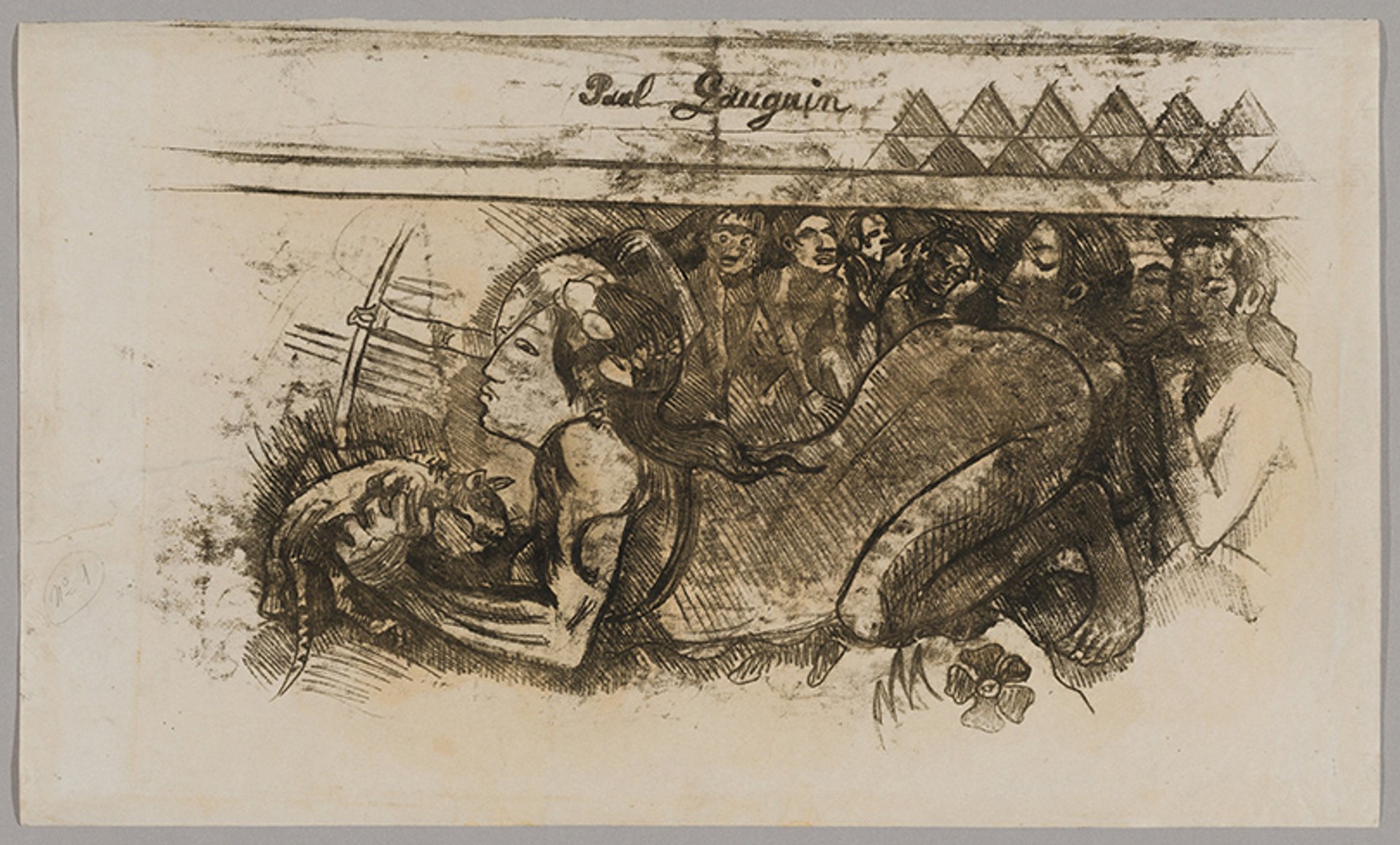
Gauguin’s drawing Woman with a Cat (around 1900) also features a crouching female figure
Courtesy of the Art Institute of Chicago
As for the colouration, Pearlman recalled a visit to New York by the sculptor Jacques Lipchitz. Discussing Te Fare Amu together, the two men felt that Gauguin had added red genitals to balance the red lips of the Polynesian woman on the far right of the carving.
In its content, Te Fare Amu seems to have more to do with lust than food, which raises questions about the title. It has much in common with Gauguin’s decorative wood panels for his Maison du Jouir (house of joy), which he carved in 1901-02 for his hut on Hiva Oa. These other panels are now at the Musée d’Orsay, which translates Gauguin’s “jouir” as “sensual pleasure”.
Some Gauguin specialists have suggested that the crouching woman was inspired by Polynesian sculpture. A rare example of this subject survives at the British Museum, where the wood carving of a naked figure (probably Hawaiian but possibly Tahitian) is described as a device to serve as a stand for holding a spear or a fishing rod. The image of a crouching woman also appears, once again with a serpent, in a Gauguin drawing: the sphinx-like Polynesian female in Woman with a Cat (around 1900), which is now at the Art Institute of Chicago.