An investigation has revealed the vast scale of human remains held in British museums and universities, prompting criticism from politicians and scholars and raising the question of whether mummies should be displayed in galleries and exhibitions.
The investigation by The Guardian found that more than 263,000 items of human remains are held by 241 museums, universities and local authorities across the UK, including skeletons, skulls, bones, mummies and other body parts. Of these, around 37,000 are known to originate from overseas, many from former British colonies, while the provenance of thousands more remains uncertain.
Meghan Backhouse, the chair of the Museum Ethnographers Group (MEG)—which acts as an interface between museums and community stakeholders—told The Art Newspaper: “The significant number of ancestors held in UK museums is extremely distressing and symbolic of the colonial origins of these collections. We hope that the responses gathered by The Guardian will be shared with the relevant communities to support them in bringing their ancestors home.”
Members of the MEG, Backhouse says, include curators and other museum staff who see the need to undertake culturally appropriate care for the remains and prioritise their return home. She adds: “In order to undertake more of this work with the level of care and respect required, the sector urgently needs funding for training, research and physical return.”
The figures were compiled from freedom of information requests sent to institutions nationwide. Due to incomplete records and complex cataloguing systems, researchers say the total number of remains, and the number of individuals represented, is likely higher.
Origins of remains
About 63% of remains originate from the UK, largely from archaeological excavations, but tens of thousands come from Africa, Asia, Oceania and the Americas. Among the remains identified from outside Europe are more than 11,800 from Africa, 9,500 from Asia, 3,200 from Oceania, and smaller numbers from North and South America. Many were collected during Britain's colonial period, often without the consent of the individuals or communities involved.
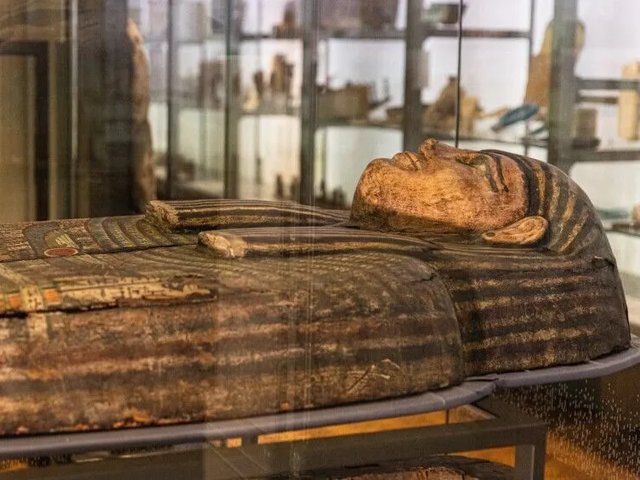
The investigation adds to growing international debates about the display of human remains, such as mummies, in galleries and exhibition spaces. Last year Manchester Museum invited visitors to give their opinion on whether it should continue to display the mummified remains of an Egyptian woman, Asru. Of the 8,000 individual responses, the results indicated a “pretty evenly split” vote between those in favour and those against.
Egyptian-born Heba Abd El Gawad, senior curator of anthropology at the Horniman Museum and Gardens in south London, told The Art Newspaper that such decisions should not be made by public poll.
“The Egyptian community of descent continues to be excluded from decisions about how our ancestors are treated, while museums instead survey the public about whether they would like to see them on display.
"The wishes of the dead in ancient Egypt are not unknown or speculative. Egyptian funerary texts, tomb inscriptions, and burial practices make this abundantly clear: the mummified body is sacred and secretive should remain intact, protected, and undisturbed so that the person could safely continue their existence in the afterlife.
She says that Egyptian mummified ancestral remains represent one of the largest and most violent displacements of human remains in history. “Tens of thousands of our ancestors were removed from their tombs, traded, studied and displayed as curiosities in museums.” She adds: “For many Egyptians today, they remain sacred beings. Displaying them while disregarding the known wishes of the dead robs both the ancestors and their descendants of dignity.”
Georgina Young, head of exhibitions and collections at Manchester Museum, said that the public consultation is one element of a wider review that includes consultation with Egyptian diaspora communities in Manchester and people in Egypt.
"As a university museum, it’s part of our purpose to create space for thinking in public. By better understanding public sentiment, it allows us to meet people where they’re at, especially when communicating changes to policy and practice, creating deeper connections between our communities and our work. That way, we can approach changes with transparency, not only about the future direction of the museum but the harm it has done in the past," Young adds.
New legislation needed
The findings have prompted criticism from MPs and archaeologists, who say the retention of such remains raises ethical questions for museums. Dan Hicks, curator and professor of contemporary archaeology at the University of Oxford, told The Art Newspaper that this needs to be a wake-up call for the government to take action.
“Today the time for secrecy over these literal skeletons in the closets is over,” he said. “The general public and descendant groups alike now need transparency about what, or rather whom, is being held at taxpayers’ expense so long after any scientific justification for retaining human tissue without consent have been debunked. It is only through openness, accountability and public scrutiny that the urgent work of finding dignity for human remains taken under colonialism, returning the dead where possible, and rebuilding ethical curatorial practice will progress.”
Politicians including the Labour MP Bell Ribeiro-Addy and the former cabinet minister Lord Paul Boateng have urged the government to establish a national register of human remains in museum collections and to strengthen rules governing their treatment and potential repatriation. The Human Tissue Act 2004, the primary UK legislation focused on the retention of human remains, specifies that only body parts over 100 years old can be kept without permission.
The Natural History Museum in London holds the largest collection of non-European remains with approximately 11,785 individuals, followed by holdings at the University of Cambridge and the British Museum.
A spokesperson for the Natural History Museum said: “We always acknowledge that the museum was founded within the context of empire, colonialism and exploration, and, as a result, the hallmarks of this legacy exist in our collections.”
They added: “To date, our trustees have agreed to return 580 individuals to countries including Australia, New Zealand, Zimbabwe and the USA. The museum has not refused to return any remains for which connections have been established with requesting communities and places of origin.”