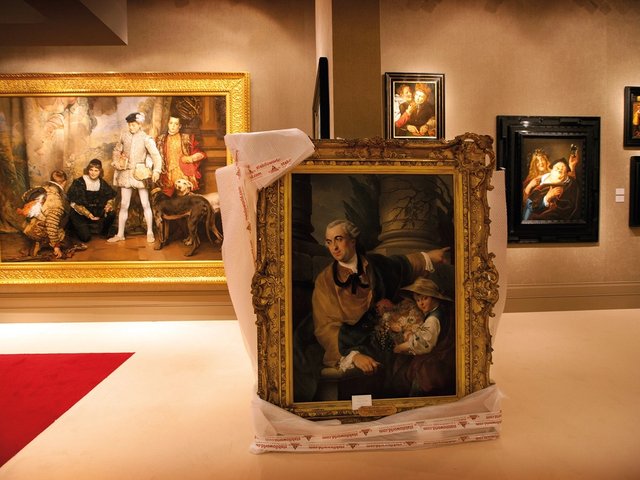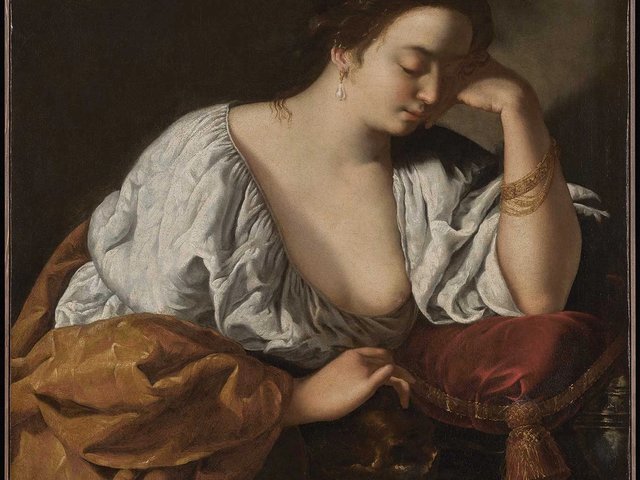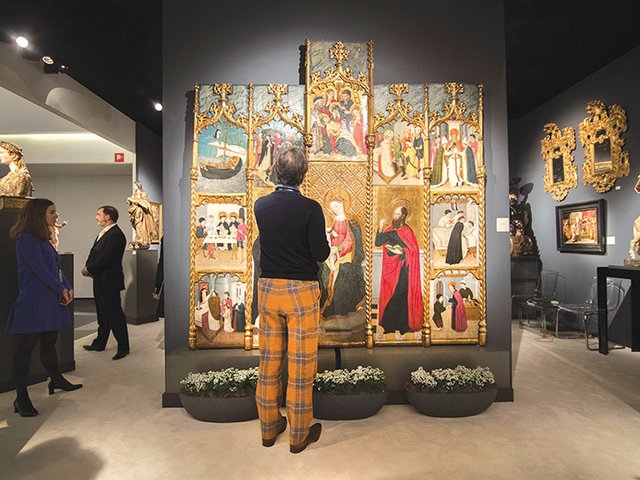
Tefaf is mostly sitting very pretty this year. Amid market uncertainty and a volatile environment for the industry’s many fairs, the Maastricht stalwart has been going for nearly 40 years and is back in favour as one of the art world’s favourite hunting grounds.
Its broad range of objects that stretch, organisers say, 7,000 years, creates a conversely niche event—there are not many art fairs that do what Tefaf Maastricht does—and the fair is gradually becoming the discerning choice for contemporary galleries with strong 20th-century secondary material. Meanwhile, the slower, more deliberate pace of today’s art market seems to match Tefaf’s sweet spot of Old Masters hits. What could be a better backdrop than Christie’s sale of a Michelangelo drawing for $27m in February?
Tefaf’s own politics do not yet match the mood, however. Its latest leader, Dominique Savelkoul, came in last year promising a more stable direction as the fair’s fifth managing director in four years and following a tumultuous period, including through the Covid-19 pandemic. Her tenure did not last the year though, so it is back to the drawing board to find someone to oversee this venerable event.
“It would be more ideal to have a settled team in place, but in the end, the team below [the managing director level] is largely unchanged and it is still a very well-run fair,” says the London-based dealer Stephen Ongpin, a view echoed by many of Tefaf’s exhibitors. Stuart Lochhead, the sculpture specialist who sits on the fair’s small executive committee, adds that, while the management shuffles “haven’t held things back”, it is “essential to get someone in place who stays”.
Business as usual
In the meantime, the show goes on. The fair, with its 276 exhibitors (including five shared stands), will follow the usual format, with all dealers still on its plush ground floor, and the mezzanine dedicated to museum partners, VIP lounges and restaurants including Michelin-starred seafood. There are tweaks to the floorplan, for example the Showcase section, for younger, emerging dealerships, is at the back of the fair after a foregrounding moment last year.
A loose theme this year is making sure that the medium of photography is “not just a bit part” says Will Korner, Tefaf’s head of fairs. He highlights works by Robert Mapplethorpe (with Galerie Thomas Schulte) in this year’s more centrally-zoned Focus section for solo stands, as well as a shared stand by the rare books dealer Daniel Crouch and the photography specialist Michael Hoppen, which matches antiquarian maps with cityscapes by the contemporary Japanese photographer Sohei Nishino.
At the time of writing, announced highlights go back more than 4,000 years. Gisèle Croës has a Neolithic painted pottery jar from China, including a humanoid head as a handle, which dates from around 2200BC-2000BC (£120,000) while Charles Ede brings a statuette of a male official, made in wood in ancient Egypt’s Middle Kingdom (around 2055BC-1911BC, €38,000). Also among the eight Ancient art specialists is London’s David Aaron, whose highlights include a delicately carved, rare Greek tomb stele of an unwed woman of marriageable age (see the Wishlist, p8) as well as a curiously calming Egyptian limestone baboon (664BC-343BC, £280,000).
Other gems include a collier (necklace) of eight tourmalines, including one at 68.85 carat, created by the Australian jewellery designer Margot McKinney for her debut at Tefaf last year. Titled Bloem, it has since been worn by Helen Mirren when the actress received her Cecil B. DeMille Award at the Golden Globe awards in January (price on application).
Less wearable, but still precious, is an early Cologne-produced manuscript on vellum that tells the lives of 18 saints, including a page of portraits arranged genealogically. The diagram neatly stands up the claim that Saint Servatius, the patron saint of Maastricht, was related to Jesus Christ, through Mary’s aunt, Esmeria. Called the St. Pantaleon Legendarium (around 1140-80), it will be exhibited by Basel-based Dr. Jörn Günther Rare Books, priced at SFr1.6m ($2.1m).
As ever, Tefaf Maastricht remains a hotspot for 17th-century Dutch paintings. This year these include a recently restituted and rediscovered work by the Antwerp Golden Age painter Jacob Jordaens, shown for the first time by the Belgian dealership Pelgrims de Bigard. The Return of the Holy Family from Egypt (around 1613), one of three known versions by the artist, was among the items stolen by the Nazis in 1940 when they occupied the Mechelen castle of the resistance fighter Joseph Scheppers de Bergstein, who later died in a concentration camp. The painting resurfaced in a cellar in Ardèche, France in 2022 and was restituted soon after to the Scheppers de Bergstein heirs. “There are too many cousins so they have decided to sell it,” says the dealer Cédric Pelgrims de Bigard. He has yet to price the painting, he says, though says it will be below the €800,000 level floated at the time of its restitution.
New resonance for Old Master
Pelgrims de Bigard also brings a meticulous grisaille by Adriaen van Salm, showing whaler ships in drifing ice around Greenland, an area “that resonates strongly with current events”, Pelgrims de Bigard says, adding, “It is quite rare for an Old Master work to connect to today’s news.” Van Salm’s Whalers in the Arctic (around 1712-15) is priced around €300,000.
Will Korner, Tefaf’s head of fairs © Maison Rowena
“We are finding exhibitors who want to show alongside Rembrandt and Rubens”
The fair’s prestige, and accompanying museum visitors, means that dealers secure or save the best for the halls of the Maastricht Exhibition & Conference Centre (MECC). This increasingly includes more recently made art. The Zurich dealer Larkin Erdmann, a Tefaf newcomer, brings an early painting by Paul Gauguin, Bouquets et céramique sur une commode (1886, around $6m). Painted before the artist’s transformative move to Tahiti in 1891, Erdmann says that the Breton work, with its blousy flowers, “already shows Gauguin as a colourist”. Erdmann, who also shows at Art Basel and Frieze Masters, says that the Gauguin comes “from a phenomenal Swiss collection and it speaks a lot of the fair that they are happy to have this at Tefaf Maastricht”.
Other 19th-century hits this year include an introspective Seated Bather plaster by Auguste Rodin, once in the collection of the sculptor’s patron Anthony Roux and shown for the first time at Tefaf Maastricht by Stuart Lochhead Sculpture (£120,000). Stephen Ongpin, among the 23 dealers in Tefaf’s Works on Paper section, brings Edgar Degas’s Volcano (Le Vésuve: Souvenir de Naples) (1890-92), priced around $450,000. The pastel on paper of a gently erupting volcano is in fact not Vesuvius, Ongpin says: “It was painted decades after he visited Naples, so is more of a ‘souvenir’”.
Ongpin’s stand errs earlier too, with an ink drawing by the Renaissance sculptor Baccio Bandinelli (1493-1560), an artist often overlooked thanks to being a contemporary of Michelangelo. “He was the second most famous sculptor in Florence,” Ongpin says. His drawings are making their mark on the market though, with The Descent from the Cross selling at Sotheby’s in February for $228,600 (with fees). Ongpin’s work—A Group of Eleven Putti at Play, priced at $85,000—is of a scene taken from a frieze by Donatello, but with Bandinelli’s own interpretations, including the introduction of a turtle.
Tefaf’s own adjustments to current taste have been a slow-burn at best—contemporary and Modern galleries were added to its roster as early as 1991—but seems finally to be paying off. The London gallerist Lyndsey Ingram shows in the main section this year, after her debut in Showcase last year, and is a huge fan. “It is the nearest you get to shopping in a museum—nothing else comes close. There are magnificent things, presented by dealers with serious consideration and an audience that appreciates it,” she says.
Frankenthaler prints mark a shift
Such heft, Ingram says, means the Helen Frankenthaler Foundation has released a series of prints made between 1979 and 1996 with the American master printmaker Kenneth Tyler. “[Frankenthaler] was an aggressive proofer and she often took impressions and reworked them,” Ingram says. Her intense work is evident in unique monoprints such as Spring Run I (1996, $182,000) which comes to Tefaf, as well as other artist proofs, lithographs and the full set of the Reflections series (1995, $120,000).
Tefaf’s Will Korner says that the fair “spends a lot of time courting the Modern and contemporary galleries. We are finding exhibitors that a lot of other fairs are judged on who also want to come and show alongside Rembrandt and Rubens.”
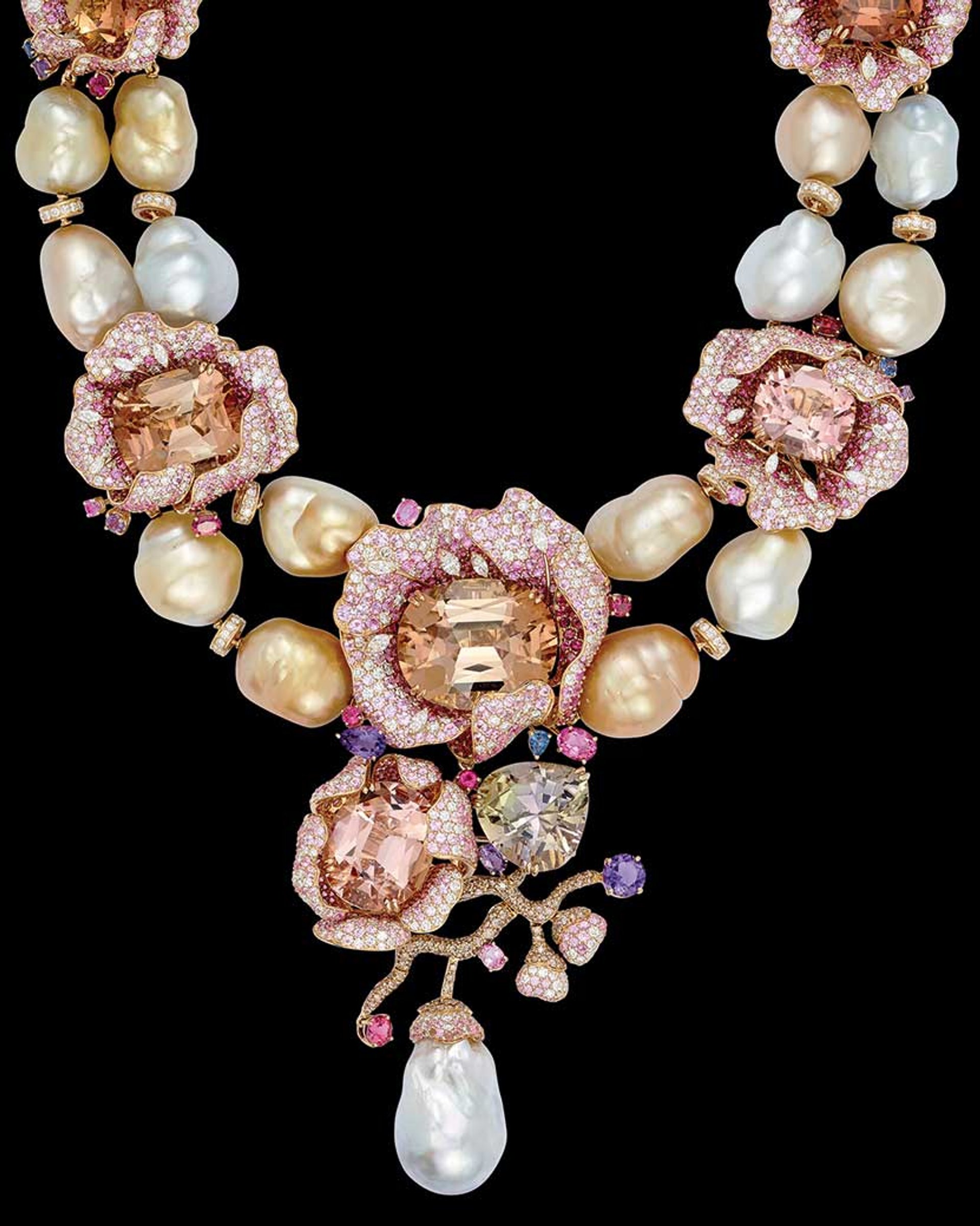
Bloem, a tourmaline collier recently worn by actress Helen Mirren, is for sale at Tefaf Courtesy Margot McKinney
Newcomer Alison Jacques is among those persuaded this year and has committed to Maastricht as well as Tefaf New York in May. Each event, she says, is “becoming increasingly important… they are top-end, quality, connoisseur fairs, with a touch of class.” Tefaf’s lengthy timeline “suits our cross-generational programme”, she adds. Her stand, in a prime corner slot in the centre of the fair, will include historical work by surrealists Dorothea Tanning—her swirling Déssaroi (disarray, 1962)—as well as by lesser-known Surrealists such as the Italy-born Bona de Mandiargues (1926-2000). Contemporary works on Jacques’s booth include Untitled (Woods) (2023), a sombre-toned gouache of a woman by a tree by the Scottish painter Graham Little (£35,000).
Boris Vervoordt, the chairman of Tefaf’s executive committee as well as an art and antiques dealer at his family’s longstanding gallery, says that welcoming the next generation of gallerists and their art is a vital plank to encourage younger visitors to the fair. “They bring their own audience… and are inspiring for future generations in the whole ecosystem, from conservators to collectors.” He finds that in-person events such as Tefaf, Maastricht are vital in an increasingly digital age, emphasising that these are not mutually exclusive phenomena. “The knowledge being built today, both artificially and regularly, helps everyone understand the past better.”
• Tefaf Maastricht, MECC, Maastricht, 14-19 March