There is no escape from the global consequences of climate change, but some countries are directly on the front line. With two thirds of its land less than five metres above sea level, the low-lying delta nation of Bangladesh is consistently singled out as one of the world’s most climate-vulnerable nations. According to recent research by John Hopkins University, rising sea levels could submerge 17% of its territory and 30% of its agricultural land by 2050, and this precariousness is ramped up by the fact that Bangladesh is one of the most populated countries in the world. And all this despite the fact that Bangladesh only contributes to a minute proportion of total global emissions.
The vulnerability of Bangladesh, the uniqueness of its terrain and the resilience of its population, together with the overarching links between natural disasters and social inequalities are all key subjects underpinning a show of paintings and drawings by Soma Surovi Jannat at the Ashmolean Museum in Oxford. Climate Culture Care is Dhaka-born Surovi’s first exhibition in the UK and is also the first solo exhibition of a Bangladesh-based artist to be held in a UK museum.
Mainly created following a residency at the Ashmolean during the summer of 2023, Surovi’s 20 or so paintings and drawings—in one case made directly onto the museum’s walls—draw their inspiration from Bangladesh’s extensive Sundarbans mangrove forest as well as from the collections of the Ashmolean.
Sundarbans—which translates to ‘the beautiful forest’—is a sprawling region shared between India and the south of Bangladesh that is laced by a network of river systems and is home to the world’s largest contiguous mangrove forest as well as a vast array of wildlife, including the endangered Bengal tiger. More than 13 million people also live in this World Heritage Site, where they are increasingly challenged by the evermore catastrophic symptoms of environmental degradation and climate change, most notably rising sea levels and resulting land salinisation. These pose a particular threat to the Sundari mangrove trees, the dominant species in the region, which have always offered essential protection for the Sundarbans with their intertwined roots forming a natural barrier against storms, as well as being able to sequester more carbon than most other tropical trees.
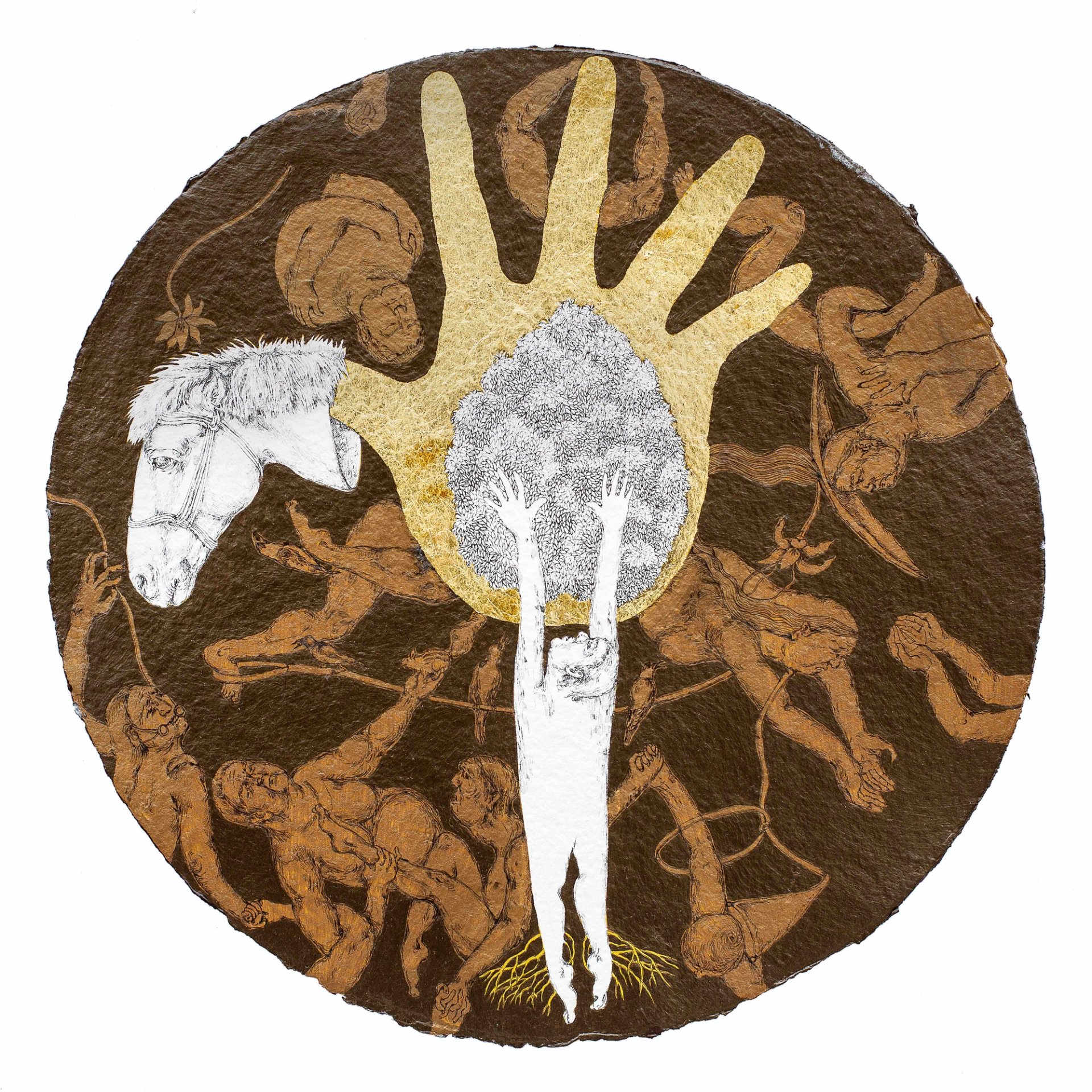
Soma Surovi Jannat's Who Carries Whom? (2025) Collection of the artist. © Soma Surovi Jannat
As well as featuring the trees of the Sundarbans, Surovi’s work is rich in both human and animal imagery and often fuses the two in distorted, exaggerated figures, set against fantastical, dreamlike backgrounds. At the Ashmolean the flora and fauna of the Sundarbans forest is made to mix and morph with images taken from its stories and cultural traditions in tumultuous and richly detailed scenarios. In a series of eight ink and acrylic works on paper titled Where Every Leaf Holds a Tale (2023-24), for example, each piece replicates the shape of one of the Sundarbans's now-shrinking archipelago of islands and sand bars. Across the surfaces of the works local creatures—from tigers to turtles, storks and shrimps—mingle and form odd alliances with folkloric figures such as Bonbibi, the region’s main forest deity, as well as humans and gods from the Hindu pantheon.
Throughout the show, a close examination of the Ashmolean’s collections—especially its holdings in works from Asia and the Indian subcontinent—is also strongly in evidence. In Surovi’s hands a terracotta plaque of a Yakshi (nature spirit) from the second century BC in the Ashmolean is reinterpreted as a giant, heavily pregnant Mother Nature figure who cradles a lifeless bird between her breasts while a mangrove shoot emerges from her navel and a roaring tiger is rammed between her legs. “Art, history and activism are deeply entwined… I am drawn to fragments—objects, memories, and landscapes—that carry traces of resilience, disruption or overlooked lives,” Surovi states in the exhibition catalogue. “For me each piece is a conversation across time, a way to honour what has been, and to imagine what might be.”
Throughout, Indian and Persian miniaturist techniques have clearly fed into the meticulous execution of her intricate crowds of cavorting, conjoined animal and human protagonists, while many of their forms show borrowings from specific pieces owned by the Ashmolean. These include a number of tumbling figures which owe their origins to an Indian gouache of street performers painted around 1790; and her menagerie of bizarre conjoined beasts, which corresponds to the grotesque inter-species creatures in a number of the Ashmolean’s 18th- and 19th-century Indian paintings.
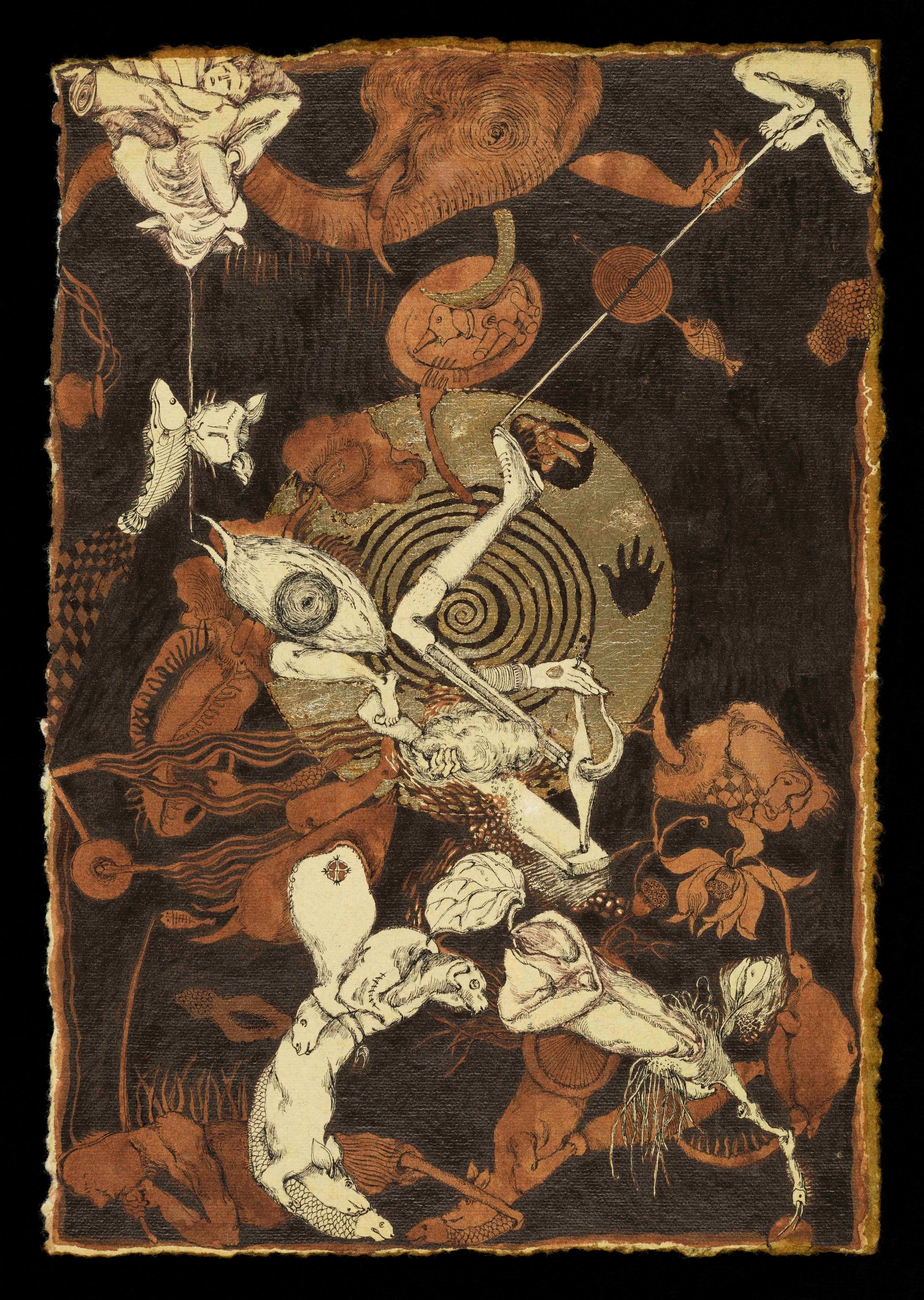
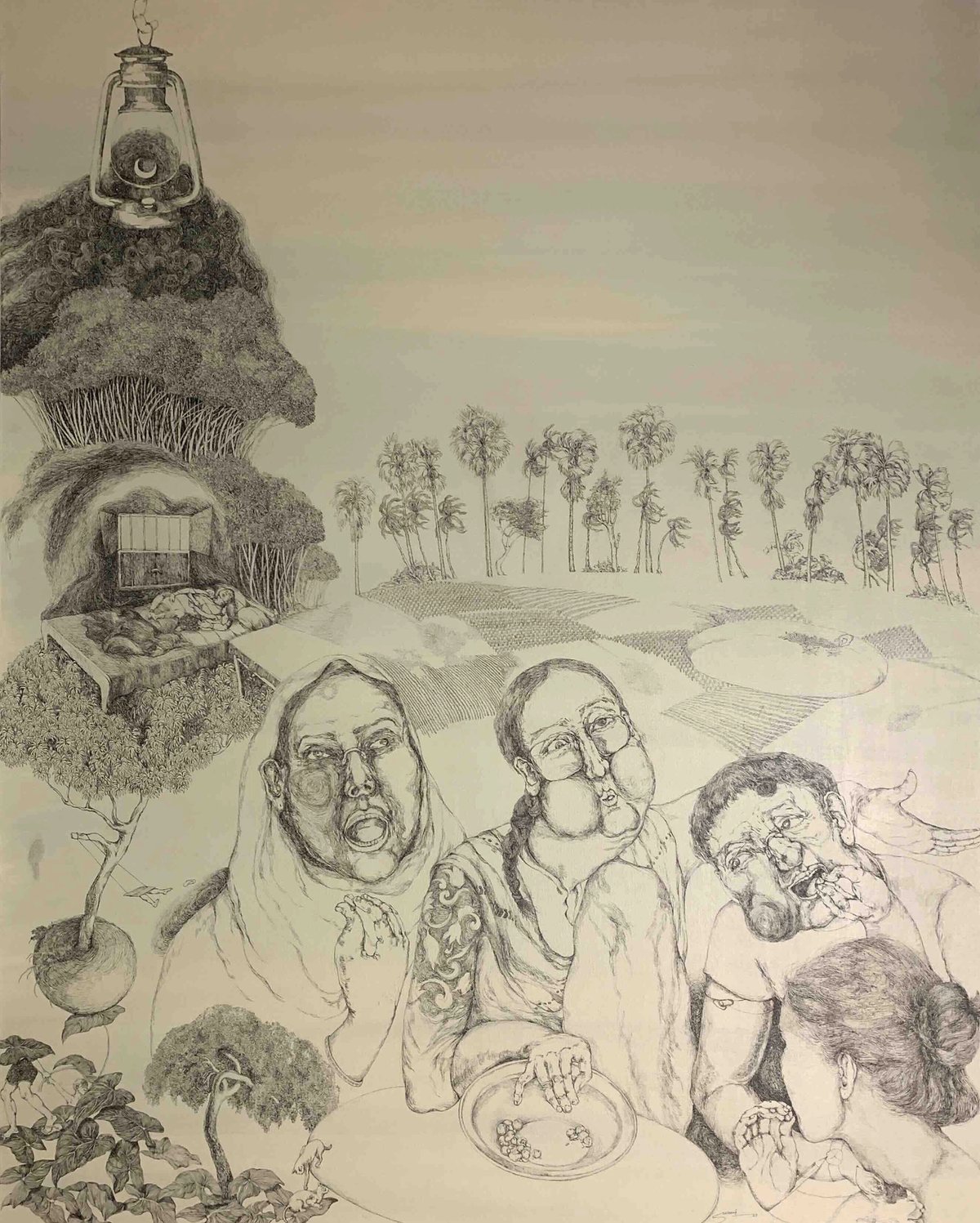
Soma Surovi Jannat's Resensitizing the Brown Narrative (2023) Collection of the artist. © Soma Surovi Jannat
Surovi’s stated commitment to “amplifying silenced voices and to creating spaces where difficult truths can be faced with honesty and imagination” is made manifest in unexpected ways. Recent Google Map images of the Sundarbans’s murky polluted waters played a key part in influencing the choice of the dark brown backgrounds and tawny hues of many of these works, but issues of racial and caste identity and demarcations of social status based on skin colour also had a part to play. This is made most explicit in the ink, acrylic and gold leaf work Resensitizing the Brown Narrative (2023) which, in both its palette of browns and contorted figures holding symbolic objects, was in great part influenced by the Ashmolean’s collection of 19th-century unfired clay models representing members of different Indian castes. These miniature figures—men, women, children all carrying out different occupations—were created in colonial-era India as ‘exotic’ souvenirs for the European market, and the 200 or so owned by the Ashmolean were originally exhibited in the Colonial and Indian exhibition in London in 1886, supposedly to showcase the British Empire and its colonised peoples.
The Ashmolean’s problematic collection of Indian archetypes of all ages, trades and religious groups from across the entire subcontinent also feature in Surovi’s epic 30ft-long scroll Between the Sea and the Sky, Who Holds the Ground? (2025). This ambitious work addresses issues of displacement and climate migration and also how South Asian bodies have historically been framed. In one section of the scroll, boats float on dark polluted waters, carrying a multitude of ordinary folk, inspired by the Ashmolean’s colonial-era figures. Here they are reimagined as refugees, carrying the tools of their trade and fleeing from the environmental changes that were invariably first set in motion by the extractive actions of colonisation.
Yet Surovi also sees these beleaguered individuals as personifying human fortitude and versatility in the face of the trauma of migration. Across her scroll some figures morph into bees, which in turn evolve into processions of ants, both, like their human counterparts, overlooked and often maligned but also utterly crucial to the health of an ecosystem. Finally, the stream of ants goes deep into the hidden but essential network of tree roots that in the Sundarbans sustains and nourishes every aspect of this unique environment. In this important show of complex and richly metaphorical works, Surovi is not only highlighting the richness and fragility of a very particular part of the world but reminding us how, from Oxford to Bangladesh, everything is interconnected. Nothing exists in isolation and consequences cannot be escaped. The sooner we realise this, the more hope there is both for the Sundarbans and the planet in general.
• Soma Surovi Jannat: Climate Culture Care, Ashmolean Museum, Oxford, 28 March-1 November