The woman in the poster—beautiful, confident and, it seems, just a tad blasé, her low-cut dress a miracle of ruffled pink glamour—has just turned away from us. She is holding a folded fan in her black-gloved right hand, while her left, as if equipped with a life of its own, crawls down the side of her dress. She could have sprung from one of the portraits of elegant ladies painted, around the same time, by John Singer Sargent, and yet, unlike those compliant sitters, she does not fully reveal herself. And for good reason. Created by Jules Chéret in 1891, the poster was never intended to be a portrait, let alone a work of art. Its sole function was to advertise the Alcazar d’Été Club at 8 Avenue Gabriel in Paris, where the woman in pink, the singer known as Kanjarowa, was the nightly attraction.
Illustrations are important not for what they are, but for what they refer to: a passage in a book, an event, a cultural or a natural fact. We do not admire them the way we would a painting in a museum. Instead, we read them, claims D.B. Dowd, a professor of design and American culture studies at Washington University in St Louis. In his aptly titled Reading Pictures, a sprawling 400-page history of the genre, Dowd lets illustrations tell their stories, from the first known example, the frontispiece of the Diamond Sutra in Tan China (AD868), to Molly Crabapple’s devastating pictorial reports from Gaza in 2015.
“Illustrator”, as a professional designation, first took hold in the middle of the 19th century, but Dowd takes care to emphasise continuities across cultures and centuries. Chéret’s poster, for one, would have been unthinkable without the xylography (a woodcut combining image and text) perfected by 17th-century printmakers in Japan. Looking ahead, Chéret’s fancy flappers (also called the Chérettes) irked the US painter Stuart Davis, a supplier of caustic covers for Max Eastman’s socialist magazine The Masses. Davis’s design for the June 1913 issue starred two women who were distinctly working class, their worn-out faces transcripts of hard-lived lives. Davis’s models—one shown from the side, her long neck accentuated by her open-necked striped blouse, the other facing us, eyebrows sarcastically raised—are fully aware of what is happening to them: “Gee, Mag,” reads the caption, “Think of Us Bein’ on a Magazine Cover.” A few decades later came an angrier variation on the theme, now from Vietnam. A poster by Duong Ngoc Canh, Look after the Land, Look after the Youth (1966), features a young Vietnamese girl wearing the checkered white and black scarf flaunted by the revolutionaries. She is carrying not a fan but a machine gun.
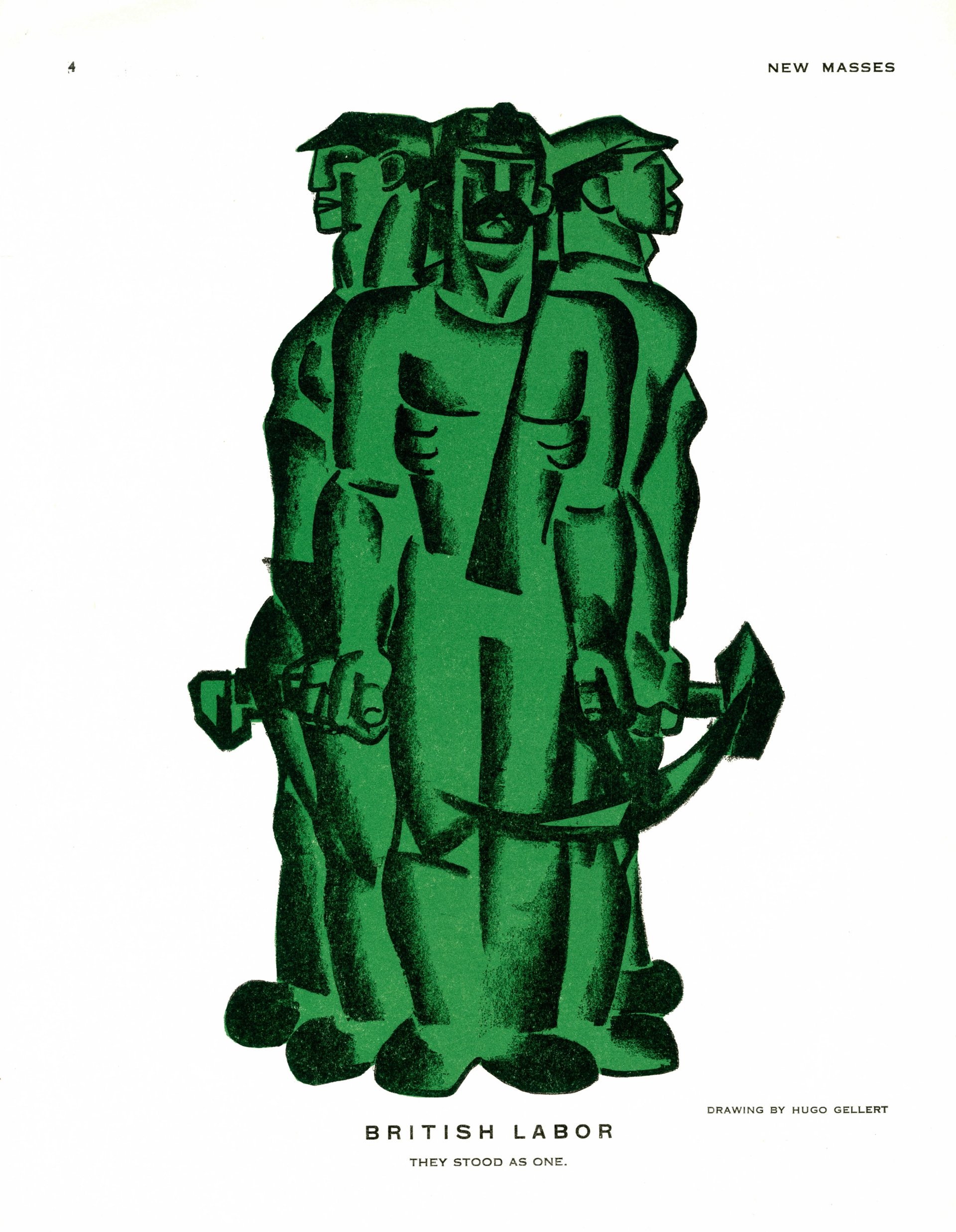
British Labor—They Stood as One, an illustration by Hugo Gilbert for New Masses magazine, June 1926 The Marxist Internet Archive
Japanese courtesans
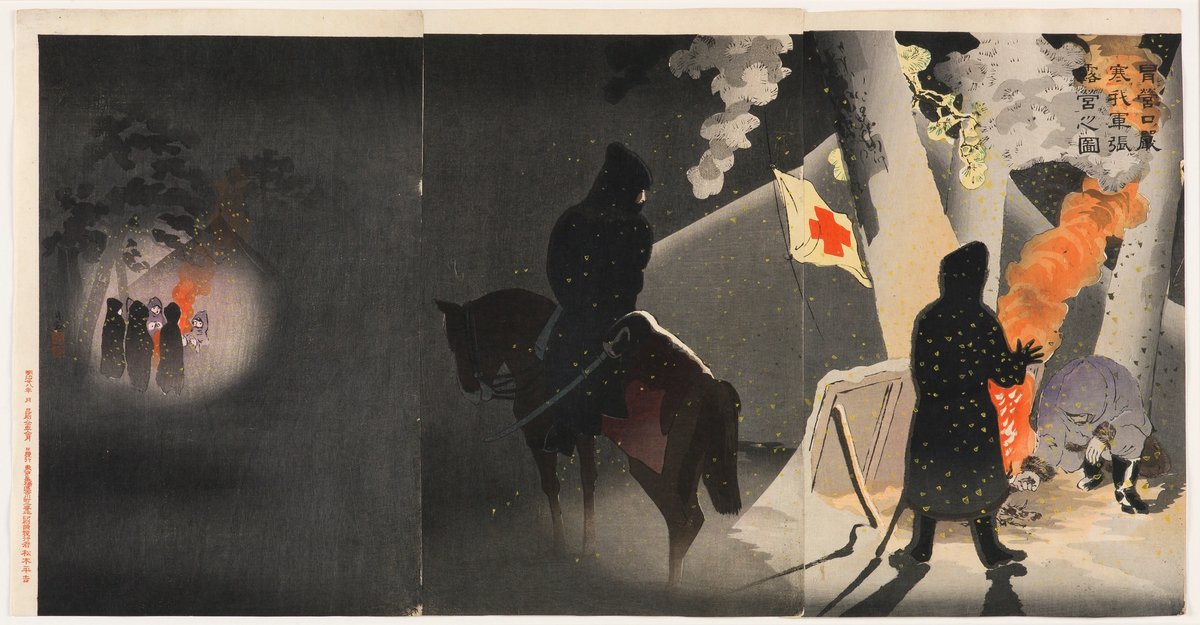
Long before the Chérettes bewitched Parisian passers-by, courtesans in 18th-century Japan, “celebrations of feminine fashion and beauty”, beckoned male customers from woodcuts sold in print shops. But Asian artists also produced sweetly intimate scenes, such as Wu Youru’s Wandering Eyes Giving Way to Wandering Thoughts, an ink drawing made for an 1890 Shanghai Pictorial (an illustrated newspaper supplement). Two courtesans are lounging on the balcony of their second-floor apartment. One is playing a lute, while the other leans over the railing to ponder two small birds perched on the power lines below: a wry comment on the collision, in modern city life, of the old and the new.
Dowd masterfully embeds his images in pages of cultural commentary, relating the steady expansion of the genre to the growth of literacy worldwide. He also offers trenchant observations on the ways in which illustrations have been abused for propaganda or profit. In the wrong hands, books for children proved convenient tools in spreading the seeds of racism. A 1938 Nazi picture book taught young Germans how to tell Jews from non-Jews by likening both to mushrooms. Which is the edible one? (Hint: it is not the one wearing the Star of David). Consumerist greed found an early outlet in advertisements, such as the shrine to customers’ desires created by the Mitsukoshi Kimono Store in Tokyo in 1920: a tower of shoes, teacups, cameras and clocks. The “varied colours and shapes,” writes Dowd, “invite the viewer to linger”, training them how to behave when visiting the store.
I enjoyed Dowd’s quirky captions even more than his lengthy overviews, which, given the vast amount of material they summarise, inevitably force him to simplify. (He repeats the old canard of Marx’s early antisemitism, which, at the very least, requires context). But when Dowd turns his mind to the images themselves, his prose always takes off, as in this humorous recreation of an illustrated scene from an early Japanese picaresque novel, Jippensha Ikku’s Footing It along Tōkaidō Road (1806). Two buffoons, Kita and Yaji, arriving at their inn after dark, stumble across what they assume is a sleeping maid on the floor. When she will not wake up, “Yaji leaps in a panic: A dead body!” The “maid” turns out to be a statue made for the local temple, “now with a broken nose”.
A glaring omission
As admirably comprehensive as Reading Pictures is, it neglects the rich tradition of natural history illustration. Just think of John James Audubon and Robert Havell Jr’s innovative life-sized aquatints of North American birds (The Birds of America, 1826-38) or Ernst Haeckel’s Art Nouveau-inspired plates of invertebrates, minuscule organisms of such astounding variety and ornamental sophistication that they seem to have come from an artist’s mind rather than nature (Art Forms in Nature, 1899-1904). These examples would have reinforced Dowd’s main point that we should not think of illustration as mainly service work or as inferior to real art.
Readers who continue to be sceptical of the genre might take a moment to sample a particularly fine specimen included in Dowd’s book, the hilarious 15 October 1951 cover of the Canadian magazine MacLean’s. Drawn by Oscar Cahén, it shows an artist at his easel amid a wildly Cubist landscape, a cascade of triangular and ovoid trees and trapezoid mountains. When you peek at the artist’s canvas, though, you discover a disappointingly conventional postcard view. Which cheekily suggests that a painter might get wrong what an illustrator gets right. Put differently, if you would like to see the world represented as it really is—jagged, crazy, in perpetual motion—turn to an illustrator.
• D.B. Dowd, Reading Pictures: A History of Illustration, Princeton University Press, 400pp, 400 colour + 24 b/w illustrations, $60/£50 (hb), published 21 April
• Christoph Irmscher is a critic and biographer