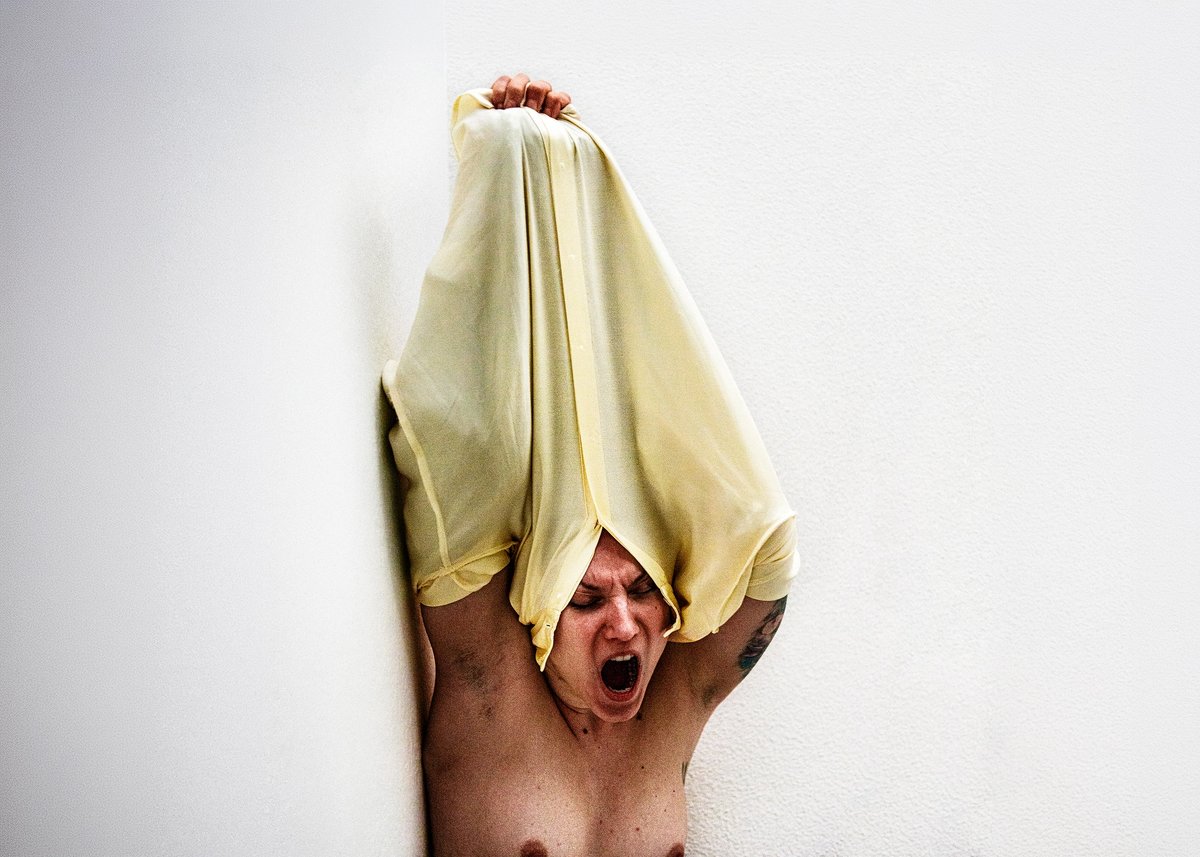
Opened in 1953 and designed by the iconic Dutch designer and architect Gerrit Rietvald, the Dutch pavilion in the Giardini is an emblem of modernity and openness. But for this year’s Venice Biennale, the artist Dries Verhoeven is turning that on its head, closing off all the windows and creating an intense performance work inside.
Born in Oosterhout in the southern Netherlands, Verhoeven studied scenography at the Maastricht Insitute of Arts. His works often combine performance and installation art, and implicate the viewer into what is happening. In his work Wanna Play? (Love in the time of Grindr), he placed himself in a glass room in the centre of Berlin and other cities, with his interactions with users of dating apps projected onto large screen. In another work, Guilty Landscapes, what appears to be a video of a sweatshop or a warzone turns out to be a live video link.
We spoke to the artist before the opening of the Biennale.
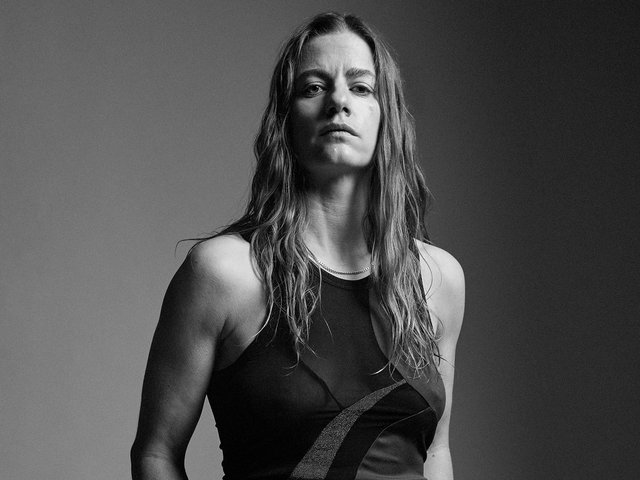
Dries Verhoeven Photo: Willem Popelier
The Art Newspaper: Can you start by telling us what you’ve done to the Dutch Pavilion itself?
Dries Verhoeven: We’ve placed a kind of veil of metal shutters over the building. It transforms what is normally an iconic, light-filled pavilion—something I see as a symbol of the post-war years—into a closed, bunker-like space. [It is] a representation of the Netherlands, or Europe, or the Global North as a space that is increasingly entrenched. And then every hour, about 100 people are allowed to enter and experience a performance in this ever-growing darkness.
So the transformation of the building is quite deliberate—a statement against its modernist ideals?
Yes. What inspired me was the building itself, and the Giardini as a kind of time capsule. It represents a bygone era—idyllic, optimistic and comfortable. But at the same time, you can see cracks in the structure, the patches of mould. The Dutch pavilion was built in the post-war years with the optimism and progressive ideals of that time. It is strongly associated with modernism and with the Netherlands as a forward-thinking, accessible, internationally engaged country—proudly representative of the “free West”. The open windows and the light that comes through them is related to that. It’s also a modernist building: this fairytale of the universal story, the neutrality that the white cube evokes. So the question is: how long do we still put on that coat that has more to do with the past than the here and now?
And what will happen inside?
Visitors will experience the gradual transformation of this building into a bunker-like environment. It might feel like you are part of the chosen ones on Noah’s Ark. It might also feel like prison, I don’t know. But you find yourself there and you see the cracks in the walls and then you see a person who’s slightly different to you and I.
We are working with a group of 13 performers who will take turns during the seven months. I won’t tell you too much, but the cracks of the building become audible in the voice of these people. So we create a raw vocal performance, which to me sounds a bit like the throats of these people are lined with sandpaper. I wanted to catch the desperation, the confusion, the not knowing how to deal with the clouds hanging [over the world].
Since you began the project, global politics have deteriorated even further.
Yes. [The work has] proved its relevance, sadly enough. Militarisation has only grown and meanwhile the Giardini still presents itself as a very safe space, where the world powers of the past are still in harmony together, pretending that nothing is happening. For example, the US pavilion is very prominent and sits just 100m from Denmark. To what extent does this reflect the here and now, or is this just nostalgic or wishful thinking?
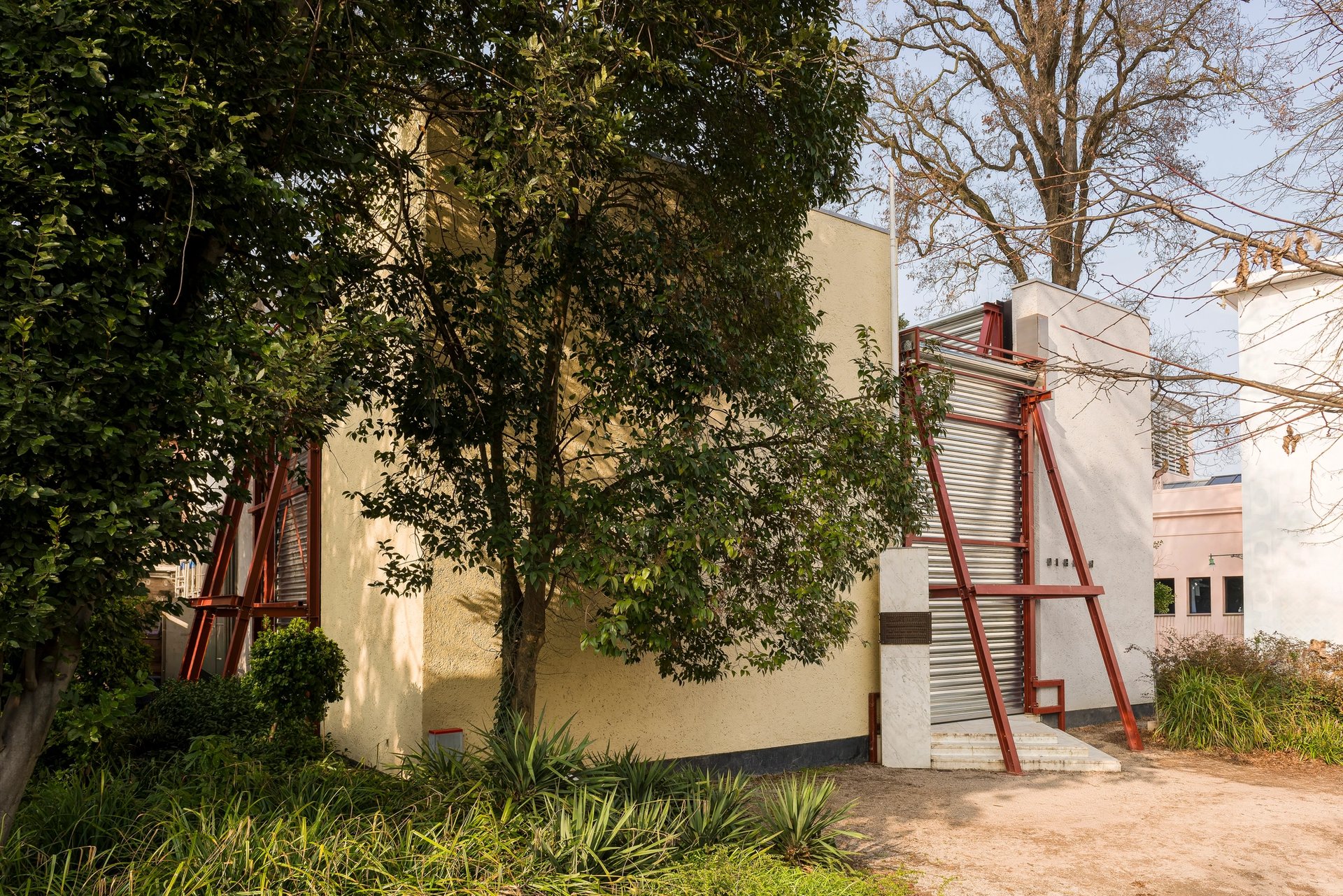
The Dutch pavilion in the Giardini has been covered with metal shutters to block out the light Photo: Willem Popelier
There are likely to be protests during the Biennale, particularly concerning Israel and Russia. How do you navigate working as an artist in such a tense political context?
For me, it’s actually a very useful situation. I prefer to stay with the trouble, I don’t need safe spaces. The Biennale is so shamelessly proving itself as a showcase of what is debatable about the West. This innocent self-image that is being evoked by the director of the Biennale, who says we are just a neutral space of cultural exchange. That’s not true because it’s clearly used as a space for propaganda as well.
It was comfortable for us in the Global North to think of ourselves as distant from the problems, that we were safe. The genocide in Gaza showed us this self-image is maybe up for renewal. And that’s been ignored by the Biennale. As such it is also a very interesting space to work from as an artist because I didn’t need to bring anything. I just had to look around and see the sore spots and put a finger on them.
Do you think the Biennale should make itself less “comfortable”?
It has a very comfortable façade—almost like an amusement park of a lost time. The horror is carefully kept at bay. You can hop from pavilion to pavilion and have another Aperol Spritz. Of course on a cognitive level you are confronted with all kinds of trouble in the world, but on an experiential level, it is one of the most safe and pleasant places you could go to. (I also really like to be in that space, I must say!).
I see a problem with that because it can give us art visitors the feeling that we are not implicated in the darkness, that we are just innocent bystanders. As if this darkness is happening without us. And for that reason, I am very hesitant to embrace the idea of a safe space, because this idea of utopia is giving us a way out. And this utopia that is created in the arts is never a better world. It’s always a symbolic patching up of the world but it’s never real.
If protests disrupted or even shut down the Biennale, would you support that?
I think it’s very questionable that certain countries—especially Israel—are getting the chance to use the Biennale as a stage. It took ten years of protest before South Africa was not welcome anymore. To say collectively, let’s not give Israel a chance to launder its public image, is very important. So if that leads to closed days or a shorter opening time of the Biennale, I wouldn’t mind.
Do you think the Biennale will still exist in its current form in 50 years?
I think so, but how will we see it? Venice is also still there, right, but it became a museum. So the Biennale might also turn into a museum of the post-war years. Because these pavilions are not inflatables. They are made of stone. We cannot easily take them away and every year it becomes more hilarious to say that those are the countries that tell us how the world functions these days.
How does your work relate to the main exhibition theme, In Minor Keys?
There’s a shared sense of melancholy. But I suspect we speak to a different emotional registers. My work deals more directly with darkness and pain, which becomes audible in the performance. I wouldn’t position myself as someone creating utopian or optimistic spaces. Given who I am—a rich white man in his 50s—I don’t think it’s up to me to create a utopian space. I more closely identify with the melancholia of lost power, so that informed my work more than a prospect into a brighter future.
• The Dutch pavilion is open for performances every hour from Wednesday to Sunday. On Tuesdays, it remains closed and functions as a sculpture