The vast majority—around 85%—of US museums face a costly backlog of maintenance or repairs to their buildings. In addition, around 77% have at least one structural issue putting their collections at risk. This is according to a recent survey conducted by the US Government Accountability Office (GAO), a non-partisan federal agency that investigates government spending and performance and reports its findings to congress.
GAO was tasked with researching the state of the country’s public museum buildings in 2024 as part of the federal appropriations process. Its findings, released in March and based on a survey of around 300 museums and 17 site visits, reveal that institutions across the US and its territories struggle to keep their buildings updated and safe because of a lack of funding. These challenges can be even more pronounced in rural and remote locations, where it can be prohibitively expensive to ship in materials and find skilled workers. The fact that many museums are housed in historic homes or sites that are essentially part of their collections adds a further wrinkle.
“One thing that was eye-opening in our work is just how many museums are very small,” says David Marroni, the director of physical infrastructure at GAO. People may think of the average museum as a major institution in a grand building in a big city, but the reality is that most of the 16,700 museums that make up the target population for the report are smaller spaces with limited budgets and staff. “There are thousands of little historical museums all over the place doing interesting stuff,” Marroni says.
Accessibility concerns
The smaller the museum, the harder it can be to deal with major structural problems. “If they need a new roof or a new HVAC [heating, ventilation and air-conditioning system] or something that is high-cost, it can be really difficult because that could be a third of their budget,” Marroni says. Updating historic sites to make them accessible by modern standards is another major concern, as many buildings were constructed before the 1990 Americans with Disabilities Act made things like ramps the norm, leaving visitors to contend with internal stairs or cobblestone walkways. One site that GAO researchers visited in California, according to the report, is at the top of a hill equal to five flights of stairs, and there is no elevator or other accessible option available.
Around half of the museums that responded to the GAO survey said they each had more than $100,000 worth of deferred maintenance. “And where do they get that money?” Marroni asks. The answer for most is private fundraising, since local and federal grants for structural needs are scarce.
The Institute of Museum and Library Services (IMLS), for example, provides grants for some conservation issues—such as dealing with humidity or fire suppression—but the money cannot be used for construction. In some cases, deferred maintenance costs can accrue to the point that it would be cheaper to construct a new building, with the report citing an example of one anonymous museum in Alaska that has suffered from two consecutive years of flooding. Other institutions have been left to store their objects and collections in less than ideal locations, including bathrooms and garages.
“This aligns very closely with what we’ve been hearing from museums across the country for years,” says a spokesperson for the American Alliance
of Museums. “Museums of all sizes are managing aging buildings and systems while operating with limited and often unpredictable funding. Deferred maintenance is not just a facilities issue; it directly affects a museum’s ability to care for its collections, serve its community and remain open and accessible to the public. What would help most is sustained investment that recognises facilities as essential infrastructure.”
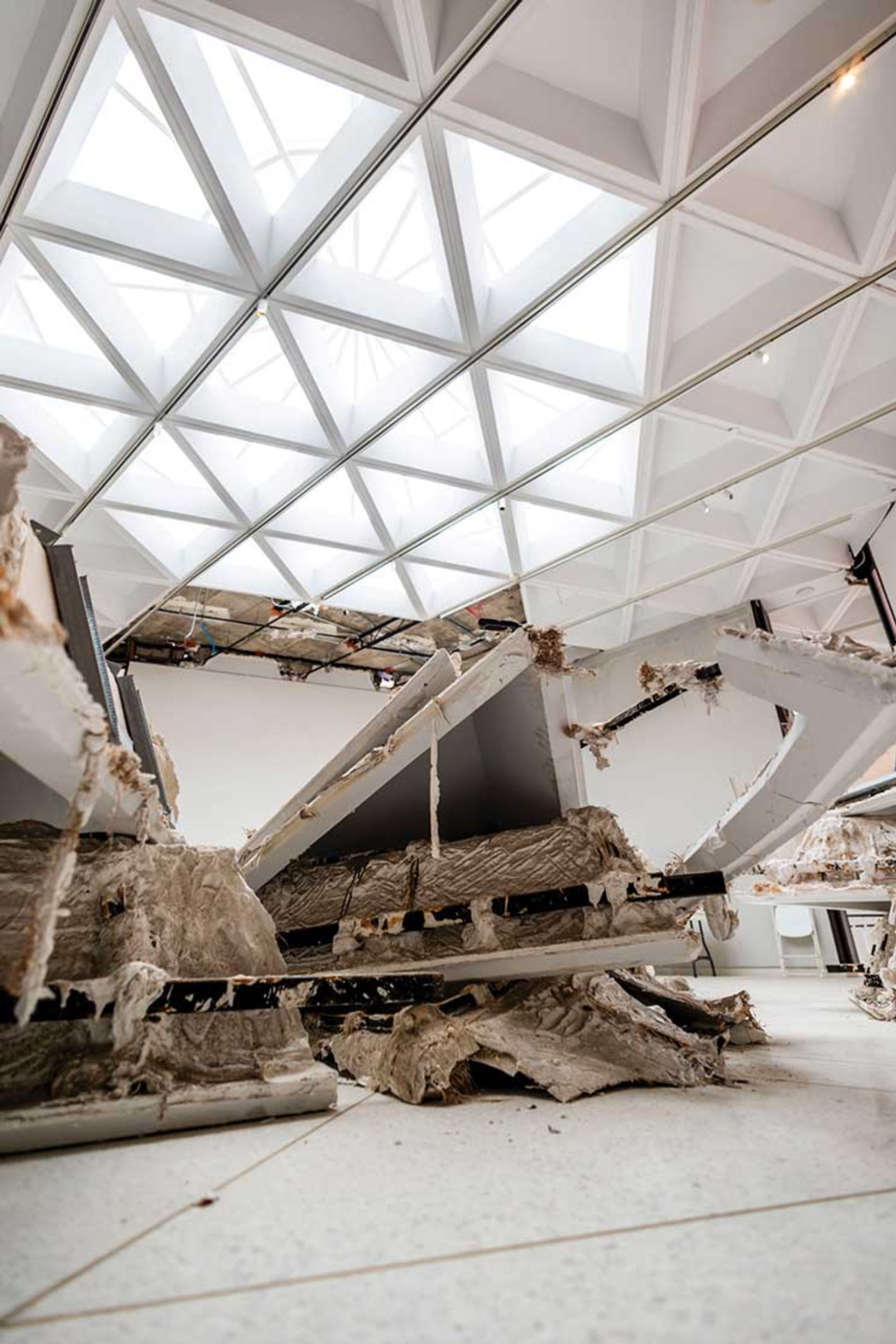
Earthquake damage at the Museo de Arte de Ponce Courtesy Museo de Arte de Ponce
‘Chronic underinvestment’
Tribal museums have the added concern of finding proper storage and display space for the sacred objects, materials and remains that have been repatriated to Indigenous communities since the passing of the 1990 Native American Graves Protection and Repatriation Act.
“Many tribal cultural facilities operate in aging or repurposed buildings, where problems with climate control, roofing and electrical systems can put irreplaceable cultural materials at risk,” says Susan Feller, the president and chief executive of the Association of Tribal Archives, Libraries and Museums. She adds that rising energy costs are making things even more difficult. “The impact is that tribal museums are often forced to delay needed repairs, reduce programming or operate under conditions that fall short of professional standards—not because of a lack of commitment, but because of chronic underinvestment.”
Museums and cultural sites are not alone in their struggles with aging buildings, according to GAO’s regular work studying federal facilities. “A lot of the buildings in this country are quite old at this point,” Marroni says, with some constructed more than a century ago. And while these buildings might remain largely unchanged, the organisations they house often outgrow them or need updated facilities that are more publicly accessible and secure. “It is a large expense for communities across the country, and it’s probably going to become a larger expense over time,” Marroni says, “because there are only so many resources, and you have a growing number of older facilities.”
What the GAO report makes clear is the demand for dedicated funding that can help museums clear the backlog of maintenance. More directly, it provides congress with data about museum needs as it considers the federal reauthorisation of IMLS, which lapsed in 2025. While President Donald Trump has repeatedly attempted to shut down the agency (including in his 2027 federal budget proposal released in April), congress has so far continued to fund IMLS, with its current budget set at $291.8m for the 2026 fiscal year.
Based on the insights provided by the GAO report, congress could adjust how IMLS uses its federally appropriated budget in the future—perhaps opening the door for grants that allow museums to update their buildings. “The ball is in congress’s court to take that information and make policy choices,” Marroni says.