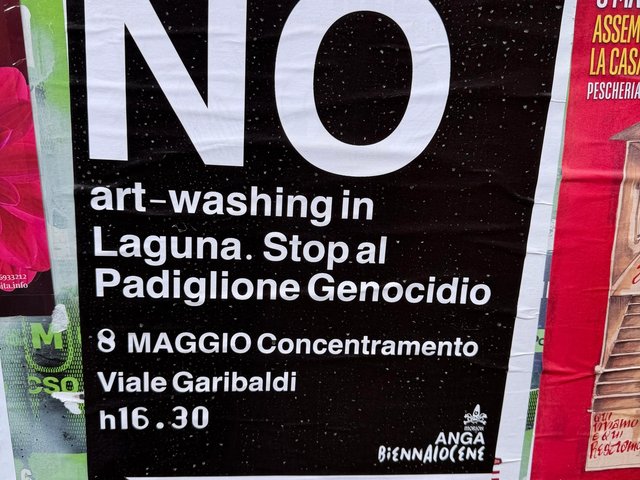
A swathe of countries taking part in the Venice Biennale closed their pavilions today (8 May) as part of a strike in protest against Israel’s participation in the event. The action, organised by the Art Not Genocide Alliance group (ANGA), “rejects both the normalisation of Israel’s presence in cultural spaces and the economies of genocide in culture, while also denouncing the ecosystem of precarious labour that grows around the Biennale event,” according to an ANGA statement.
Around 18 pavilions have been taking part in full or partial closures, including Austria, Lebanon, Slovenia and Egypt. A total of 237 curators, artists and art workers are said to be involved.
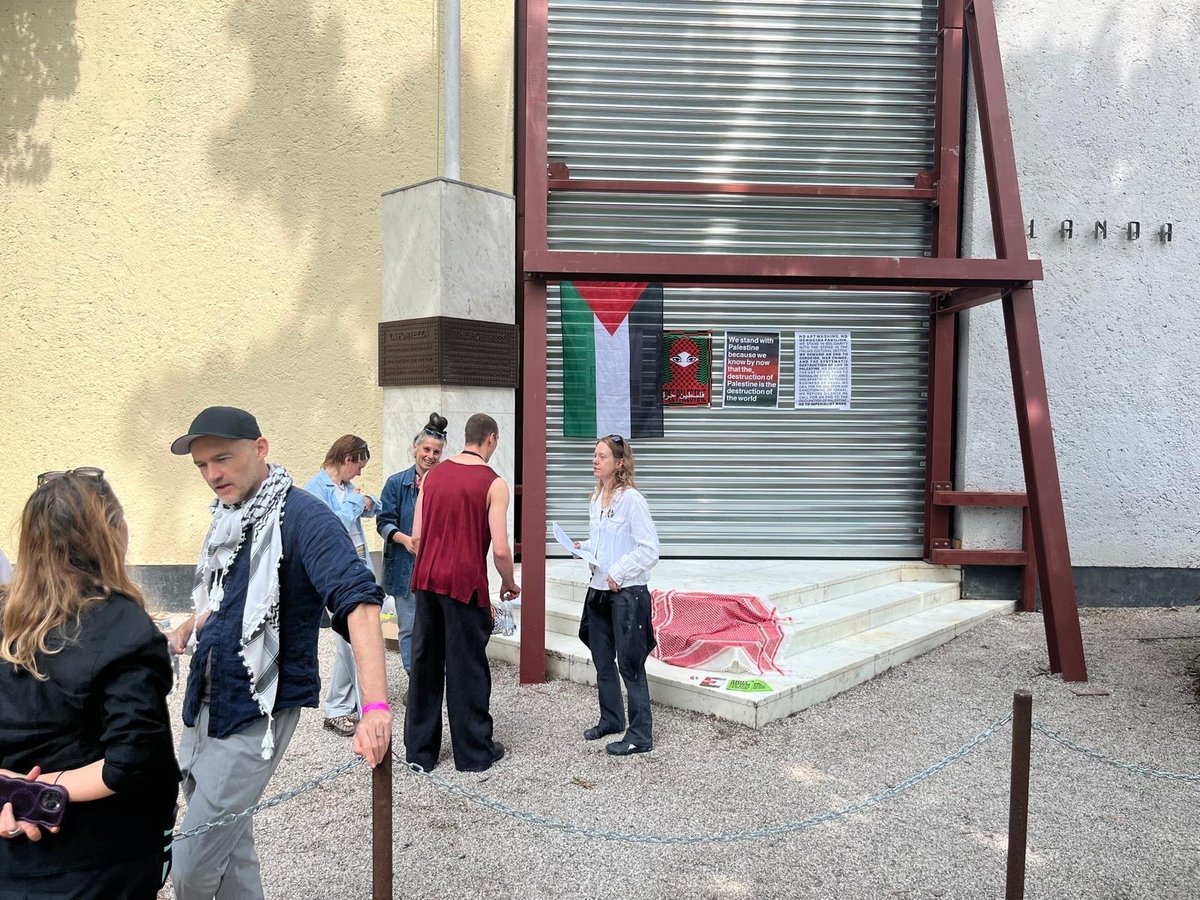
Dries Verhoeven, the artist representing the Netherlands this year, stood outside his country’s pavilion this morning, a Palestinian flag and materials relating to the protest hanging on the shuttered door behind him. “We think it’s very undesirable that Israel has been given the chance to artwash themselves with a pavilion in the Arsenale [one of the Biennale’s two main venues], and we want to make that clear,” he tells The Art Newspaper.
“We are very happy to be here, to show our work for all the other days, but we see ourselves a bit as a horse of Troy. We want to discuss the event from the inside out and also to talk to the audience and to tell the audience, please don't accept this.”
Verhoeven points to the fact that South Africa was barred from participating at the Biennale from the late 1960s to 1993, as a response to its apartheid regime. “I think the way artists and curators and art organisations manifested themselves back then, we should take that as an example.”
Another country taking part in the strike action is Poland, which will be closed from 4pm-7pm. Agnieszka Pindera, the pavilion’s commissioner, says the curators and the two artists spearheading the project “were deeply affected” by the decision to include Israel and Russia among the participants, and “they wanted somehow to provide a release to all of those emotions and take a stand.”
Pindera adds that the team hopes that the strike will contribute towards the Biennale changing its participation rules going forward: “It’s not a sustainable system and we wanted to emphasise that business is not as usual.”
Both Israel and Russia’s inclusion have been the subject of extreme controversy in the run-up to the Biennale. Russia’s show in its Giardini pavilion will close following the previews, amid warnings from the European Union (EU) that the Biennale could be breaching EU sanctions by facilitating Russia’s participation. Films and music are expected to be playing at the pavilion during the closure.
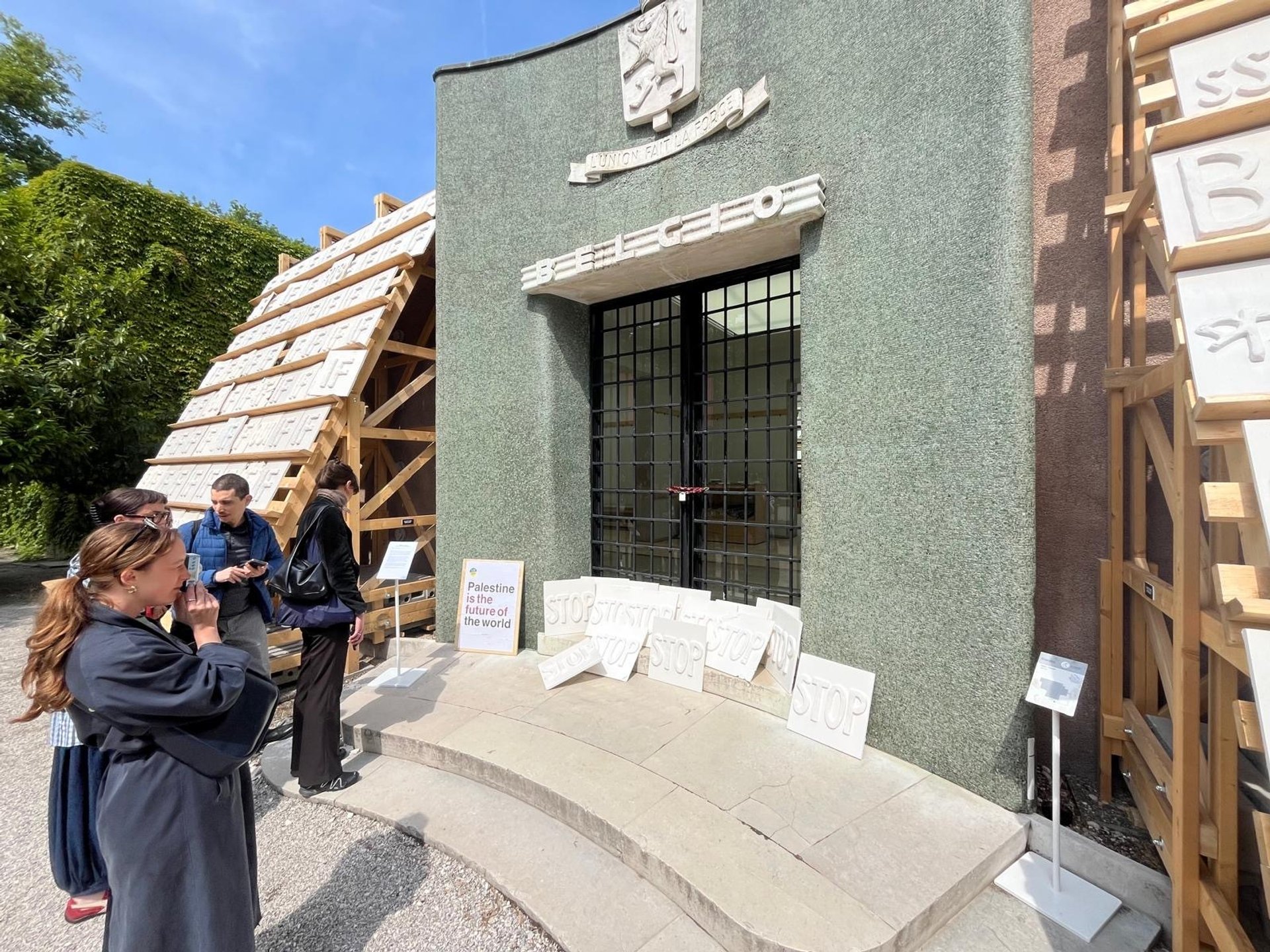
Belgium's empty pavilion on Friday Photo: The Art Newspaper
Last month, meanwhile, the jury responsible for handing out prizes resigned after it had said it would not consider artists from countries whose leaders are under arrest warrants for crimes against humanity—largely understood to be a reference to Russia and Israel. It followed an open letter in March, organised by ANGA, which was signed by more than 200 Venice Biennale participants, demanding the cancellation of the Israeli pavilion.
Partial closures
Approaches to the strike have varied. At the Arsenale, Hagar Ophir’s multi-sensory installation Living: Gathering in Venice was plunged into darkness as members of the team shut it down temporarily. Japan’s pavilion remains open, but “the participatory and audio elements of the exhibition are suspended”, a spokesperson said. The pavilion had been inviting visitors to pick up and carry an infant doll through the pavilion and surrounding garden.
Several pavilions have been shuttered, with their artists and curators not on site. One of several campaign posters on the floor of the Lebanese pavilion read: “We stand with Palestine because we know by now that the destruction of Palestine is the destruction of the world”.
An ANGA spokesperson explains that the intention is not to end the Biennale, but to encourage it to be "engaged again in thinking about itself as a body that could be an ethical light for its sector“.
They add that another aspect of the strike action, which is backed by the Italian trade unions Associazione Difesa Lavoratori (ADL Cobas), Unione Sindacale di Base and Confederazione Unitaria di Base, concerned working conditions for those in Italy’s culture sector. “Not everybody here is allowed to strike because they are on precarious contracts, for example,” the spokesperson said. “So, we also wanted to highlight the way that labour is often a really big question of the Biennale.”
‘Art can change worlds‘
Armen Agop, who is representing Egypt and closed his pavilion for an hour, takes a philosophical view. The artist, who spoke emotionally about his family’s experience of the Armenian genocide, points to the theme of his exhibition, Silence Pavilion: Between the Tangible and the Intangible, and the importance of “listening to our inner voice, our instinct, our human experience” as a means of finding answers to today’s most important questions. He continues: “People ask if art can change worlds. The way I see it: yes, art can.”
Israel is being represented at the Biennale by the Romanian-born sculptor Belu-Simion Fainaru, who is based in Haifa. Fainuru previously told The Art Newspaper that “as an artist, I am opposed to cultural boycotts as I believe in the importance of dialogue and exchange, especially in difficult times”. Russia is presenting a programme called The tree is rooted in the sky, featuring performances from figures including Diaki Kone, a Malian DH known as DJ Diaki, and the Russian folk ensemble Toloka.
Organisers for both pavilions were contacted for comment.
In a statement to The Art Newspaper, a spokesperson from the Biennale press office said: “With regard to the news reports circulating in recent days on social media and in the press concerning demonstrations planned in Venice during the pre-opening and opening days of Biennale Arte 2026, La Biennale di Venezia states that these initiatives, as well as any announced strike actions, do not involve the institution’s staff or organisation.
“Furthermore, La Biennale di Venezia underlines that its activities are carried out in full compliance with current regulations and that its relationships with collaborators and suppliers are governed by contracts in accordance with the law. Finally, La Biennale di Venezia reaffirms its commitment to ensuring the orderly running of the event, in a spirit of respect for freedom of expression and pluralism of opinion.”
The vernissage week for the Venice Biennale has been marked by protests that are scheduled to continue this afternoon with a rally on the city’s Via Garibaldi, a thoroughfare near the Arsenale site.