Americans are living through trying times—with destructive wars overseas, tens of thousands locked in detention centres at home, a surge in inflation and an unpopular president overseeing it all. But this spring and summer will nonetheless see an explosion of patriotic fanfare, as well as sober reflection, marking 250 years since the country established independence from its British overlords and became the US.
The celebrations and initiatives, which have been subject to their own ideological battles, feature everything from historical re-enactments to the rededication of the National Mall in Washington, DC. Two series of mobile exhibits aboard Freedom Trucks and a Freedom Plane are also making their way across the US with historical documents and interactive exhibits, including a quiz to determine whether you are Patriot or a Loyalist.
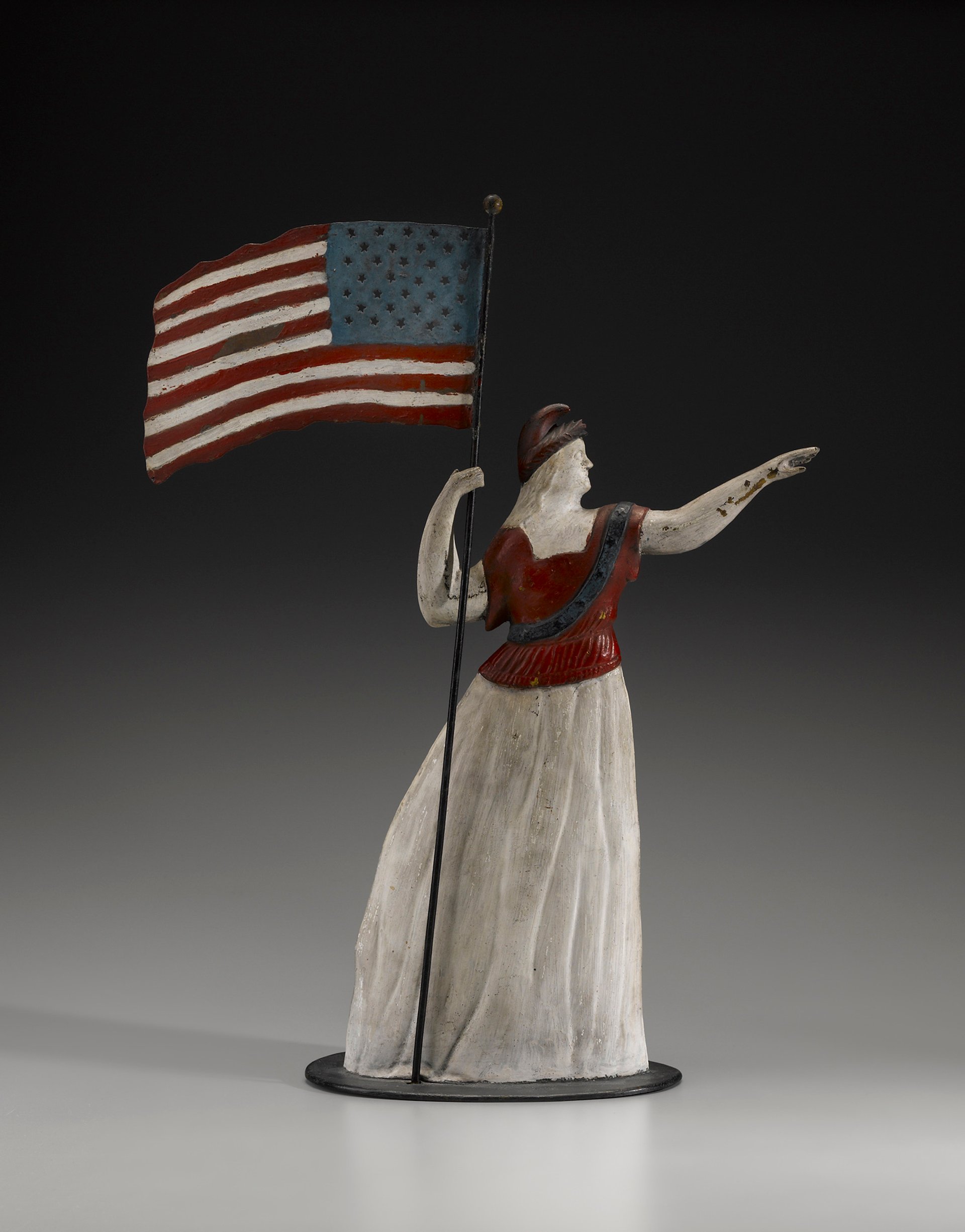
Weathervane by an unidentified artist (around 1865–75), at the American Folk Art Museum © American Folk Art Museum
New York, which played a pivotal role in the Revolutionary War and was an early capital of the US, is getting several serious and immersive explorations of the events surrounding the war and the signing of the Declaration of Independence. This includes a chance to see three of the 26 surviving Declarations printed at John Dunlap’s press in Philadelphia on the night of 4 July 1776. One of these, bought by the billionaire insurance executive William R. Berkley in a private sale in the early 1990s and now held in the Berkley Collection, is on view at the Grey Art Museum at New York University (NYU) (until 10 July), alongside more than 100 other documents that give context to the Patriots’ desire for revolution. (Two other copies are on display at the Morgan Library and Museum and the New York Public Library.)
Berkley tells The Art Newspaper that he hopes the exhibition, The Declaration of Independence: Long Trail to Liberty, will be a source of optimism. He says a renewed focus on the country’s founding documents could offer “a reawakening of all the potential of America. We tend to get bogged down by the bad things that have happened, and there are plenty of bad things, but the structure of the country and its founding documents is so exciting and so wonderful.”
Berkley attributes his own personal successes in life to the opportunity he found in the US even as a child from a poor family—in particular, the full scholarship he received to study at NYU. “Our prospects are still bright if we remember what grounds America and its future,” he says.
Ideological battleground
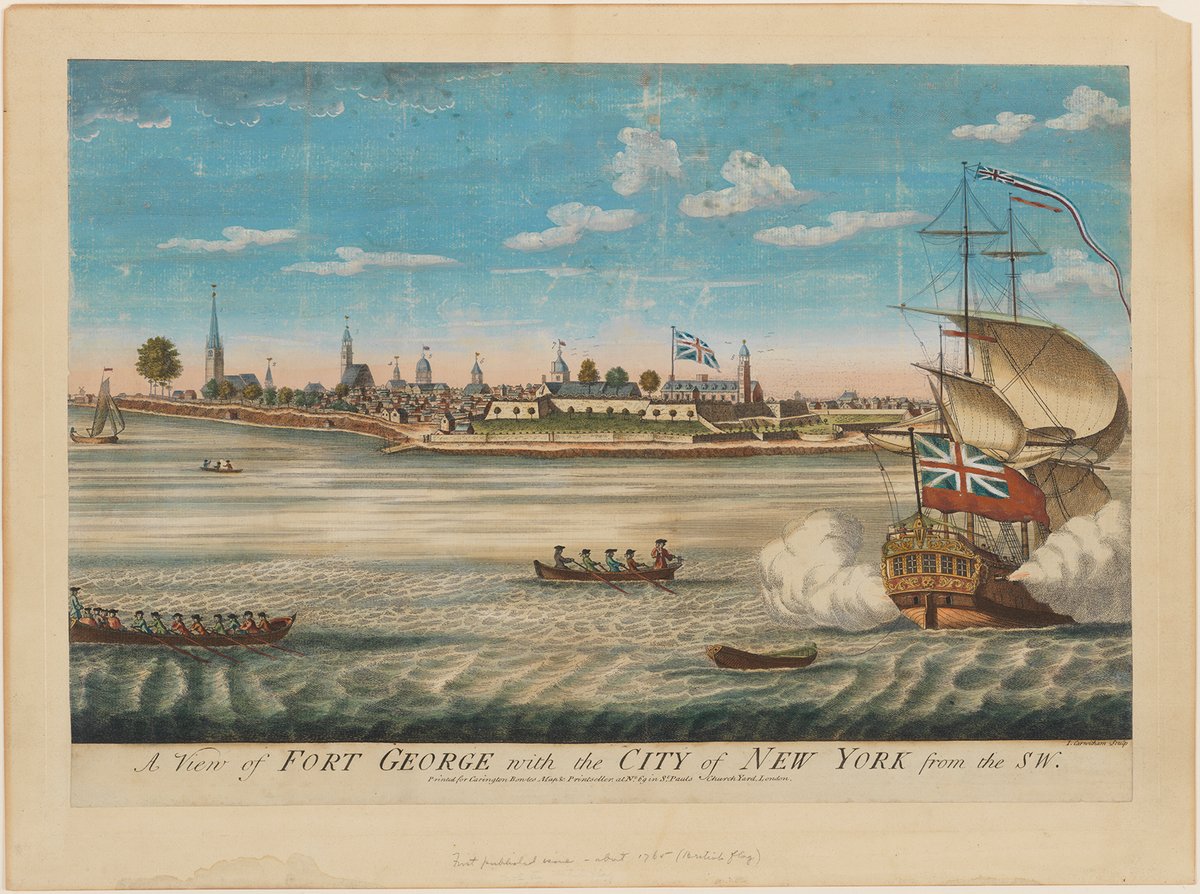
Uptown at the Museum of the City of New York (MCNY), the ongoing exhibition The Occupied City also focuses on the revolutionary era. It transports visitors to a period when New York was an ideological and strategic battleground, when the British occupied the city for seven years and the Great Fire decimated parts of the city, linking the era to future events.
Among its interactive installations, the show includes a re-creation of a coffee house and a tavern (the main gathering points for debate); a simulated flythrough of the damage wrought by the Great Fire; and a chance to pull ropes and topple a digital effigy of King George III. This last activity re-creates the moment when the Sons of Liberty pulled down a statue of the British monarch from Manhattan’s Bowling Green in the days following the signing of the Declaration of Independence.
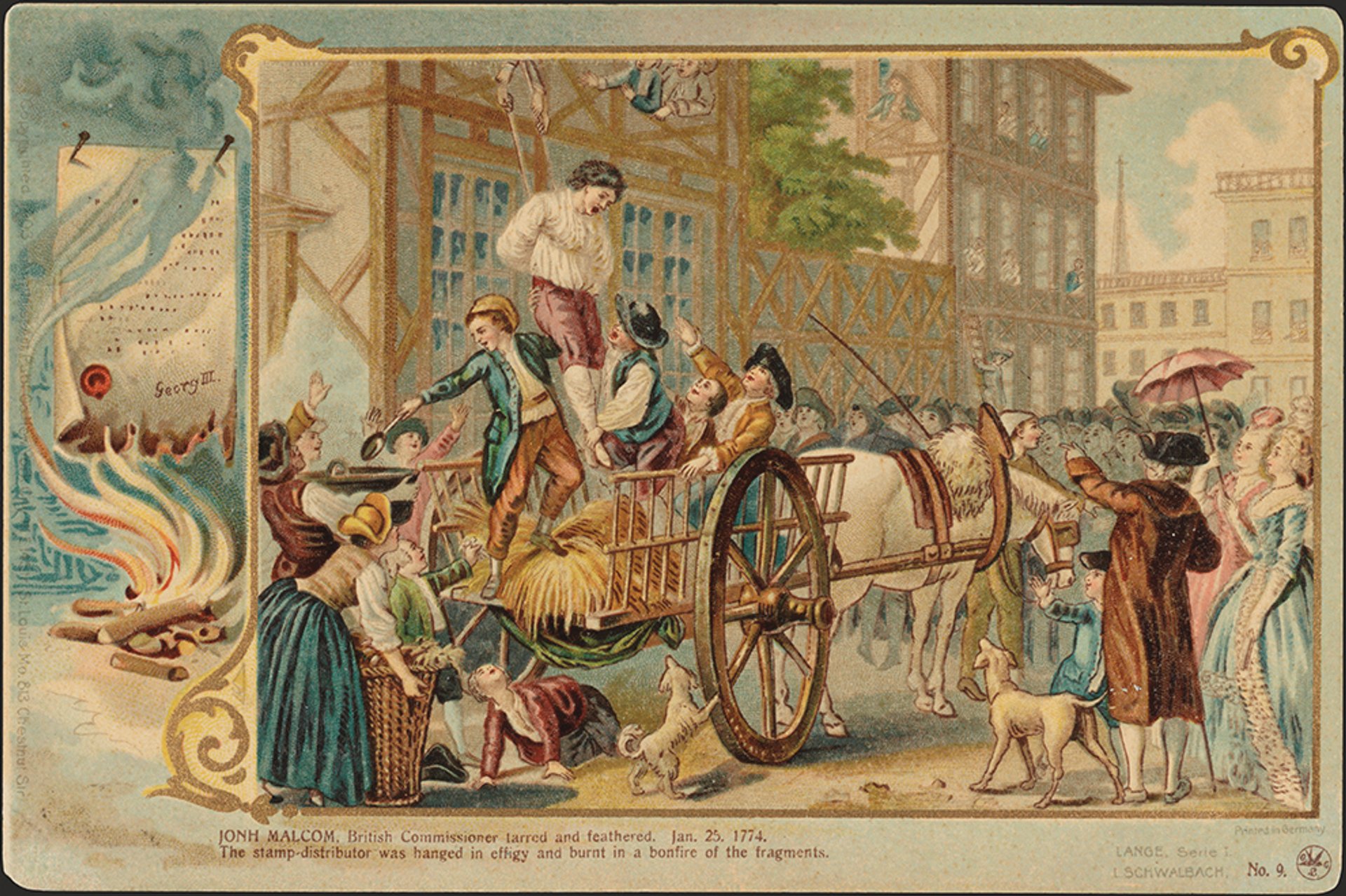
A 1774 postcard of a British commissioner, tarred and feathered, at MCNY Courtesy of the Museum of the City of New York
Elisabeth Sherman, MCNY’s chief curator and deputy director, hopes that Occupied New York will give nuance to the popular understanding of the Revolutionary War as being primarily about taxation without representation. “The ideological contests that came before were much more about economic precarity,” she says, noting the exhibition’s exploration of revolutionary-era discourse around the agricultural and trade economies. Visitors may also “find grounding in the knowledge that others lived through really challenging times”, Sherman adds. “Others had to face forces that were out of their control and find agency in ways that they could. And out of that, they built something hopeful or idealistic.”
Across Central Park on the Upper West Side, the New York Historical is hosting at least four semiquincentennial-related exhibitions this year. One of these, Revolutionary Women (29 May-25 October) tells the stories of women who contributed to the war effort as both Patriots and Loyalists.
“If people are thinking about women during the revolutionary period at all, they’re thinking about those that were part of the households of the Founding Fathers—elites like Eliza Schuyler Hamilton and Abigail Adams,” says Anna Danziger Halperin, a curator of the exhibition and the director of the museum’s Center for Women’s History. Revolutionary Women does include Hamilton and Adams, but it also focuses on working-class women who took up arms, took over businesses and saw in the war an opportunity to pursue their own liberty.
Women of the Revolution
Among these women was Deborah Sampson, a cross-dressing soldier who enlisted under a male alias and fought for more than a year before her true identity was uncovered when she fell ill and was hospitalised. There is also Molly Brant, a Haudenosaunee woman who played an important diplomatic role as an ally of the British, and Deborah Squash, an enslaved Black woman who self-emancipated from George Washington’s plantation.
The British had urged enslaved Black men to self-emancipate to British lines in exchange for their freedom, Halperin explains. The message also reached Black women, who showed up offering their help as well. After the war, the British evacuated many of their Black and Native American allies, including Squash and Brant, to Canada to guarantee their freedom.
But not all semiquincentennial exhibitions in the city are focusing on the past. The Cooper Hewitt—a Smithsonian Institution museum, meaning that it has been at least adjacent to intense pressure and scrutiny from the Trump administration—is showing Made in America: The Industrial Photography of Christopher Payne (until 27 September). The show features an eerie, awe-inspiring and sometimes lightly romanticised tour through US factories over the past ten years. It “upends the notion that nothing is made here anymore”, says its curator, Susan Brown, who describes Payne as working in the tradition of photographers like Gordon Parks. She points to both Payne’s images of the 154-year-old Steinway piano factory in Astoria, Queens, and to photos of factories that make computer chips and robotics.
Brown’s personal favourite—and one that might have resonance with contemporary audiences amid the head-spinning ascension of automation in our lives—is an image of the new Hyundai factory in Georgia that opened last year. Brown calls it the most intimate photograph in the show. “It reminds me of a dad taking a splinter out of a child’s finger,” she says. “It has a parental quality.”
If Payne’s photographs capture something of US industriousness and an element of craft (the human hand) that still exists in the assembly lines of mass production, a tiny but impactful exhibition at the American Folk Art Museum reminds viewers that material culture has always been where Americans expressed themselves and searched for a national identity. According to the curator Emelie Gevalt, every 50 years—when the time comes to celebrate the US’s biggest birthdays—there is a renewed interest in collecting Americana and folk art. It is a category of objects that, to many, feels closest to an authentic version of the country.
In Folk Nation: Crafting Patriotism in the United States (until 13 September), an exhibition drawn from the museum’s collections, a juxtaposition of objects could read like an elegant summation of the US’s current predicament. Here, visitors find Uncle Sam riding precarious and high on the winds of technological change in the form of a Gilded Age-era whirligig, featuring the figure flying overhead on a bicycle mounted to an airplane. Beneath him, easily overlooked, is a message Benjamin Franklin Perkins wrote on his 1990 painting of Lady Liberty: “Miss Liberty reaches out to welcome the persecuted, sick, hungry to the land of opportunity.”