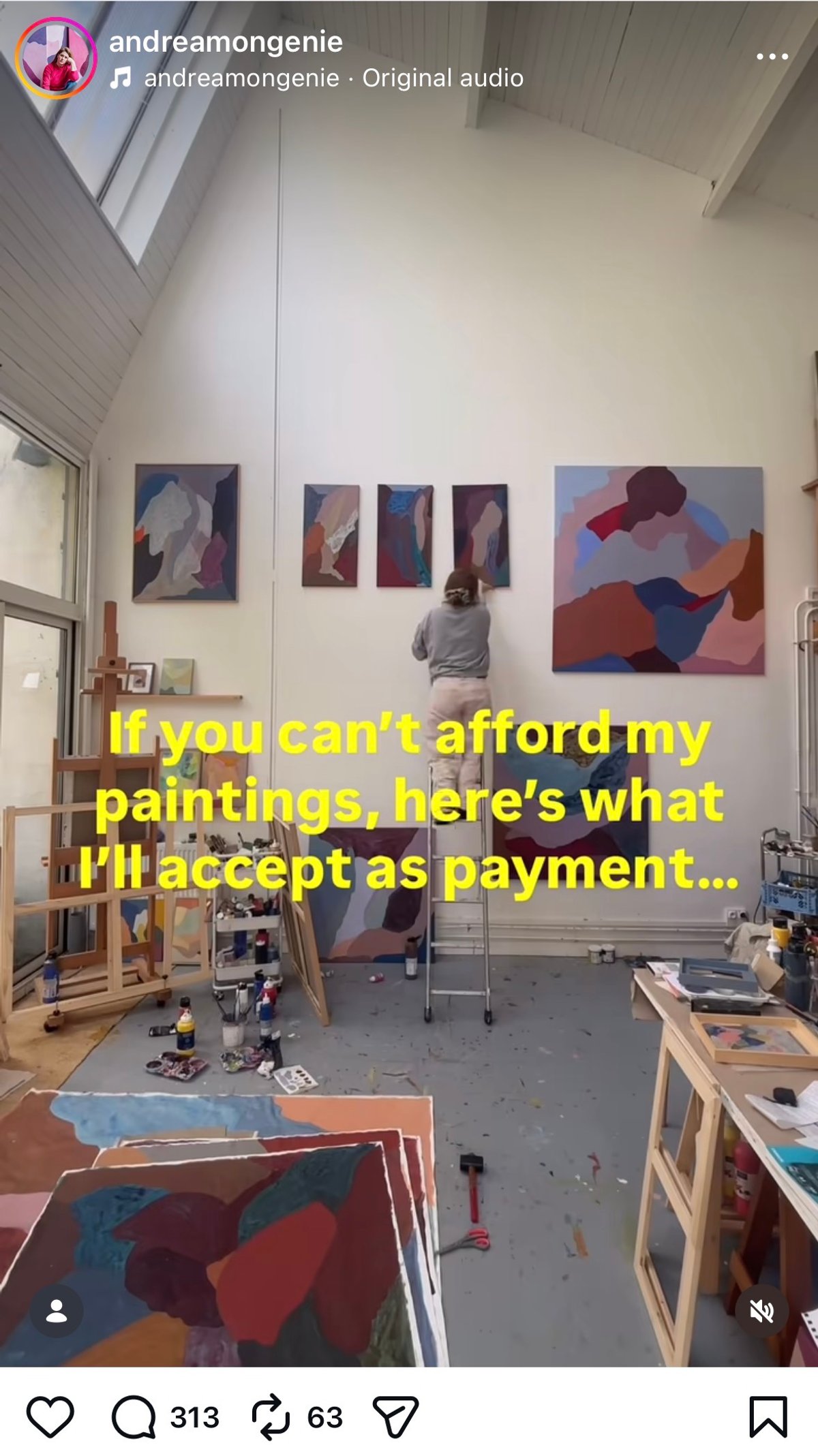
Creatives around the world have recently taken to social media to offer their art in exchange for anything other than money. “If my art isn’t in your budget right now, I’ll accept the following as payment…” the viral posts on Instagram and TikTok read. The caption includes a list of items or services that the artist will trade the work for, ranging from handmade clothes, jewellery and tattoos to accommodation, meals and beauty services. Some simply say: make me an offer.
The reasons for this foray into bartering are wide but many reference anti-capitalist agendas. “I think this system is trending right now because we are getting to the point in late-stage capitalism where people are truly starting to feel helpless and discouraged,” says Lin Snow, an artist based in Maine, US. “A lot of us are not wealthy with money but we are all wealthy in other ways: skills, trades, goods, etc. and have so many other wonderful things to offer. The ‘big guys’ don’t care about any of us so we are seeking comfort in our community and rebuilding our connections that capitalism slowly pulled out from under us.”
For many, the trend is a reflection of the stark economic circumstances of creatives today. “The current climate for independent artists has pushed many of us to our limits, and in a strange way, it has forced me back to the resourceful roots of my early career,” says Oli Fowler, an artist and screenprinter in Hertfordshire, England. He began trading his work when he moved from London to the countryside. “I found myself surrounded by incredibly talented local craftspeople and tradesmen who appreciated my work but, like me, were navigating their own economic challenges,” he says. So he traded his work in exchange for their expertise.
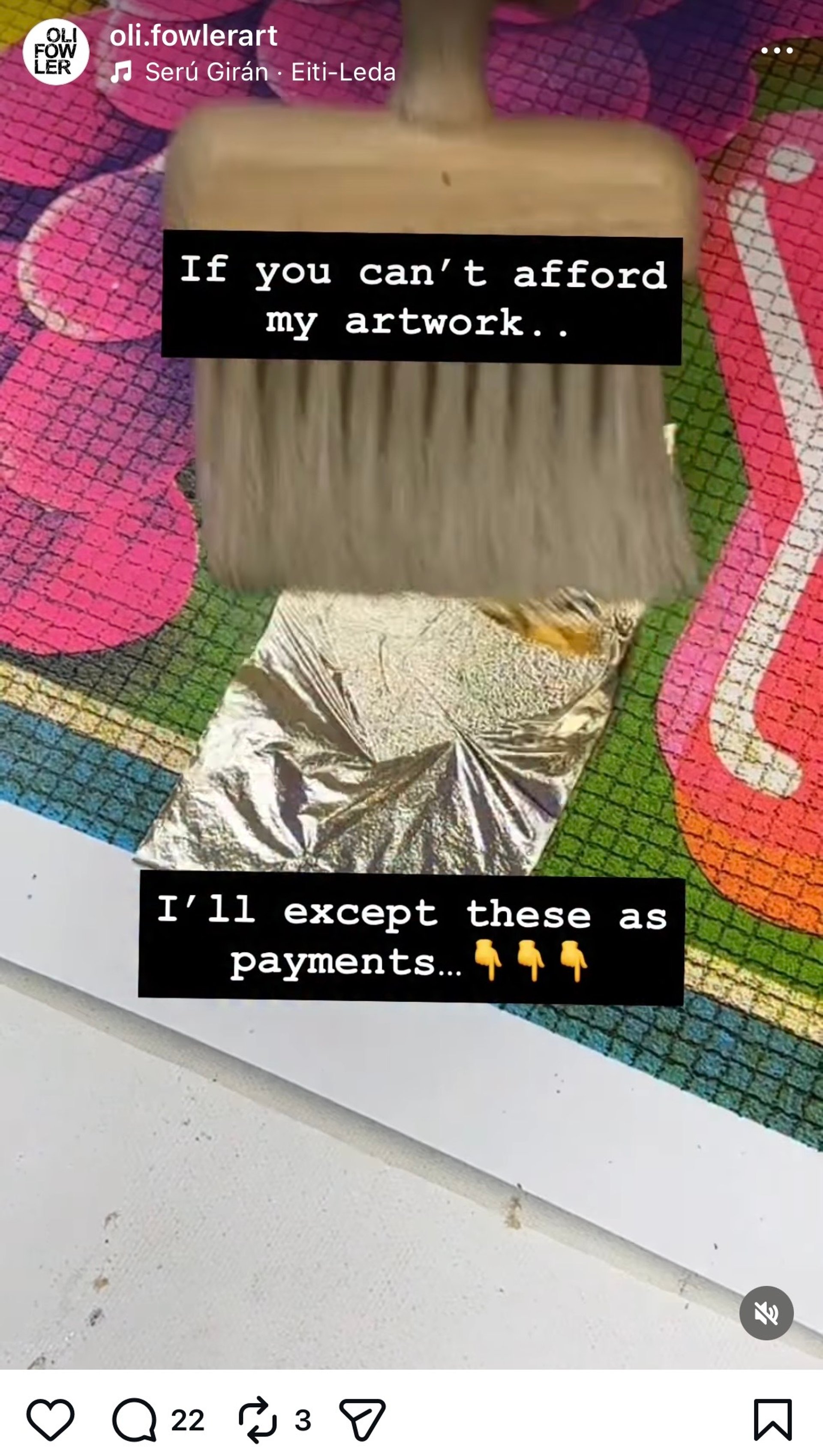
Courtesy of Oli Fowler
The Paris-based painter Andrea Mongenie agrees. “The quality of life has changed quite drastically in the last 30 years. We’re earning the same, but everything has become so much more expensive,” she says. “As a freelance household (my husband is a music composer), it feels like there is very little left at the end of the month after bills, taxes, childcare and basic life costs.” Mongenie says that the idea of trading her abstract works “spoke to her” and felt “practical”.
Mongenie has successfully traded a few of her works and some trades are ongoing. She has exchanged works with other artists and traded one with a writer who is creating a book and writing package as a gift for her son. She has traded another painting for help with video editing and is in negotiations for help with her website. “I’ve also had a lot of offers for accommodation, in places like Lisbon, Austria or near Copenhagen, which I’d really like to explore, especially as a way to make travelling with my family more accessible,” she adds.
Fowler was able to exchange a £2,000 original work of art for 30 bespoke, handmade solid oak frames from a master furniture builder that he says “saved” his career this year. “Without those frames, my new collection would still be sitting in my studio, unseen and unmarketable. Because of that barter, I was able to catch the eye of a gallery in London [IIF Gallery], where the work is now being delivered for exhibition,” he says.
Fowler says his bartered transactions are also a vital act of rebellion. “I’m tired of being fleeced by a system that takes at every turn, and bartering allows me to bypass the ‘middleman’ entirely. It’s a visceral, human way of doing business that prioritises community over corporate tax structures,” he says.
Some creatives have spoken out about how such trades also foster a sense of community. Snow began trading with other vendors at markets. “Everyone seemed to have such an excitement about trades and it never seemed to be about the monetary value; it was more about the connection,” she says. “It creates connections with people who genuinely value the work,” Mongenie says. “The exchange feels intentional.”
The bartering trend harks back to the #artistsupportpledge movement that began during Covid to encourage art sales at a time when opportunities, attention and finances were limited. The cyclical system invited artists to post works for sale for under £200 on social media with the promise that they would buy another artist’s work once they reached £1,000 in sales. "In an uncertain climate there are two things we can be sure of—it is tough for artists to make a living and they are good at finding creative solutions in all they do,” says the art market expert (and columnist for The Art Newspaper), Melanie Gerlis. “In an ideal world, artists would get properly compensated for their work, but bartering has long been an alternative exchange mechanism and an effective way to start creating value from their art. Peak capitalism doesn’t seem to be a working model for most professional artists at the moment, so good for them for seeking out authentic and community-based solutions."