The photographs in this volume, taken between 1906 and 1913, were originally produced for Henry John Elwes and Augustine Henry’s The Trees of Great Britain and Ireland, an ambitious photographic catalogue designed, Elwes wrote, to “give a complete account of all the trees which grow naturally or are cultivated” in each country. Filling seven volumes and 2,022 pages, the series boasted more than 400 photographs—mostly taken by uncredited photographers—appearing alongside exacting botanical descriptions of over 500 species.
Elwes and Henry’s project, conceived initially as a sequel to John Claudius Loudon’s Arboretum et Fruticetum Britannicum (1835-38), “was consistent with the prevailing ethos of the period to catalogue and classify”, writes Michael Pritchard, former chief executive of the Royal Photographic Society, in an introduction to this new selected edition. The project also encapsulated the increasingly widespread use of photography as “a means to create a visual record to support science and new ways of classifying the natural world”, exemplified by Anna Atkins’s use of cyanotype impressions for her landmark Photographs of British Algae (1843-53). Reproducing over 60 photographs from Elwes and Henry’s seven-volume series, Trees of Great Britain and Ireland offers a handsome insight into the history of botanical photography, and an undeniably beautiful sequence of pictures that underscores the stately presence of trees as a significant motif in British and Irish art of the past 120 years.
In the early 1900s, these photographs were printed by the Autotype Company using a high-quality collotype process capable of producing a varied tonal range, lending the photographs “a restrained and almost poetic softness”, writes the photographic historian Björn Andersson in his accompanying notes. Newly lithoprinted to honour the collotype gradients, the photographs here remain lusciously detailed, the colliding shapes and textures captured in a broad spectrum of subtle greys that render the subject of each picture with remarkable clarity, and anticipating the authority and focus of Sebastião Salgado’s photographs of trees on the Anavilhanas archipelago by more than a century.
Impossible level of detail
The pictures in this volume are given full-page reproductions, the majority afforded the breathing room of a double-page spread, each sitting opposite a cool white page, allowing the power of each to speak for itself. It rewards careful looking. Every specimen is a complex network of capillary-like branches, bearing impossible numbers of leaves, as in the breathtaking “Weeping White Lime at Hatherop Castle” that features on the cover: the picture’s steady tonal range recording not only thousands of silvery leaf-shapes but the backdrop of an unmistakably English sky.
At times, the accuracy and detail of these photographs can seem like a deliberate rejection of the loose, suggestive brushwork of Impressionist painting, as though mounting a renewed commitment to the world as it is.
There is something profoundly objective about the skeletal trees depicted in their leafless winter forms—“Spanish Chestnut at Rydal” and “Common Maple
at Cassiobury” are particularly fine examples—revealing the “strange perfection” of their structures, to quote the poet Wendell Berry. The photographs are distant forebears of the meticulous quill-pen drawings of Cesare Leonardi and Franca Stagi’s masterwork, The Architecture of Trees, first published in 1982, which features more than 200 species rendered in a scale of 1:100, the majority drawn twice (both with and without foliage).
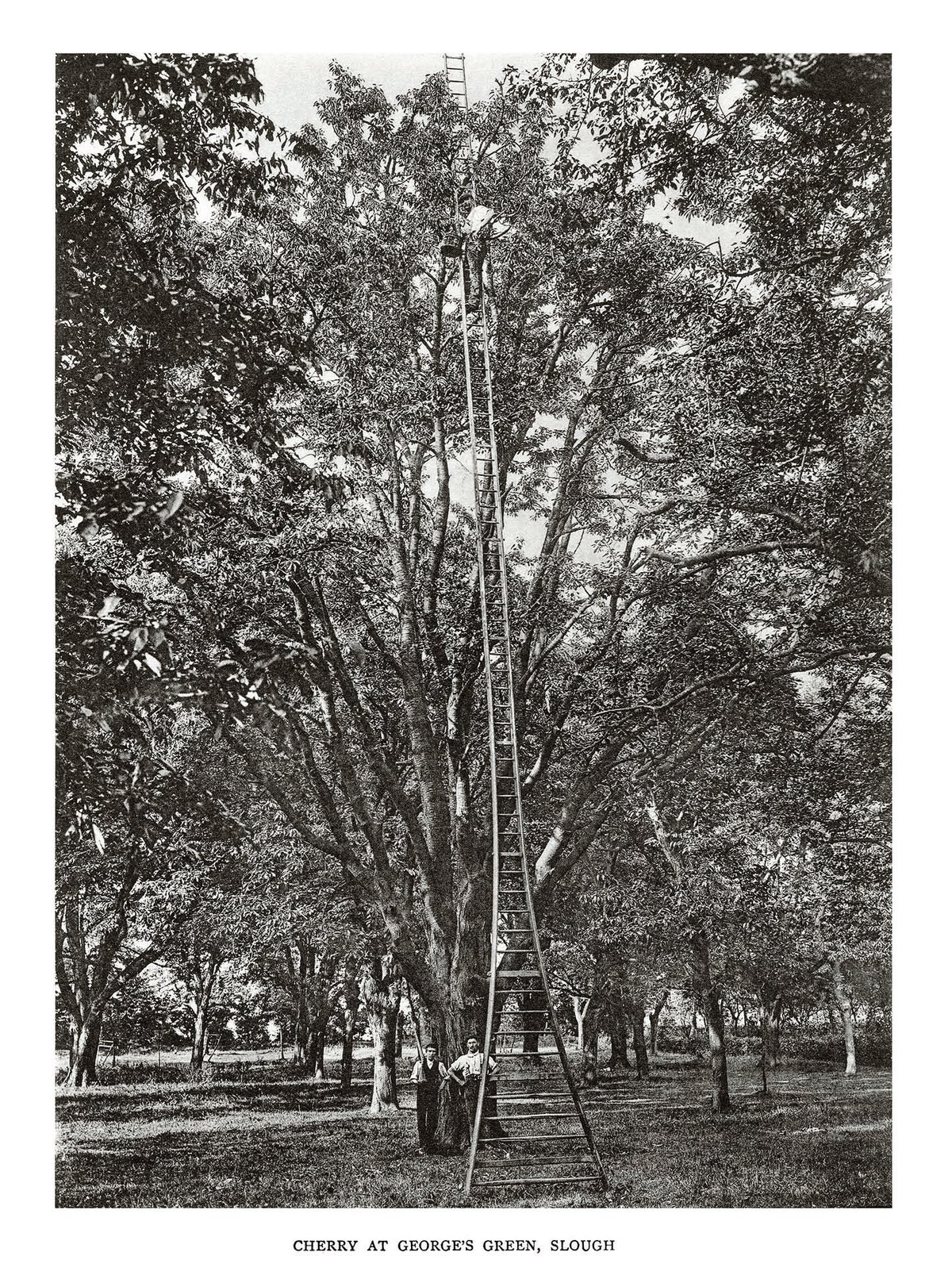
Each tree in Elwes and Henry’s series features a person or a group of people to indicate scale. “Cherry at George’s Green, Slough” includes a wide-based, gently curving ladder, with a man atop balanced precariously high to gather cherries from the upmost branches. Perhaps inevitably, these figures lend the images a spectral quality, a reminder that each picture is also a marker of time; one cannot help but wonder which, if any, of the trees depicted are still standing. “Silver Fir at Cowdray” towers above a hillside of felled trunks, an eerie premonition of the blasted landscapes of the First World War, just a few years ahead; one thinks of the shattered trees in paintings by John and Paul Nash, as seen in The Menin Road (1918) and Oppy Wood, 1917. Evening (1918). The pictures look ahead to David Hockney’s Bigger Trees Near Warter (2007), Tacita Dean’s own photographs of monumental specimens in Majesty (2006) and Crowhurst (2006), and even the wilful vandalism by Daniel Graham and Adam Carruthers at Sycamore Gap, Northumberland, in September 2023.
Reproduced at a moment when ancient woodland makes up less than 3% of the UK’s landmass, according to statistics published by the Woodland Trust, the photographs in Trees of Great Britain and Ireland exist not only as scientific curios but artworks rooting us in time and place, tethered to the past and future. Above all, this publication is a timely reminder of the role that trees play in the landscape of our lives, their beauty and endurance, their diversity and there-ness. To quote the American poet W.S. Merwin, “they may be one of the things I will miss / most from the earth / though many of the ones I have seen / already I cannot remember”.
• Henry John Elwes and Augustine Henry, with an essay by Michael Pritchard, and Notes on Printing, Trees and Terminology by Björn Andersson, Trees of Great Britain and Ireland, RRB Photobooks, 128pp, illustrated throughout, £35 (pb), 1 December 2025
• Rowland Bagnall is a writer and poet