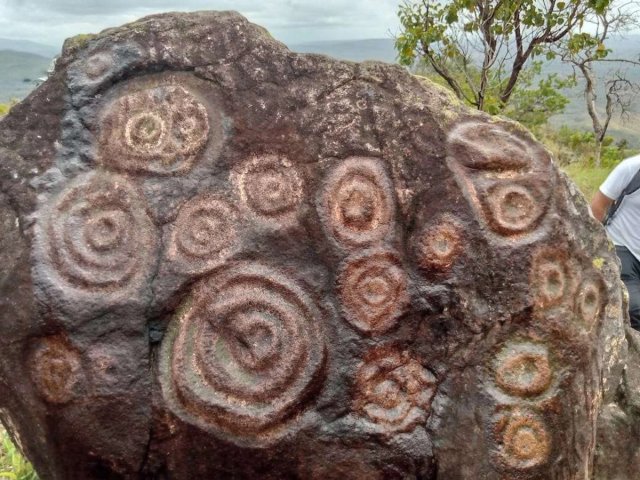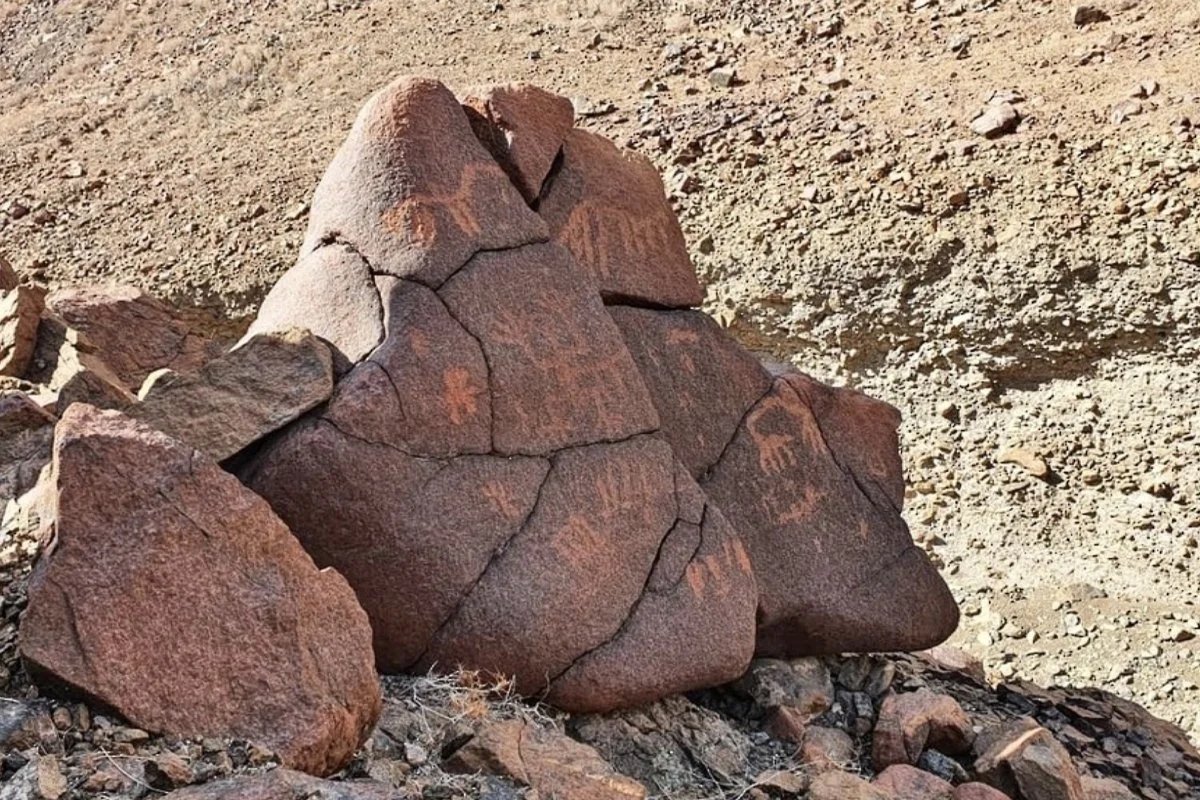
The Omani Ministry of Heritage and Tourism has announced the discovery of ancient rock carvings and drawings. Found in the archaeologically-rich Hajar Al Sinanat area in the north of Oman, preliminarily studies of the site by Angelo Eugenio Fossati, an Italian specialist in rock art and a professor of prehistory and protohistory at the Catholic University of the Sacred Heart in Milan, Italy, suggest that the site dates back to the first millennium BC.
According to a press release from the ministry, the carvings comprise geometric symbols as well as animal and human figures and were created via a pecking technique, where rock surfaces are struck repeatedly to form shapes. Researchers believe that the carvings may have been created over generations, possibly even across thousands of years. This kind of generational revisitation of sites is common across the Arabian Peninsula.
While further research into the site is planned, the initial dating of the carvings was reached “by comparing their motifs and subjects with other well studied rock art in Oman and the region”, says Wafa Dawood Al Hamdan, a spokesperson for the Omani Ministry of Heritage and Tourism. “Researchers also considered the degree of weathering and patination on the engraved surfaces, as well as their archaeological context. Together, these indicators suggest that the carvings belong to ancient historical periods rather than in recent times.”
The discovery is part of the ministry’s ongoing efforts to document and preserve archaeological sites. As the press release states, “These carvings represent an important visual record documenting aspects of early human life and the prevailing environmental patterns during those historical periods.”
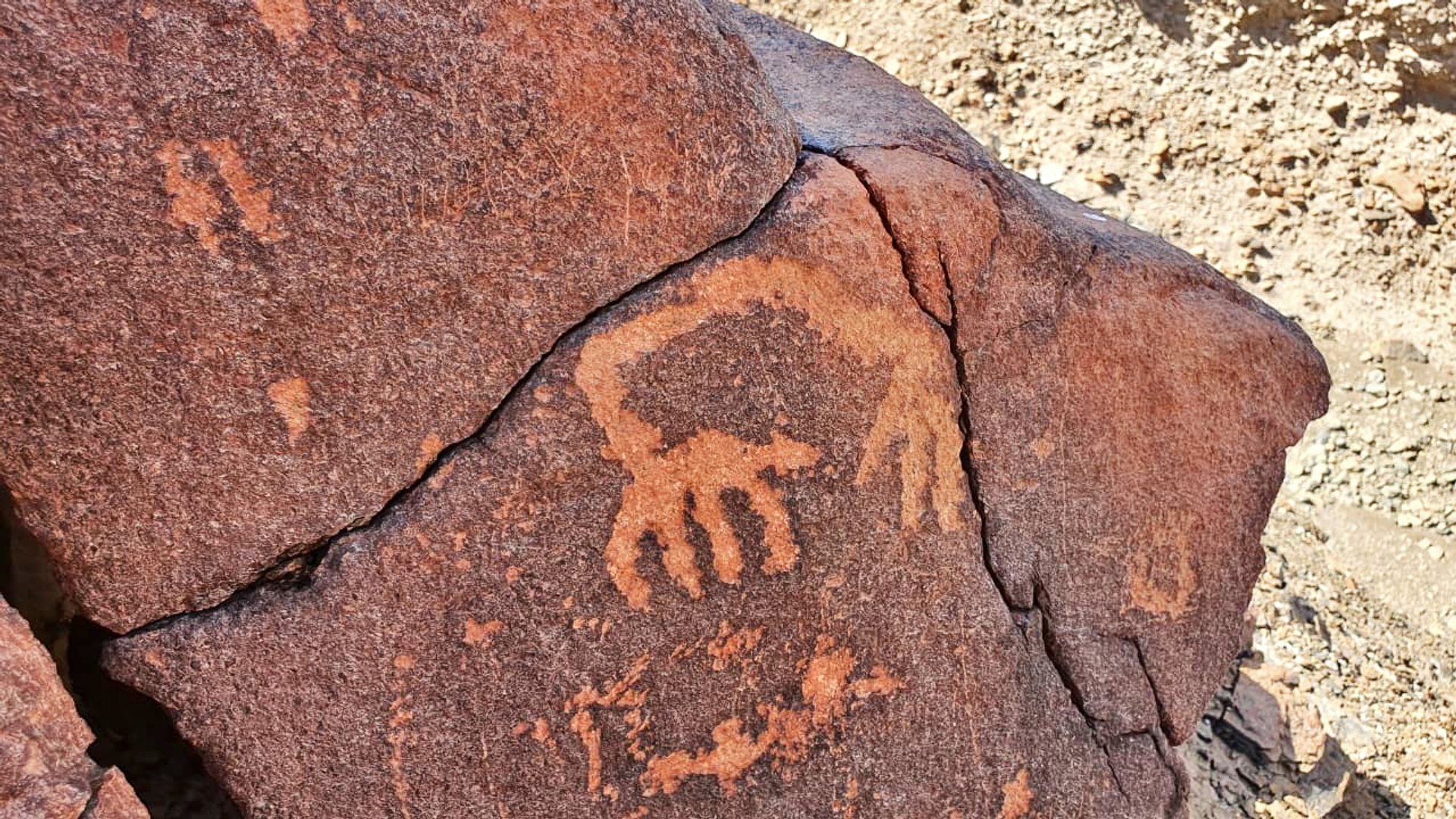
A close up of the rock art discovered in northern Oman Image courtesy of the Omani Ministry of Heritage and Tourism
Untapped source
Rock art is a key source of archaeological discovery, especially in nomadic societies, which left behind fewer material legacies than sedentary ones.
Ali AlMahrouqi, the director of the department of archaeological surveys and excavations, says in a statement that rock art “represents one of the most prominent elements of Oman’s cultural heritage and is widely distributed across the country’s mountains and valleys, shedding light on significant civilisational aspects throughout different historical periods”. The northern area of the Oman Peninsula is a particularly rich and largely untapped source of ancient rock art.
Recent discoveries include Wadi Al Lajam (Sohar), an important archaeological complex with engravings spanning thousands of years, including ones of horses, camels and ibex, as well as uniquely featuring drawings of the Arabian leopard; Wadi Nafūn/Aṣ Ṣafiyya (Duqm), known for more than 500 engraved figures and 200 South Arabian inscriptions, as well as maritime depictions of sea turtles and sperm whales; and Horses Rock Petroglyphs (Ad Dabbaniyyah), whose detailed, ancient petroglyphs captured early quotidian Omani life and hunting parties.
The recently discovered images on the rocks are at once ancient and oddly modern, and bear a striking resemblance to ancient rock art found in South America. “The recent discovery of rock carvings in Oman invites a fascinating visual dialogue with the ancient images of the Canaima region in Venezuela and, more broadly, with the symbolic traditions of the Americas,” José-Miguel Perez Gomez, an expert on Latin American rock art, tells The Art Newspaper. “Although the Omani examples are technically engravings cut into stone rather than painted pictographs, their visual language resonates with the universal grammar of early image-making: simplified human forms, animal figures, geometric signs, repeated marks, and an evident desire to transform natural rock surfaces into spaces of memory, identity, and sacred meaning.”
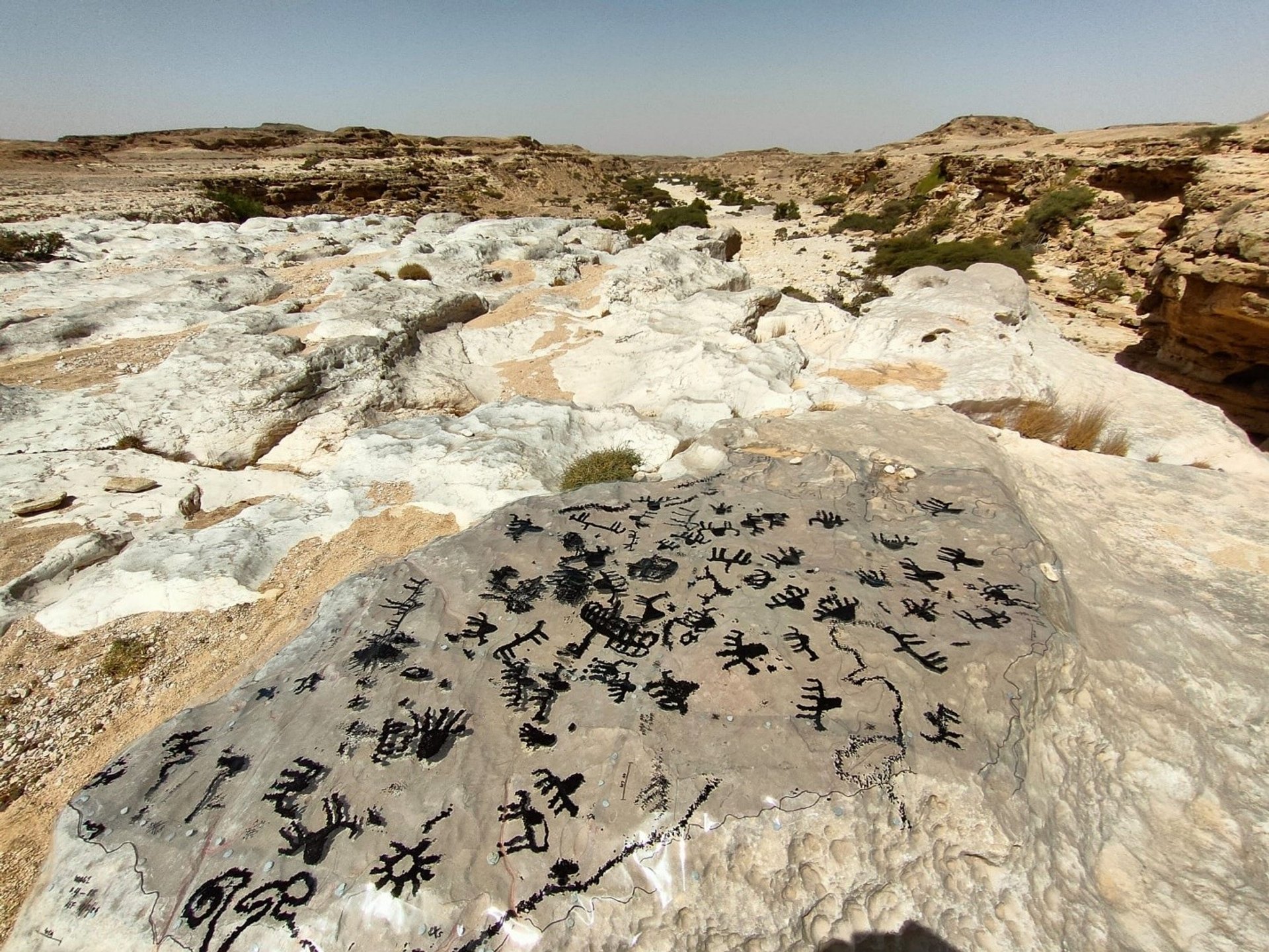
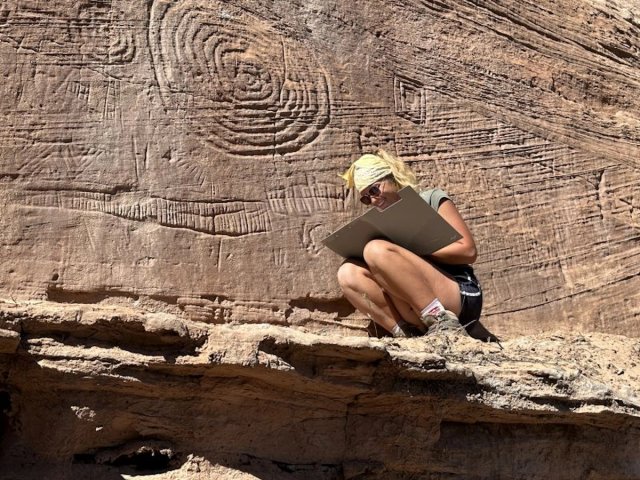
Previously discovered rock engravings associated with human settlements in the Oman desert spanning from 5000 BC to 1000AD Image courtesy of the Omani Ministry of Heritage and Tourism
Archaeologists are currently documenting the extremely fragile rock art sites in northern Oman using special photography and digital mapping techniques before further damage occurs, according to the online archaeology platform ArchaeOman. Methods including optically stimulated luminescence, radiocarbon dating and x-ray fluorescence analysis can help discover patterns in motifs and production techniques in the rock art, and determine how diachronic changes are connected to natural conditions or topographic features within the larger context of cultural and historical changes.
While the newly discovered rock art also depicts daily life, researchers believe that the sheer number of carvings concentrated on a single rock surface may suggest that the site held a special cultural importance as a meeting place tied to shared memory.
“These images remind us that rock art is not primitive decoration, but one of humanity’s earliest and most enduring artistic languages,” says Perez Gomez. “Whether carved into the stones of Arabia or painted on the ancient rocks of the Guiana Shield, such works reveal a profound human impulse to leave marks that survive beyond individual lives and continue to speak across time.”