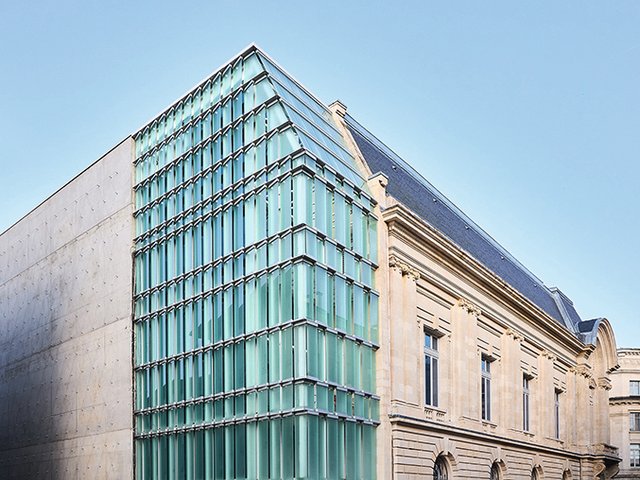
Home to the unique collection of the Brazilian-born Parisian art dealer Cérès Franco, La Coopérative-Musée Cérès Franco in Montolieu, southern France, reopens on 20 June after a four-year hiatus and extensive renovation.
Its expansion enabled the museum, housed in a 1939 Art Deco winery, to attain Musée de France status last year, fulfilling a condition Franco had attached to her gift of nearly 1,750 of her life’s treasures. Franco wanted the French state to take under its wing art that it had previously ignored, explains the museum’s director, Maximilien Fortier.
Over the latter half of the 20th-century, a huge collection of between 3,000 and 4,500 pieces by artists from around the world passed through Franco’s hands, most of whom are entirely unrepresented in France’s other public collections. Among them are leading proponents of the mid-century avant-garde CoBrA movement and the 1960s New Realism movement, as defined by the art critic Pierre Restany, along with outsider artists, artistes bruts and folk artists. She was particularly drawn to naïve artists from across South America, especially Brazil’s Primitivos. This focus means the museum now holds the country’s leading collection of works by artists of Brazilian heritage.
The museum first opened its doors in 2015, six years before Franco died. Her stipulation that the museum should attain Musée de France status within ten years meant pressure: it had no adequate storage facilities, offices or temperature control. The toilet was an outhouse in the garden.
In December 2025, after a €4.6m remodel, the culture ministry added it to the official roster, which counts 1,220 institutions nationwide. For Fortier, this means access to a countrywide peer network and considerable financial assistance from the Direction Régionale et des Affaires Culturelles (DRAC). He says the museum recently completed an urgent conservation project to rid the collection of insects, which had been detected as early as the 2000s. “That’s a €43,000 operation,” he says. “We got €25,000 in aid from the DRAC.”
The ministry’s announcement cited Franco’s visionary independence in “defending, with passion, singular artists often relegated to the margins of mainstream trends, who prioritised creative freedom, expressivity and personal engagement”.
That serves as an accurate description of Franco herself. A gallerist, collector, art critic and poet, she was born in 1926 in Bagé, Brazil. After art history studies at Columbia University under the art historian Meyer Shapiro, she moved to Paris in 1951 and instantly fell in with an experimental crowd. Turning to curation well before it was an established profession, she embarked on a mad-cap programme of exhibitions. These were often thematic. In 1962 she invited artists to make something in a round or oval format and titled the show, L’Œil de Bœuf (ox eye).

An untitled work by Paulina Laks Eizirik, one of the many unsung artists championed by Cérès Franco Photo: © Hervé Samzun, courtesy of La Coopérative-Musée Cérès Franco
In another instance, she invited artists to create a stamp of herself, “Cérès”, the Roman goddess of agriculture, being both her namesake and the figure depicted on the first French postage stamp (the 20 centimes noir, released in 1849).
Nurture and support for artists
In 1972 Franco opened her first gallery, L’Œil de Bœuf, at 58 rue Quincampoix, a stone’s throw from the Centre Pompidou. As a student, she had cultivated both a love of ancient art and a compulsion to nurture and support the artists of her time. Two encounters in Paris proved life-changing.
The first was with the Dutch artist Guillaume Corneille (1922-2010), who co-founded the CoBrA movement in the late 1940s and cleaved to the unfetteredness of children’s drawings. The second was with Michel Macréau (1935-95), the French artist associated with art brut and free figuration. Fortier says Musée Cérès Franco is the only Musée de France to hold any of his works: Franco, he says, “was a great defender of this artist, who, today, is sadly completely unknown in France”.
Hailing from a wealthy, landed family, Franco had long had the means to buy what she liked. Quite what that was, as Fortier puts it, is however “pretty undefinable”. In her later years, she would speak of the myriad works that bejewelled her walls from floor to ceiling as her “children”. Of the artists to whom she was so loyal for so long, she said they were the ultimate “guarantee of authenticity”.
The museum aims to show that, idiosyncrasies aside, Franco knew exactly what she was doing. Fortier insisted the family include her personal archive with the works she donated to the institution, because it details her thinking and provides invaluable information, in terms of provenance, in particular. This is especially important where works by outsider artists are concerned.
Franco felt it her responsibility to support artists who fell outside of le goût officiel—the official taste
“From 1980, there is a shift in her thinking,” Fortier says. “She starts collecting what she knows [the Centre] Pompidou will not.” She felt it her responsibility to support artists who fell outside of le goût officiel (the official taste), as she liked to put it.
The celebrated Moroccan outsider artist, Chaïbia(aka Chaïbia Talal, 1929-2004), is, as Fortier says, “the museum’s international calling card”. Chaïbia started making work in 1963 after hearing voices tell her, in a dream, to “get up and paint, you have a palace to decorate!” Franco’s gallery gave Chaïbia her first solo show in Paris just over a decade later, in 1974. Several of her gouaches and oils are held in the collection.
For Franco, what mattered more than anything was freedom to create. Of her themed shows, she said, “I don’t give artists a dogma to study. I give them a limit to exceed,” which, as Fortier puts it, “is much more interesting.”