Are they a jolly couple enjoying a quiet moment in their courtyard—or are they playing a drinking game that could lead to drunkenness and debauchery?
The return of a painted-out soldier to the middle of a 17th-century painting by the Dutch master Pieter de Hooch gives a new interpretation to the classic work, now on show at the Mauritshuis in The Hague.
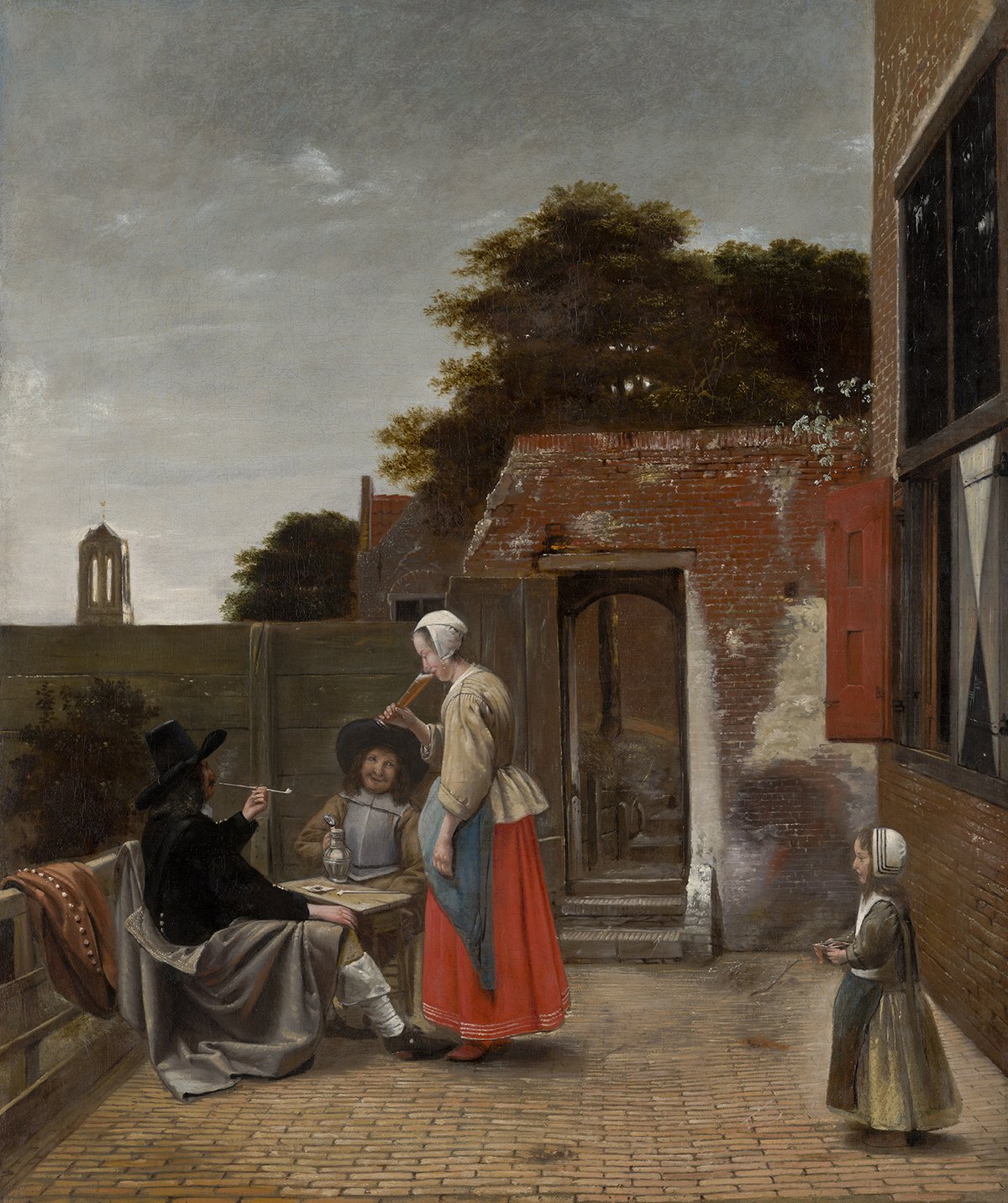
When restorers set to work on A Man Smoking and a Woman Drinking in a Courtyard (around 1658-60) they were aware that a soldier sitting right at the heart of the painting had been painted out at some stage in its history. Another version of the painting, titled A Dutch Courtyard and held at the National Gallery of Art in Washington, DC, still contains this red-faced soldier.
So the Dutch restorers, Sabrina Meloni and Abbie Vandivere, decided for the first time to paint the soldier back on to the canvas at the Mauritshuis, using a technique that makes their work reversible.
“The men are challenging the woman to a drinking game—that is the subject of the painting," said Meloni in a press release. She adds, however, that discolouration of the rest of the painting affected the way they approached the work. “Over the past 360 years, the painting's pigments have partially discoloured. We therefore chose a more understated, less detailed depiction of the soldier [to help the figure blend in].”
The Dutch painting has been renamed Figures in a Courtyard.
Judith Niessen, the head of collections and research at the Mauritshuis, explains to The Art Newspaper how the restoration changes the way the painting can be read.
“With only the man and the woman at the table, the painting seems to be way more innocent than with the second man present," she says.
"Where she would be just drinking a glass of beer before, now it is much more obvious that they are playing a drinking game, where she is drinking the pass-glass and the two man are not. [It] is now much more moralistic, which was the intention of De Hooch."
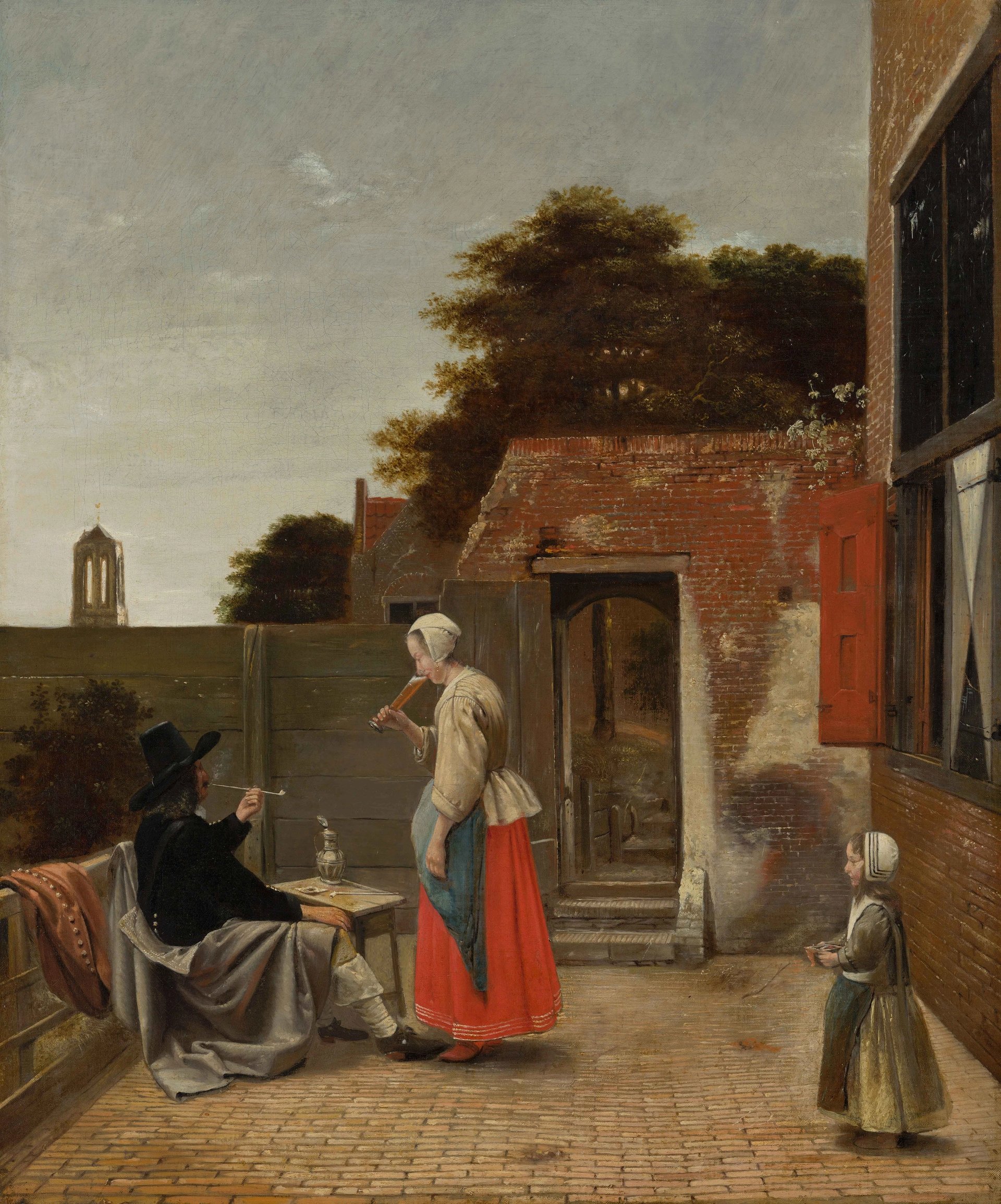
Pieter de Hooch’s A Man Smoking and a Woman Drinking in a Courtyard (around 1658-60) before the restoration work
Courtesy of the Mauritshuis
Returning the central figure, she and the restorers point out, also brings back the physical balance of the painting.
The Mauritshuis did an extensive investigation into the painting but was unable to answer the question of who had removed the soldier from the work and why. The museum says it was certainly not De Hooch who had done so, while adding that it was possible a later owner wanted to make the painting more “unique”, or that the figure was painted over because soldiers were no longer everyday figures in society or someone simply didn't like them. A catalogue listing for the painting at the John Smith Gallery in London in 1833 described it without the soldier.
In recent years, there has been more attention placed on De Hooch who, like Vermeer, was a painter from the city of Delft and was particularly known for the way he portrayed its architecture, interiors and daily life.
Immoral doings are frequently portrayed in Dutch art of this period, although there is some debate about whether the buying public was more interested in a moralising message or in the unsaintly activities themselves.