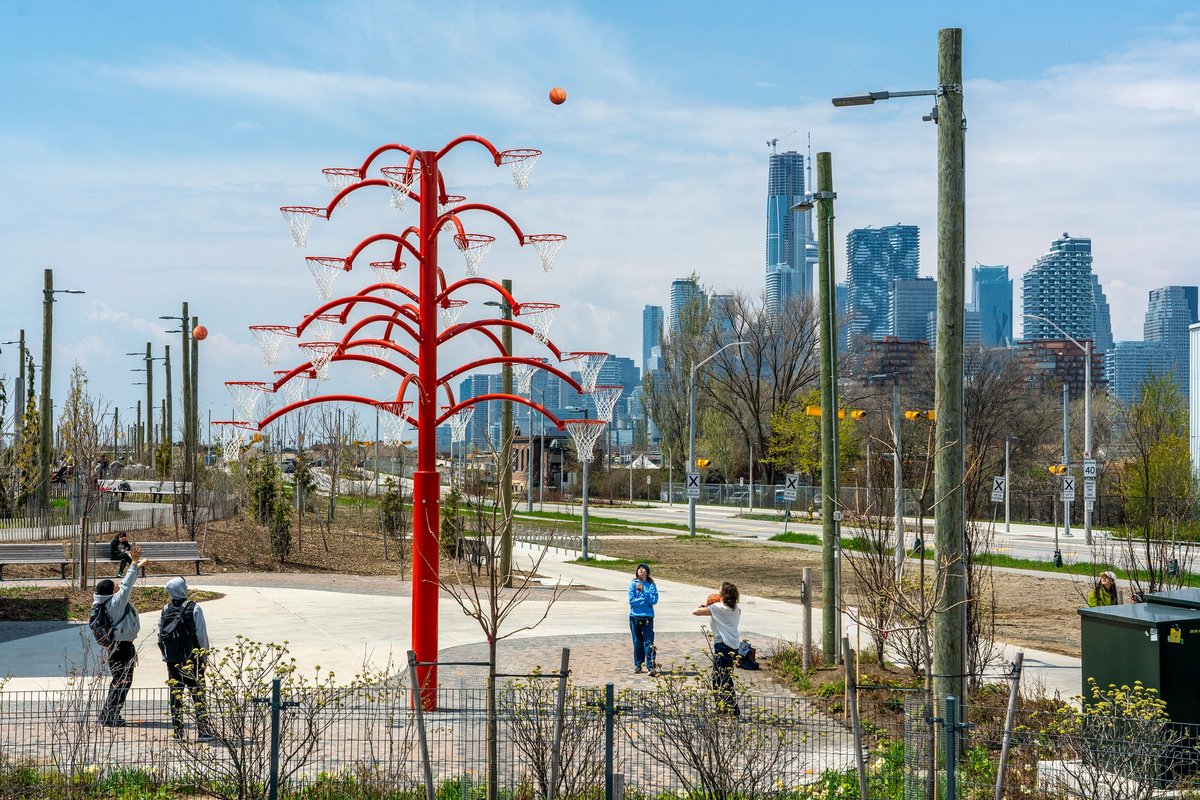
Coming upon Toronto’s Biidaasige Park in the Port Lands area, a curious sight emerges in the form of a monumental tree-like structure covered in red basketball hoops. With more than 20 nets at different heights hanging off the ends of ‘branches’, Orange Functional (2022) by the Cuban artist Alexandre Arrechea is part of the new Lassonde Art Trail (Lat), an ambitious initiative that opened in June to bring public art to the city’s waterfront. Years in the making, the free, open-air art trail marks a significant milestone in a larger C$1.4bn ($1bn) revitalisation project and feat of engineering to improve Toronto’s relationship with its waterways.
“The city was built with its back to the river,” says Chloë Catán, the executive director of Lat. “For many reasons, Toronto cut itself off from the waterfront, and areas like the Port Lands have long sat underused.” Connecting downtown with Lake Ontario, the Port Lands span hundreds of acres, yet for much of the 20th century, the area was synonymous with heavy industry, polluted soil and neglected infrastructure.
Over the past decade, however, a vast public investment programme has sought to reverse that legacy. Through years of engineering, several improvements were made, including the creation of Ookwemin Minising, a new island where Biidaasige Park is located. Additionally, the city rerouted the mouth of the Don River, installed infrastructure and restored wetlands to protect Toronto from floods. “Biidaasige Park was conceived as a destination,” Catán says. “You can come down here and kayak, play in the playground, have a barbecue. The art trail is another layer to this vibrant space.”
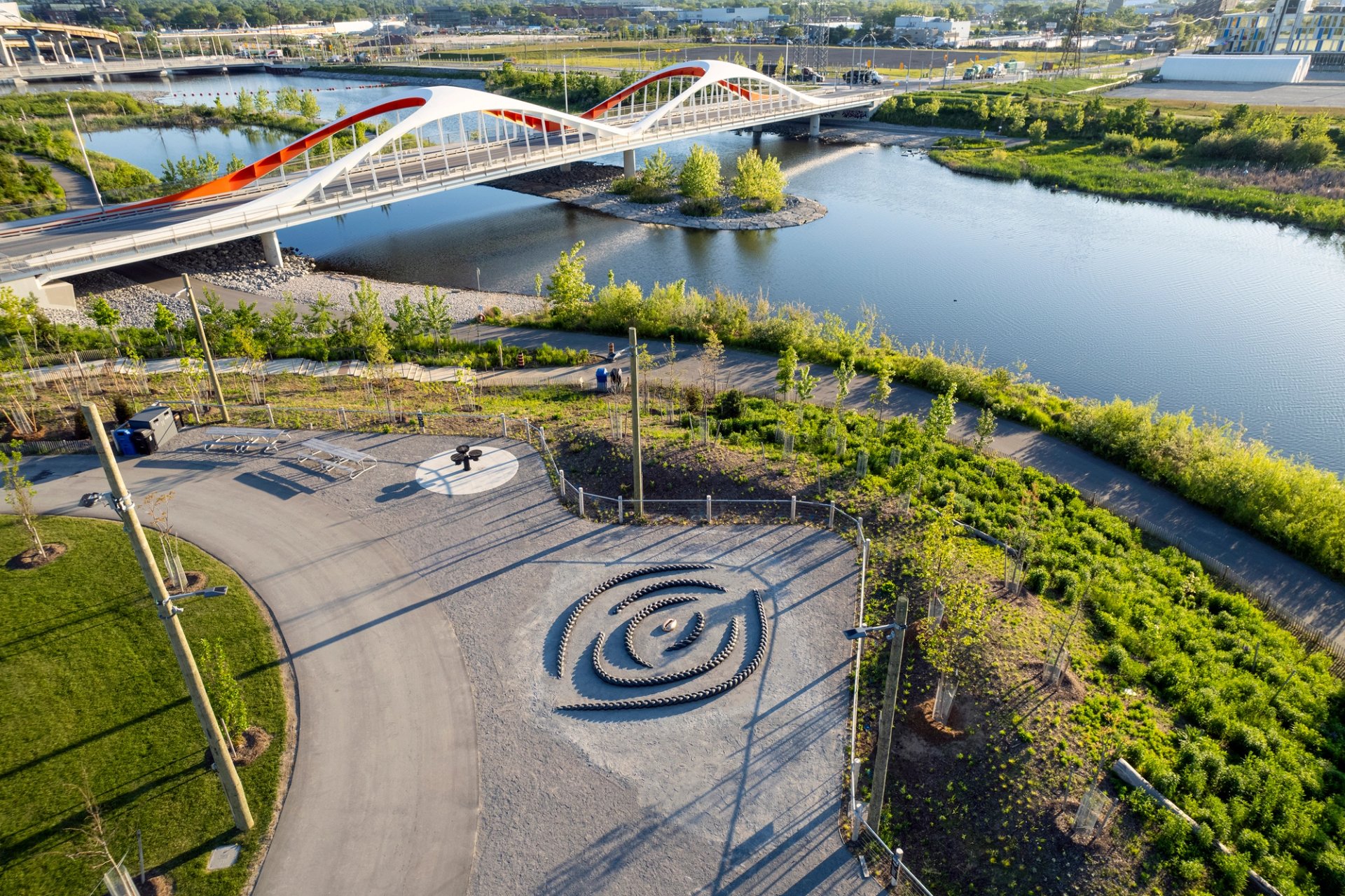
An aerial view of Oluseye's Crown Act (2026), part of the Lassonde Art Trail
Photo: Vid Ingelevics and Ryan Walker; courtesy the artist and Lassonde Art Trail
Funded through a C$25m gift from the philanthropist Pierre Lassonde, the art trail spans two and a half miles and brings together both permanent and temporary artworks. The inaugural group features 17 pieces, the majority of which are new commissions, with the first round unveiled in June. Arrechea’s basketball hoops are among the most playful of Lat’s projects. Visitors can bring their own balls and try their hand at shooting into the towering nets. If they aim high, they might score at a lower level even if they miss the higher net. “I think of it like the many decisions we have in life,” Arrechea says. “We can aim for one spot and take that path, but we might end up somewhere else.” The piece quickly drew interest on opening day as children and adults alike showed up to play ball.
Additional works will continue to be installed as the park is completed and, while most are temporary, two permanent sculptures by the Cree artist Kent Monkman and the Portuguese sculptor Joana Vasconcelos will be added in the coming months. Monkman’s commission is his first public sculpture and will resemble a condominium full of beavers set against the backdrop of downtown Toronto. Beavers near the condo will engage in cheeky activities ranging from belting out a tune to emerging from a seashell like Botticelli’s Venus.
“The view of the skyline behind Kent’s work is unfamiliar to many because very few people visited the area in its previous state,” says November Paynter, Lat’s artistic director and chief curator. “We envision the works in this part of the park as responding to the view and thinking about our relationship to the urban environment.”
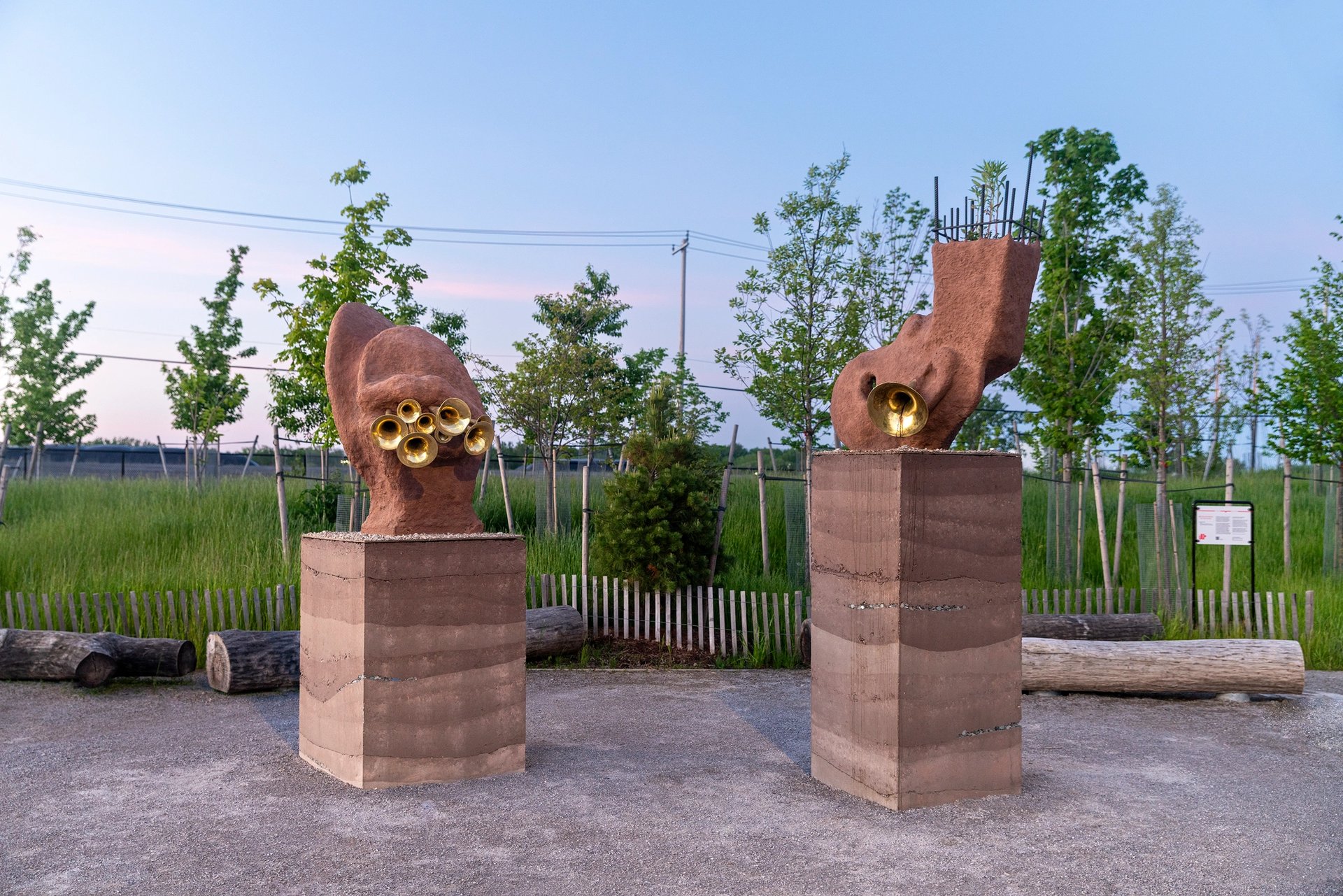
Kara Hamilton's Delicate Matter (for the birds) (2026) Photo: Vid Ingelevics and Ryan Walker; courtesy of the artist and Lassonde Art Trail
The waterfront long predates Toronto itself, and the curatorial programme acknowledges the area’s Indigeneity, histories of settlement, migration and ecological stewardship that extend far beyond the city’s modern development. “We wanted every aspect of the artists on view to be diverse, whether that’s their background, their materials and approaches to art, even whether they have much or any experience with public spaces,” Paynter says. “Potentially 1.5 million visitors will come each year, many for reasons other than art. We want to welcome people who have never interacted with contemporary art.”
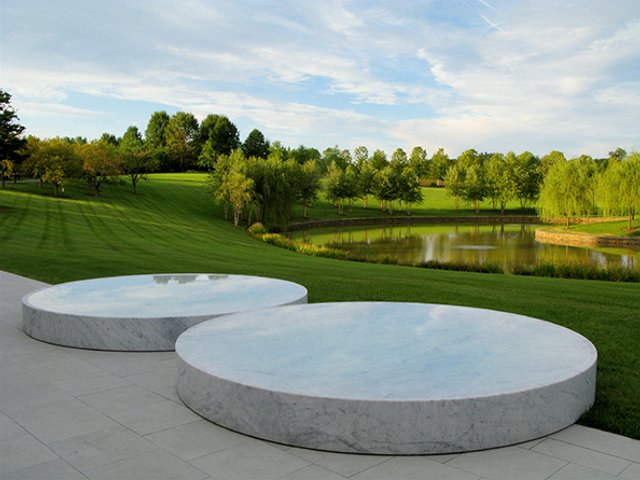
Other pieces centre on sustainability and regeneration, inviting visitors to think about how the natural world fits within the urban context of Toronto. The Canadian artist Kara Hamilton’s site-responsive commission, Delicate Matter (for the birds) (2026), includes two rammed earth plinths whose surfaces resemble stratigraphic layers with embedded beach glass. On top are abstract sculptures with brass instruments, suggesting the artworks are in conversation with each other and with the visitors. Atop one piece sits a vessel with hyssop plants to support pollination.
Also exploring the environment, the Japanese-Canadian artist Alexa Kumiko Hatanaka created a series of fish-shaped sculptures that blow in the wind atop flagpoles. Called against the wind, with the wind (2026), the work borrows from the ancient myth of a carp that swam upstream for years and was rewarded by being turned into a dragon. Hatanaka’s fish are based on local species, including the pickerel and pumpkinseed, which have returned to the river.
“I was thinking of the fish turning into a dragon and the message of perseverance in relation to the Don River revitalisation,” Hatanaka says. “Several fish species, including the invasive carp, have returned to the area. They offer a real-life example of strength and determination. And they’re a reminder of the importance of protecting the natural environment.”