A sensational discovery of an ancient Roman shipwreck off the coast of Sicily promises to provide new information about ancient Mediterranean trade routes.
Earlier this month, two Italian divers came across the wreck in the Strait of Sicily, some three miles off the coast of Mazara del Vallo, a fishing port in the far-west of the island, down the coast from Marsala. The wreckage is 21m long and 6m wide, according to reports in local media.
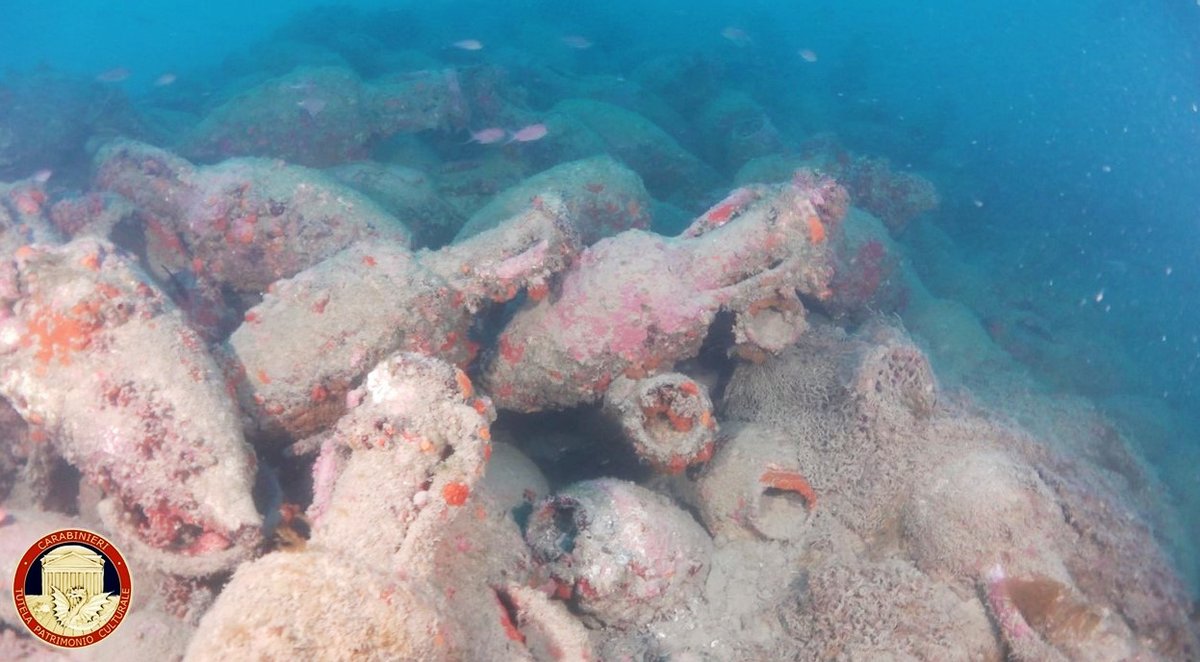
Believed to date to between the second and first centuries BC, the site—found at a depth of 46m—contains hundreds of amphoras, the pointy-bottomed vessels used to store and transport wine in antiquity. According to Italy’s Ministry of Culture, which announced the finding on 8 August, most of the amphoras are of a type known as Dressel 1A, two-handled ceramic jars that could hold up to around 20l of liquid.
The diver and champion spear fisherman Giacomo De Mola wrote on Instagram on 9 August that he and fellow diver Igor Bisulli were investigating what their scanning device indicated was “simple rock”. But “something compelled me to check it out,” he wrote. Then on closer inspection while diving, he realised it was in fact a 2,000-year-old historic find.
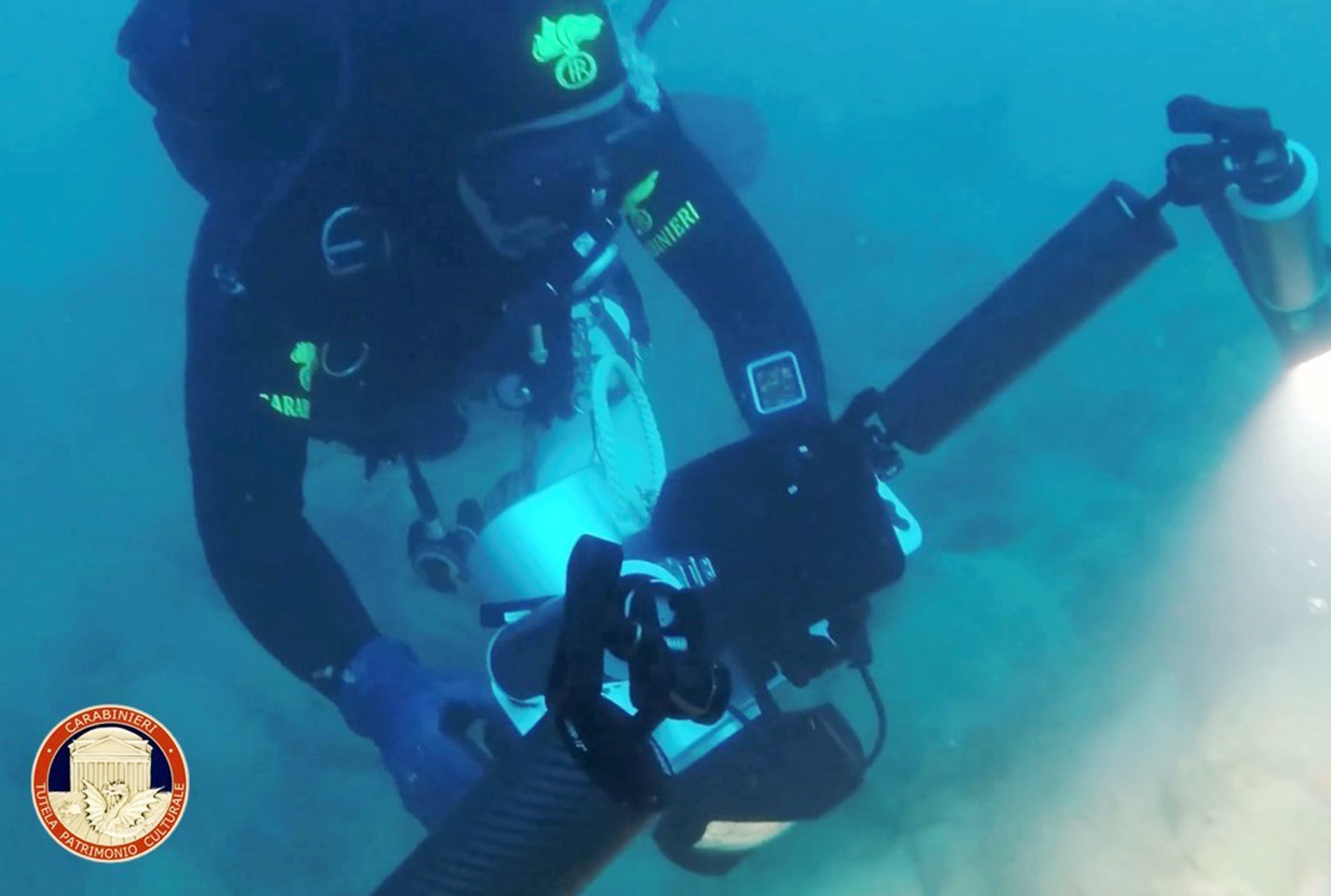
The shipwreck was discovered by fishermen before being investigated further by local authorities. Image courtesy of the Italian Ministry of Culture
The divers contacted the authorities and the significance of the site was initially confirmed by a joint inspection of heritage authorities and underwater search units, says the Ministry of Culture. Photographs and a video of the wreck show mounds of the distinctive ceramic vessels chock-a-block on the seabed. Alessandro Giuli, Italy’s minister of culture, has declared it “one of the most important underwater archaeological discoveries of recent years”.
“This is an extraordinary site,” says David Gibbins, a maritime archaeologist and author of the book A History of the World in Twelve Shipwrecks (2024). He adds that the fate of the site would likely be one of conservation in situ, rather than complete excavation and removal. “I think the view would be that you only remove what's seemed to be essential to characterise the site—to date it and to give a good account of the cargo material,” he tells The Art Newspaper, adding that perhaps there could be “a limited excavation, which might go down to the hull, if it survives”.
The innovation of scuba diving in the 1940s allowed for the exploration of this type of offshore Mediterranean shipwreck, Gibbins says. This initially led to unscientific disruptions and outright looting, but Italy has more recently led the way in the managing and monitoring of shipwreck sites.
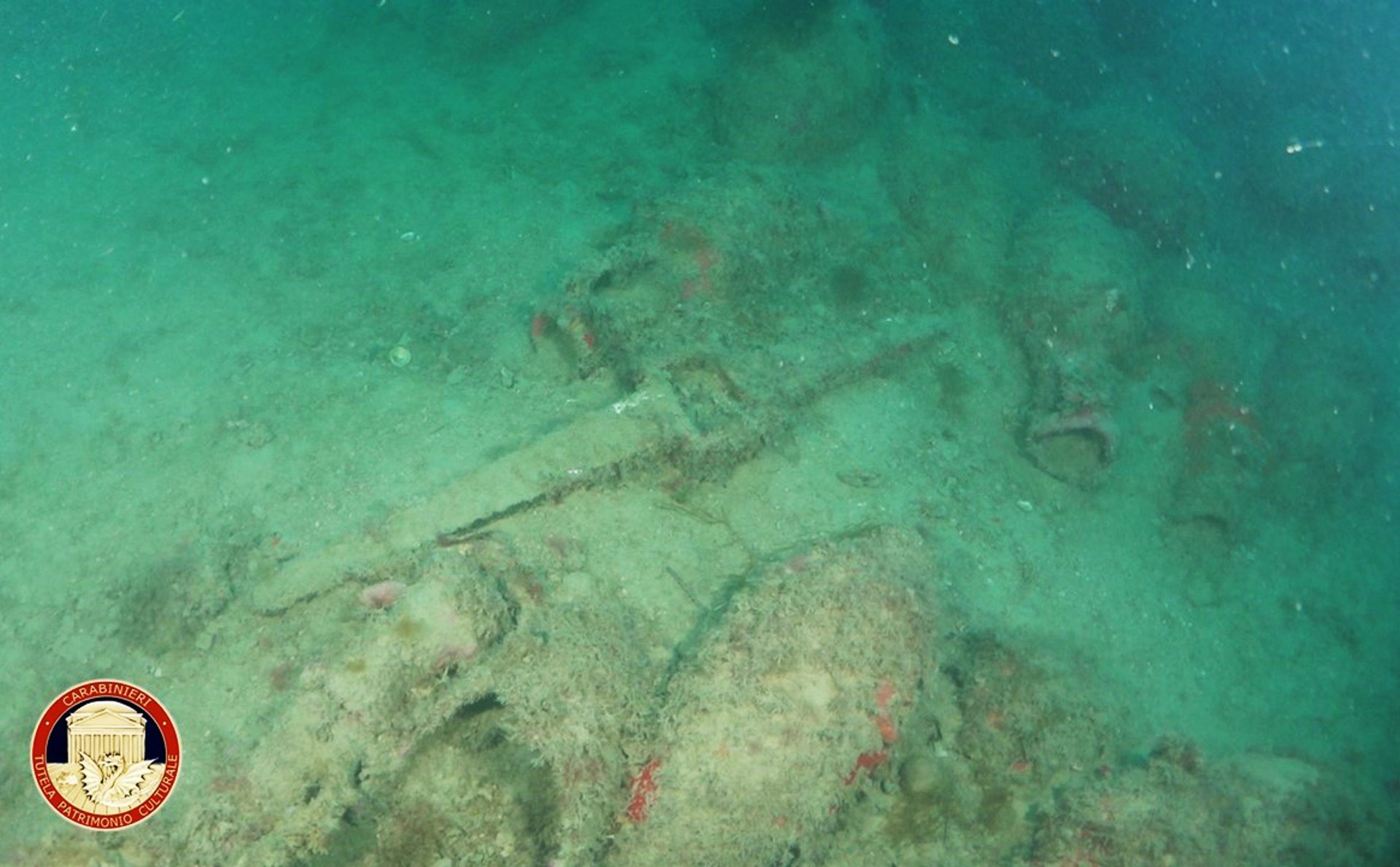
Experts have dated the vessel to the first or second century BC Image courtesy of the Italian Ministry of Culture
Looters, in any case, might be hard-pressed to find gold or other precious material in an ancient wreck like this, Gibbins says. “The huge value of these cargoes in antiquity was in the wine that was carried in these amphoras,” which he says were typically the product of estates controlled by wealthy Roman senators and other landowners. Expertly sealed, some of the amphoras may still contain wine residue, Gibbins says, and archaeologists can look forward to finding telltale inscriptions, impressed onto the vessels before they were fired, that could reveal much more about their origins.
The precise location of the wreck itself—in addition to its massive scale—is also a cause for excitement, Gibbins adds. Southwest Sicily was “fairly off the main trade route” that connected ancient Rome’s big wine estates, which ran from what is now Tuscany down to the area around present-day Naples. At the time of the shipwreck, he says, large quantities of Italian wine were regularly going to the Celtic chieftains of Gaul, even before it was finally conquered by Julius Caesar around 50 BC.
But the location means that it’s “interesting to speculate where the ship was taking this cargo”, Gibbins says. He believes it could be North Africa—a Roman possession starting from the mid-second century BC—or possibly Spain. Investigating the new Mazara del Vallo wreck, Gibbins adds, might tell us “an additional interesting story about trade routes and trading activities” during a period when Rome was starting to transition from an expansive if chaotic republic into an established empire.