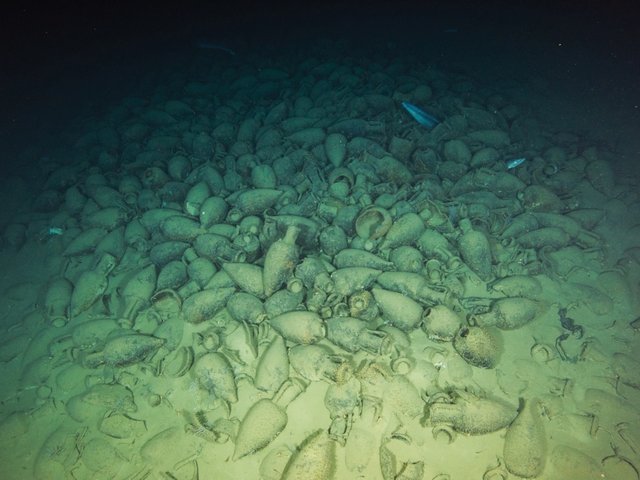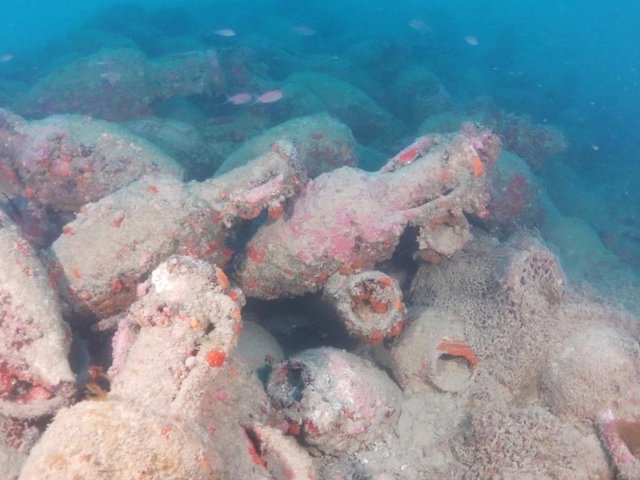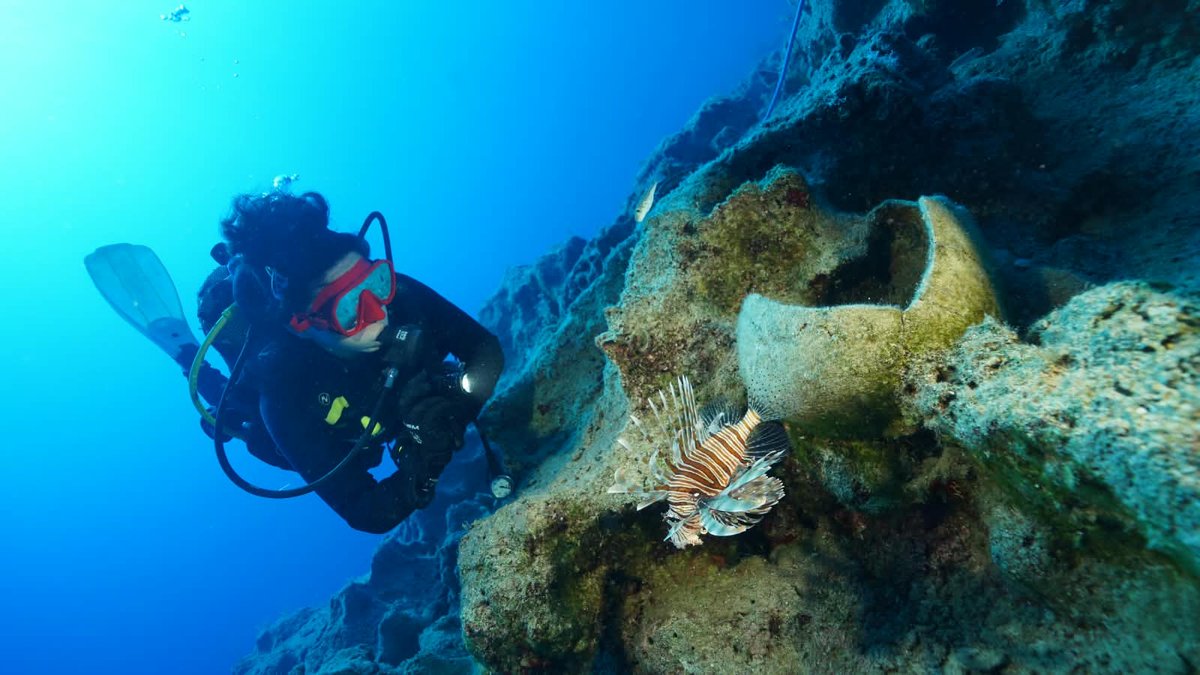
Archaeologists in Turkey have discovered what they believe may be the remains of the world’s oldest known shipwreck. About 30 ceramic storage jars, or amphorae, were found near the small island of Kekova off Turkey’s south-west coast, said Hakan Öniz, a professor of archaeology at Akdeniz University who lead the excavation by the Mediterranean Archaeology Association. They are believed to belong to a vessel that sank some 4,500 years ago, when Bronze Age communities were building far-reaching trade networks across the eastern Mediterranean.
Some of the clay containers, lying on a slope in clear waters at depths of between 25 and 40 metres, still contain the residue of the goods they carried. The jars’ distinctive shape and clay are characteristic of pottery produced in the Jordan Valley during the Early Bronze Age, providing new clues as to the movement of goods between the Levant, Egypt and the Aegean Sea, Öniz told The Art Newspaper. The wooden ship, which may have been 10 metres long, that carried the amphorae has long since disappeared, likely eaten away by Teredo navalis, a wood-boring mollusc common in the Mediterranean.
“This wreck has become the first scientific evidence in the world that maritime routes existed and were used during that period,” he said. While historical sources indicated seaborne commerce occured in the eastern Mediterranean at the time, the Kekova wreck provides rare physical proof, he said.
The site was first identified in 2022 during a survey of the Kekova area, where strong currents can run against the wind through a narrow passage, creating turbulent conditions for ships.
Öniz’s team initially thought the flat-bottomed jars featuring two side handles, which resemble traditional Turkish water jugs, were from the Ottoman period. “To us, it was just another wreck, one of 434,” he says, referring to the number of shipwrecks documented along the coast. The breakthrough came when Öniz encountered similar, far older pottery in a publication on Egyptian archaeology. “I thought, ‘By God.’”

An artefact being removed from the seabed
Photo: Hakan Öniz/Akdeniz University
Öniz consulted with Karin Sowada, an Egyptologist at Macquarie University in Australia, who examined the finds and confirmed their resemblance to imported Levantine amphorae, he said. Similar examples have been found in Egypt and at sites associated with Troy and Minoan Crete.
Preliminary finds, published in the Journal of Maritime Archaeology in July, date the finds to around 2700-2400 BCE. This would make the Kekova wreck older than the current holder of the title for the oldest shipwreck ever discovered: a vessel believed to be 4,200 years old that was found in 1975 off the Greek island of Dokos in the Aegean.
The amphorae “shed light on the deep-rooted history of trade along the Anatolian coast,” Mehmet Nuri Ersoy, Turkey’s culture minister, said in a social media post. “These containers, believed to have been used to transport olive oil or wine, bear important traces of trade and cultural interaction in the eastern Mediterranean.”
Tree resin, dried meat or dried fish are other possibilities for the cargo. Researchers are using X-ray fluorescence and X-ray diffraction to analyse the pottery’s material and contents, Öniz said.
One perforated ceramic vessel, bearing nine symbols that may represent spiritual beliefs, may have been used by the sailors as a churn. Öniz said the ship may have carried a handful of goats to make butter or cheese during the long voyage before they were consumed for meat.
Such glimpses of life aboard an ancient trading vessel remind Öniz of the people who never returned home. “You wonder what the captain was feeling as the ship went down, what the sailors went through trying to reach the shore [and] their families waiting for them in port,” he said.