The federal government of Canada still cannot locate 111 Indigenous works missing from its art collection, the Canadian Press recently reported, nearly two years after an internal audit found it could not account for 132 pieces.
The works that are unaccounted for are all part of the Indigenous Art Centre’s collection, established by the federal government in 1965 to support the creation, promotion and preservation of contemporary Indigenous art in Canada. According to its website, the centre’s collection includes more than 5,000 works by more than 990 Indigenous artists, which were acquired through a peer-juried process. The collection of works by First Nations, Métis and Inuit artists is now valued at around C$14.4m ($10.4m) and includes works by such renowned artists as Norval Morrisseau, Christi Belcourt, Elisapee Ishulutaq and Kent Monkman.
An internal audit of the collection from November 2024, which tracked the centre’s operations from April 2019 to August 2024, was posted last October on the website of the federal department known as Crown-Indigenous Relations and Northern Affairs Canada (CIRCNAC), which the centre is a part of. The report said the centre could not account for 132 items in the collection but did not identify specific works or their value.
“The Indigenous Art Collection has existed for decades and includes thousands of artworks that have been acquired, exhibited, loaned, stored and transferred over time,” Maryéva Métellus, a spokesperson for CIRNAC, tells The Art Newspaper. “Accounting for artworks can require the review and reconciliation of historical inventory records, tracking documentation, loan and exhibition records, storage records and collection-management databases. In some cases, records span multiple decades and systems, requiring detailed verification before an artwork’s status can be confirmed.”
Métellus adds: “An ‘unaccounted for’ designation does not mean an artwork is lost or stolen. Rather, it is an inventory and records-management designation assigned to an artwork whose location cannot be confirmed through available documentation. It indicates that further review and reconciliation of records is required before the artwork’s status can be confirmed. There are no criminal investigations underway. Of the remaining 111 artworks still to be accounted for, 20 are reproductions.”
To date, Métellus says, 17 of the 132 artworks identified as “unaccounted for” in the 2024 audit have since been resolved: six of them were located in the centre’s storage facility, 11 were found to be duplicate entries in the database. An additional four works have been flagged as potential duplicate entries. As a result, 111 works are still unaccounted for.
“We recognise that past practices for managing the Indigenous Art Collection have not met the standards Canadians expect,” Métellus says. “That’s why the Indigenous Art Centre began updating its approach to how artworks are acquired, cared for and exhibited—before the audit was even published. This important work is ongoing and reflects our commitment to meaningful change.”
The renowned artist Lawrence Paul Yuxweluptun, who is of Cowichan (Hul’q’umi’num Coast Salish) and Okanagan (Syilx) descent, had his 1985 painting Leaving My Reservation to Go to Ottawa and Fight for a New Constitution acquired by the Indigenous Art Centre decades ago. He expressed alarm at the number of works in the centre’s collection that remain unaccounted for, telling The Art Newspaper: “This is just another example of government incompetence... We expect that they’re going to look after the art.”
Yuxuluptan adds: “The Indigenous Art Centre should be shut down. There are institutions that can do a better job and be more responsible for native art. […] This is Canadian culture so let’s put it in the budget of the Canada Council for the Arts. Let’s change it to a national collection and hire someone competent to take care of it. This needs to be rectified.”
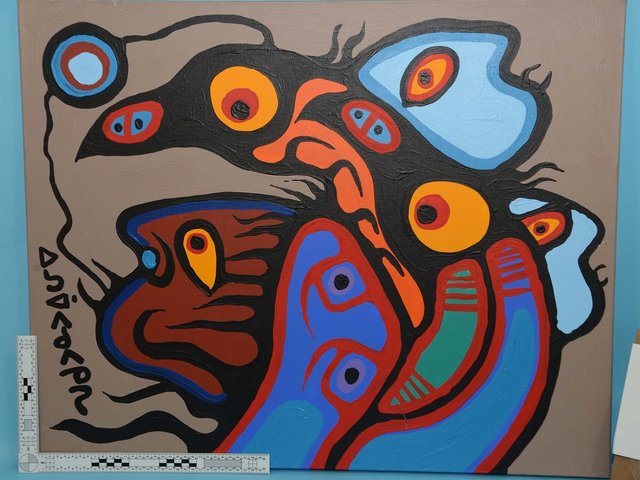
The centre also owns a masterpiece by the late Anishinaabe artist Norval Morrisseau, Androgyny (1983), which is current on view in the exhibition Love Medicine at the Mackenzie Art Gallery in Regina, Saskatchewan. Cory Dingle, the executive director of the Norval Morrisseau estate, has a more measured view of the works that the Indigenous Art Centre lost track of.
“We see this as a positive moment in Canada’s continuing cultural evolution—an opportunity to recognise that our art, history and cultural heritage deserve serious protection and investment,” Dingle says. “Our experience with CIRNAC and the people there has always been supportive and constructive, and we believe they, along with Canada’s cultural sector more broadly, deserve the resources and tools necessary to do this work properly.”