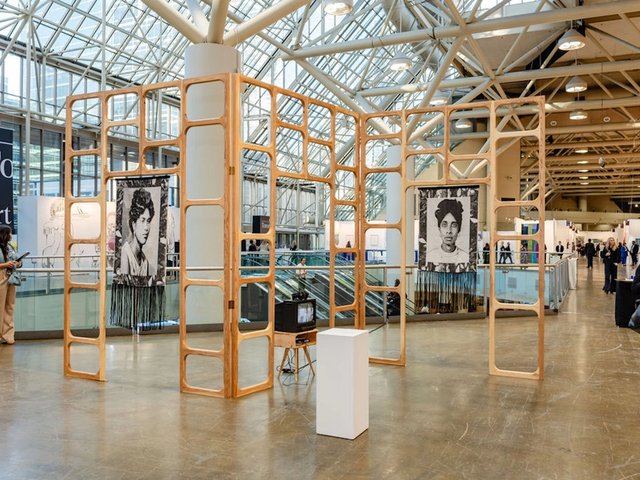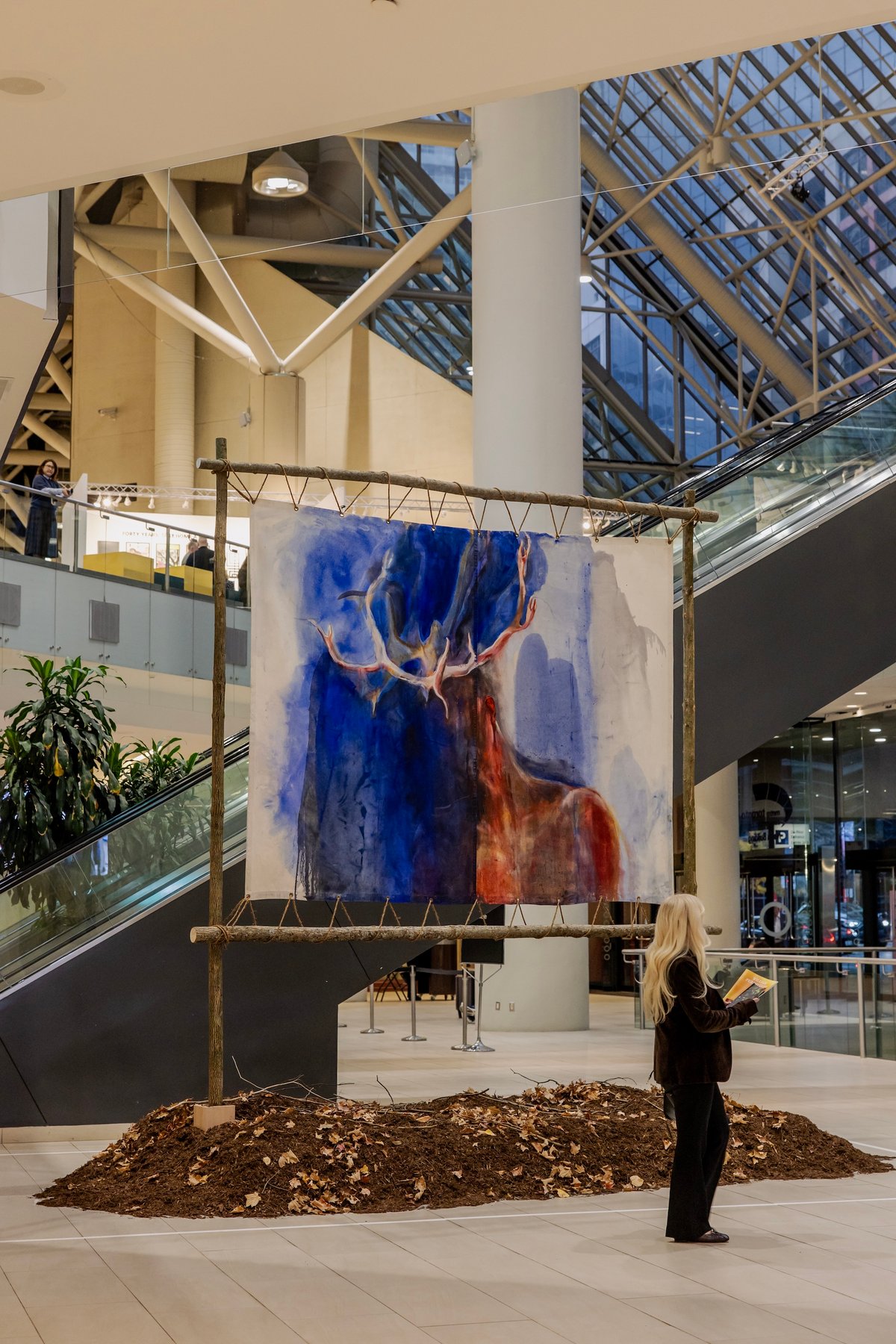
There is something strangely comforting about this year’s edition of Art Toronto (until 1 November), Canada’s biggest art fair. In spite of the vast 20,000 sq. ft of space it inhabits at the Metro Toronto Convention Centre, there is a sense of warmth and grounding in Canadian landscapes made manifest in the installation that welcomes visitors to the art fair’s 27th iteration: Untitled (Watching) (1996) by the late Lynn Donoghue and the first of her Caribou Tarp series to be shown in public, installed here on top of a pile of dirt.
Inspired by the artist’s time in Alberta in the mid 1990s, when she encountered discarded caribou antlers scattered across the tundra, the work speaks to one of the overarching themes at the fair this year, of a return to natural roots. But this Art Toronto is also about uniting the often-scattered Canadian art landscape and, as per the title of one series of talks at the fair, “Building a Stronger Arts Ecosystem”.
These are trying times for Canadian artists and galleries, hammered by a trade war with the US and larger macro-economic forces such as inflation, war and related fuel costs. Happily, though the fair’s new director Emily Jean Alexander tells The Art Newspaper that this year’s Art Toronto is “only down in capacity by 5%”, while some other international art fairs have pared back their exhibitor numbers more drastically. She says there are far fewer US galleries this year than in past editions, while 80% of the 105 exhibitors are Canadian. A commercial gallery from New Brunswick is participating for the first time, alongside dozens from British Columbia, Québec and Ontario. There is a pervasive tariffs-be-damned, “elbows up” sense of artistic solidarity afoot and, Alexander says, a renewed commitment to creating a sustainable art market in Canada.
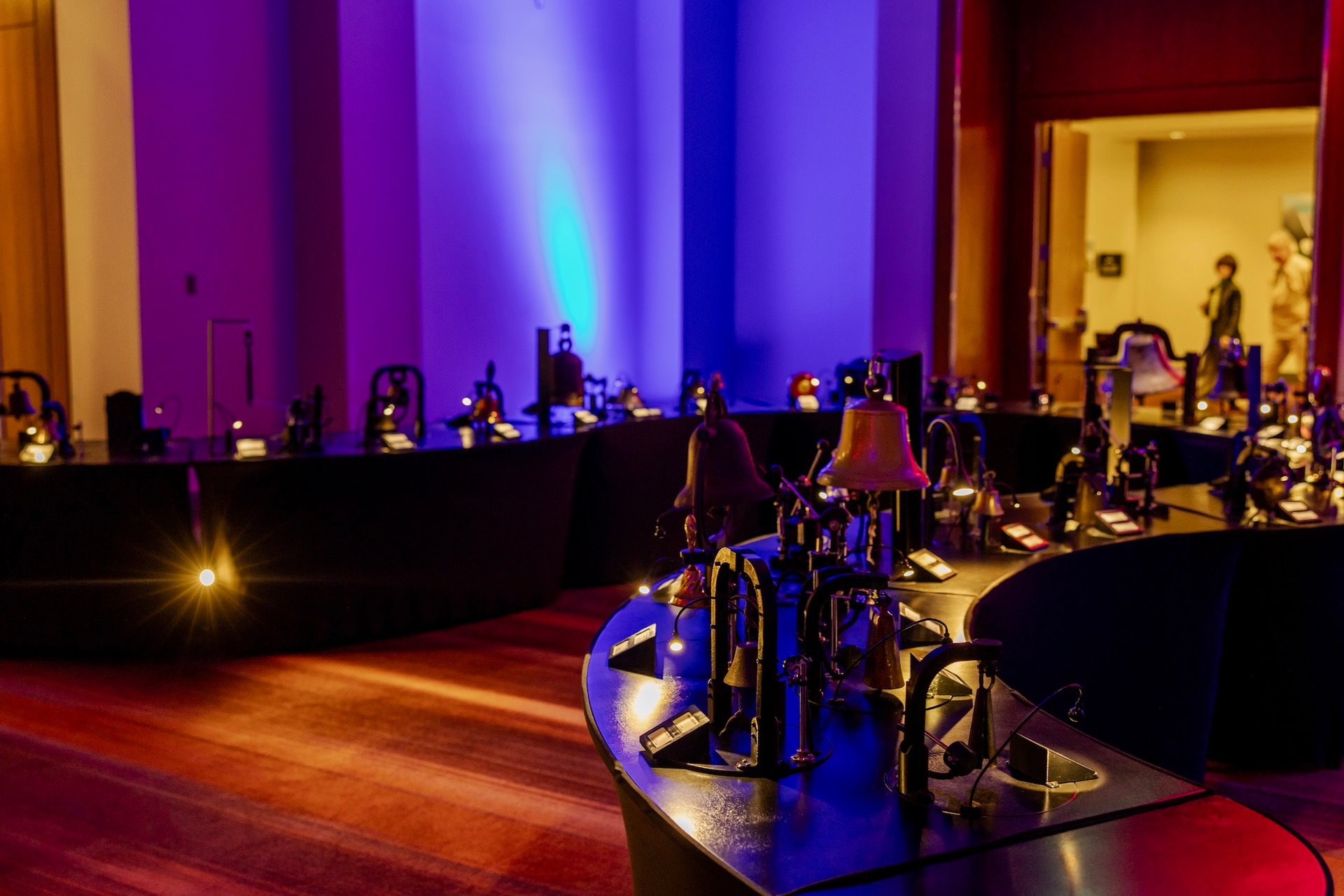
Rich Loen's Databells (2025) at Art Toronto, presented in partnership with Artist Project Photo: Jenna Marie Wakani
There is a nostalgic, McLuhanesque installation on the convention centre’s ground floor (presented with Art Toronto’s sister fair, Artist Project) by the Ottawa-based former software engineer Rich Loen. Titled Databells (2025), it connects a collection of bells with statistics ranging from the whimsical (the number of female orgasms per minute) to the digital (the number of TikTok videos played globally per minute) to the serious (amount of carbon dioxide removed from the earth’s atmosphere). The installation’s church and door bells chime at numerically precise intervals, creating a balm for our information-overloaded minds and sparking a meditative state akin to a Balinese temple. It is the perfect hybrid analogue-digital cleanse before the throng of Art Toronto’s main floor.
As visitors ascend into the fair, they can contemplate Kathy Slade’s monumental tapestry Sinking in the West (2023), presented by Mónica Reyes Gallery, which considers recurrence, time and landscape. Turning the corner, visitors will find the McMichael Canadian Art Collection stand; the Kleinburg, Ontario-based museum is currently closed for an expansion and renovation. At the fair it is showing off a recent acquisition, My First Medicine Teacher, a large-scale painting by the Métis artist Christi Belcourt.
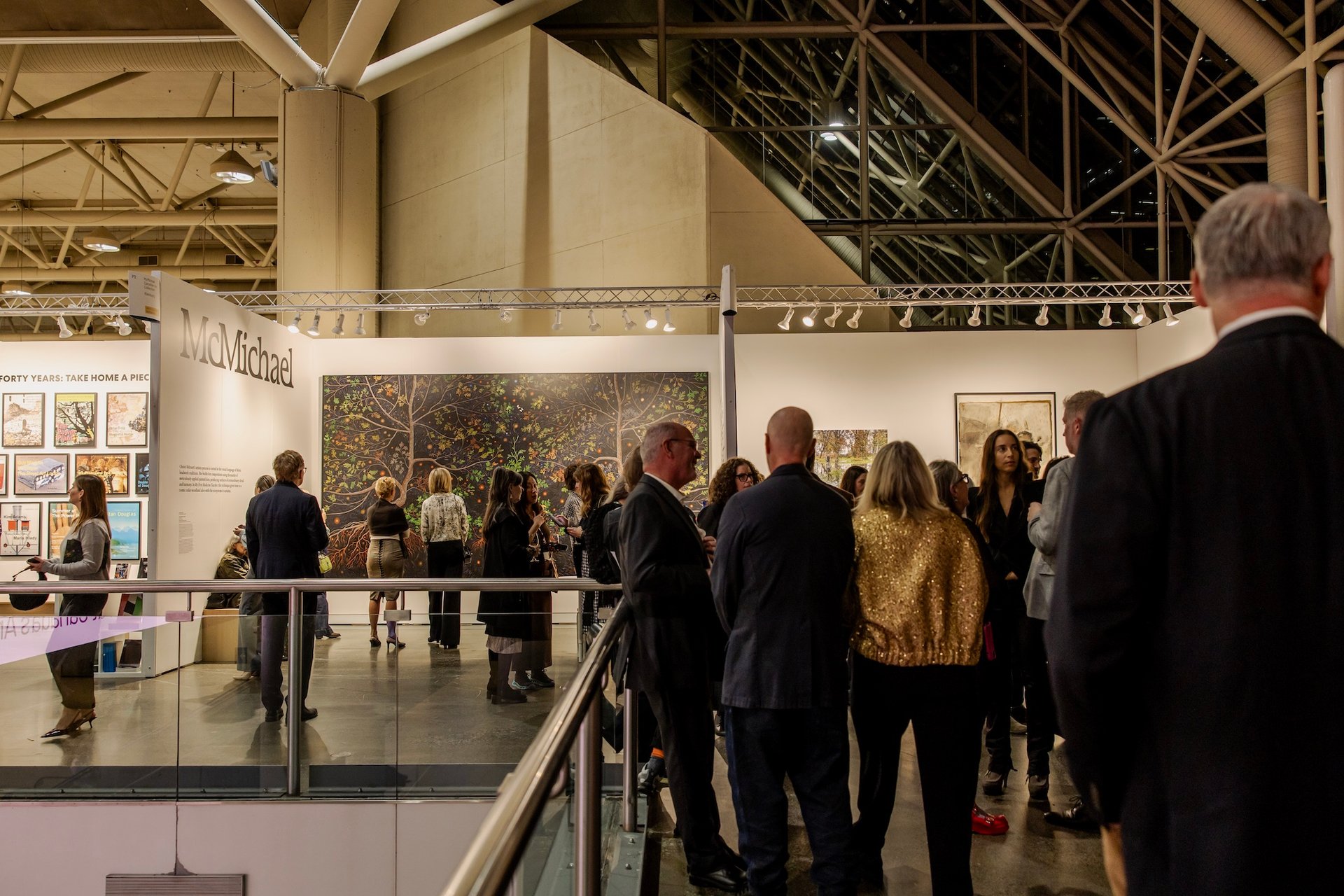
A view of Art Toronto including, at centre, the McMichael Canadian Art Collection's stand with My First Medicine Teacher by Christi Belcour Photo: Jenna Marie Wakani

Nearby, the Toronto-based Nicholas Metivier Gallery has two stands: one featuring a selection of works by gallery artists, the other showcasing four decades of work by the Canadian photographer Edward Burtynsky. The solo stand includes two new photographs from the artist’s forthcoming project, Mining: For the Future. Burtynsky tells The Art Newspaper that he got his start in aerial photography in Western Australia two decades ago and he returned there last year to revisit a subject he has explored since the mid 1980s. The textural, painterly images in vibrant colours reveal both the brutality and beauty of mining materials such as lithium, copper and cobalt that are needed for components in the technologies that will enable a more sustainable future.
Another highlight of the fair, on the stand of Montreal’s Galerie Nicolas Robert, is Ascension (for Bakers) by the artist Sameer Farooq. An extension of his ongoing Flatbread Library, a long-term research project centred on the political and social significance of the tandoor, the new work connects the forms of collected bakeware with the Buddhist stupa reliquary. The appetising installation features a gathering of vessels, bread forms and tools that honour bakers as sculptors, tracing how ideas, objects and food move across cultures.
Next to it is the Vancouver-based gallery Wil Aballe, whose stand includes a work that has been attracting curatorial interest: Karin Jones’s The Bond (dress) (2023) is a mixed-media take on Queen Victoria’s wedding gown re-imagined with blonde hair extensions as a brilliant expression of the politics of adornment and beauty within contemporary material culture.
Additional eye-catching installations at the fair include Douglas Scholes’s (This is) What happens when a thing is maintained (?) (2024), a large-scale sculpture made from beeswax (presented by Galerie Robertson Arès), and the Montréal-based artist Karine Giboulo’s whimsical environment Joy is a Resistant Bacteria (The Living Room) (2026), presented by Art Mûr. Taken together, they convey a sense of the power of the organic overcoming the antiseptic aesthetics of the digital.
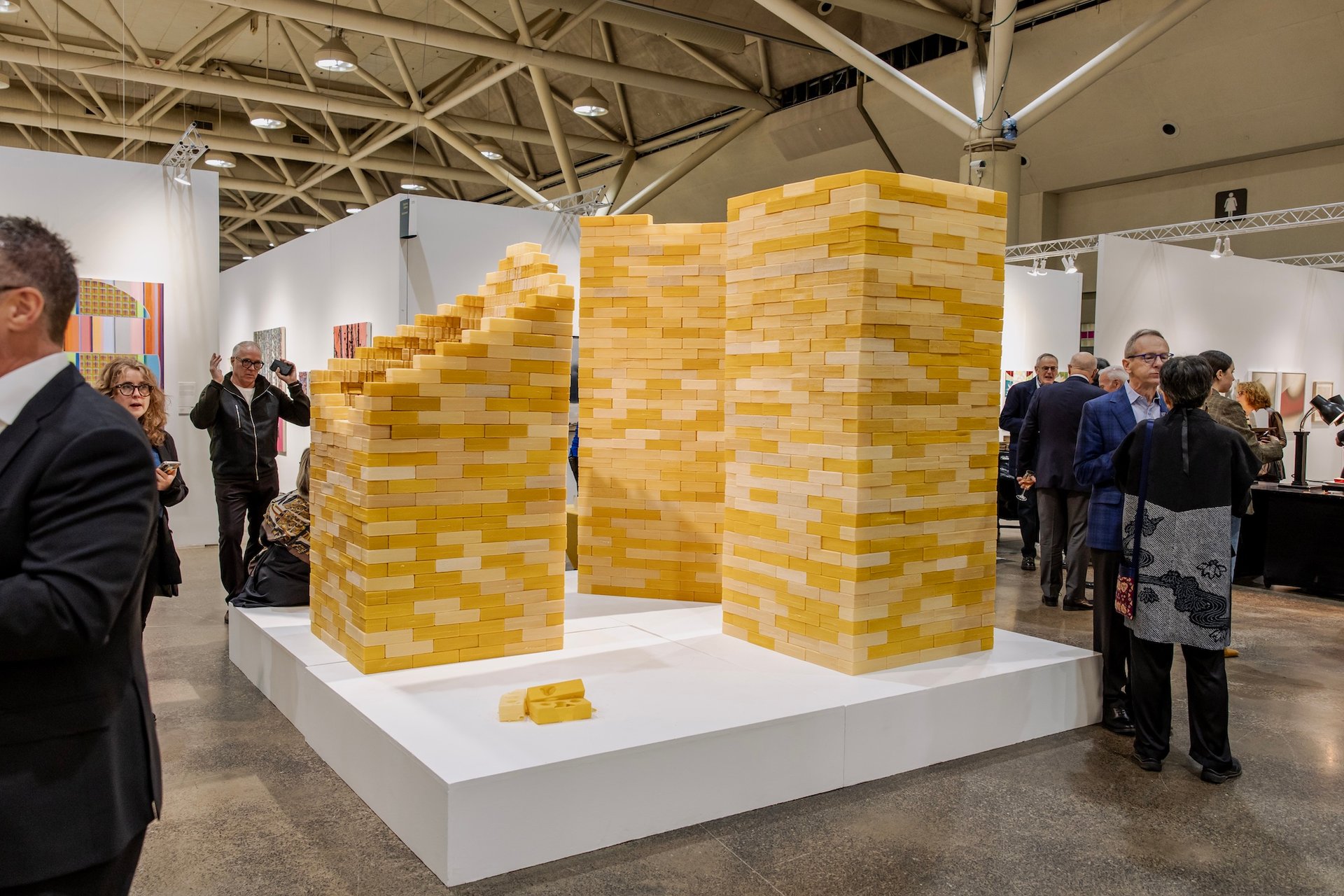
Douglas Scholes's (This is) What happens when a thing is maintained (?) (2024) at Art Toronto, presented by Galerie Robertson Arès Photo: Jenna Marie Wakani
The booth of Toronto’s Nia Centre for the Arts, Canada’s first professional Black arts centre, features the wonderful painting Califia by the Congolese Canadian artist Heritier Bilaka, paying homage to the warrior Queen Nzinga. (Concurrently with Art Toronto, Nia is hosting A Black Art Fair at its headquarters on Oakwood Avenue.)
The Vancouver-based gallery Ceremonial Art is showing works by five artists on its booth, including a remarkable woodblock print by the Tofino-based artist Marika Swan. Titled Embraced in Interdependence, it is both a rare example of West Coast Indigenous art in Toronto and a neat metaphor for the current socio-political climate in Canada and at the art fair.
A nearby stand is devoted to Portfolio, a nonprofit run by a collective of Vancouver artists and dedicated to helping emerging artists via scholarships funded from a percentage of their sales. Among others, the organisation is showing new paintings by Angela Grossman and new works from the Predator series by Lawrence Paul Yuxweluptun—who will open a solo exhibition at the Art Gallery of Ontario in February 2027.
A few booths away, Vancouver’s Equinox Gallery is showing early paintings by the late artist Gathie Falk, mid-century prints from the Fred Herzog archive and works by Sonny Assu that playfully subverts the colonial landscapes of Emily Carr by overlaying them with Kwakwaka'wakw formline designs.
During the fair’s gala preview on Thursday (29 October), benefiting the McMichael Canadian Art Collection, it was revealed that the federal and provincial governments would provide C$50m ($35.7m) each in funding for a new wing to be designed by Hariri Pontarini Architects. In a video marking the occasion, Canada’s first lady, Diana Fox Carney, proclaimed: “The world needs more Canada.” At this year’s Art Toronto, there is plenty to go around.
- Art Toronto, until 1 November, Metro Toronto Convention Centre