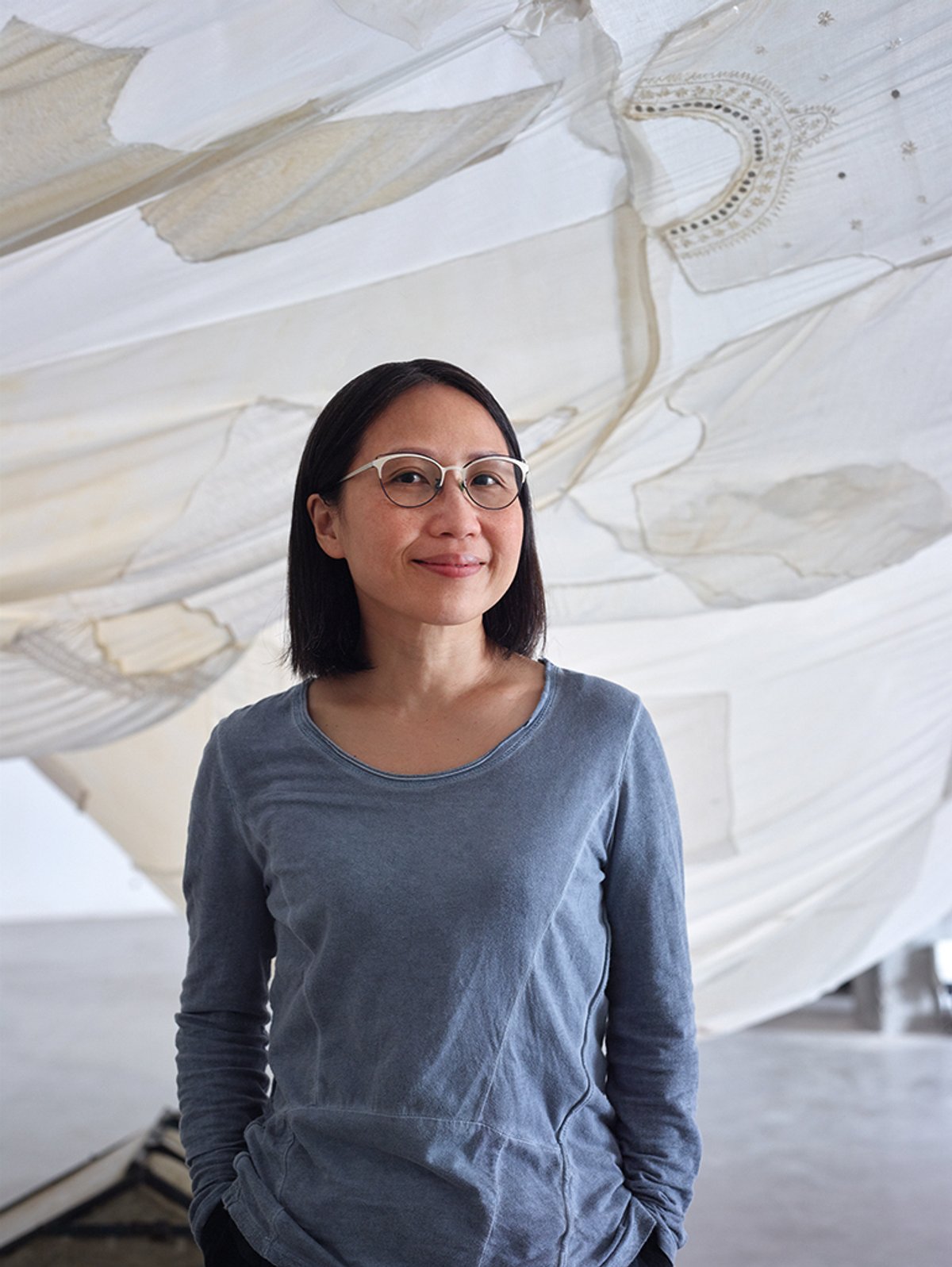
It is clear how much Jaffa Lam has been nurtured by her experiences growing up in Hong Kong. She received her BFA, MFA and Postgraduate Diploma in Education from the Chinese University of Hong Kong and continues to live and work in the city. Her process includes collaborating with groups of women and in their shared labour Lam reveals the making of things, be they for art or daily use. Known for handling recycled umbrella “skins” by stitching them together to form tent-like structures often hung overhead, Lam is at present also adapting the metal and plastic “ribs” of umbrellas into frames that resemble window lace designs.
Alongside her recent travels for exhibitions in Foshan and Shanghai—after suspending a long-time parallel teaching practice—Lam’s new ceramic pieces and other works display how her creative impulses continue to evolve. Her chosen materials and how she sources them, as well as the environmental conditions of where her works are exhibited, all play a role in her growing oeuvre.
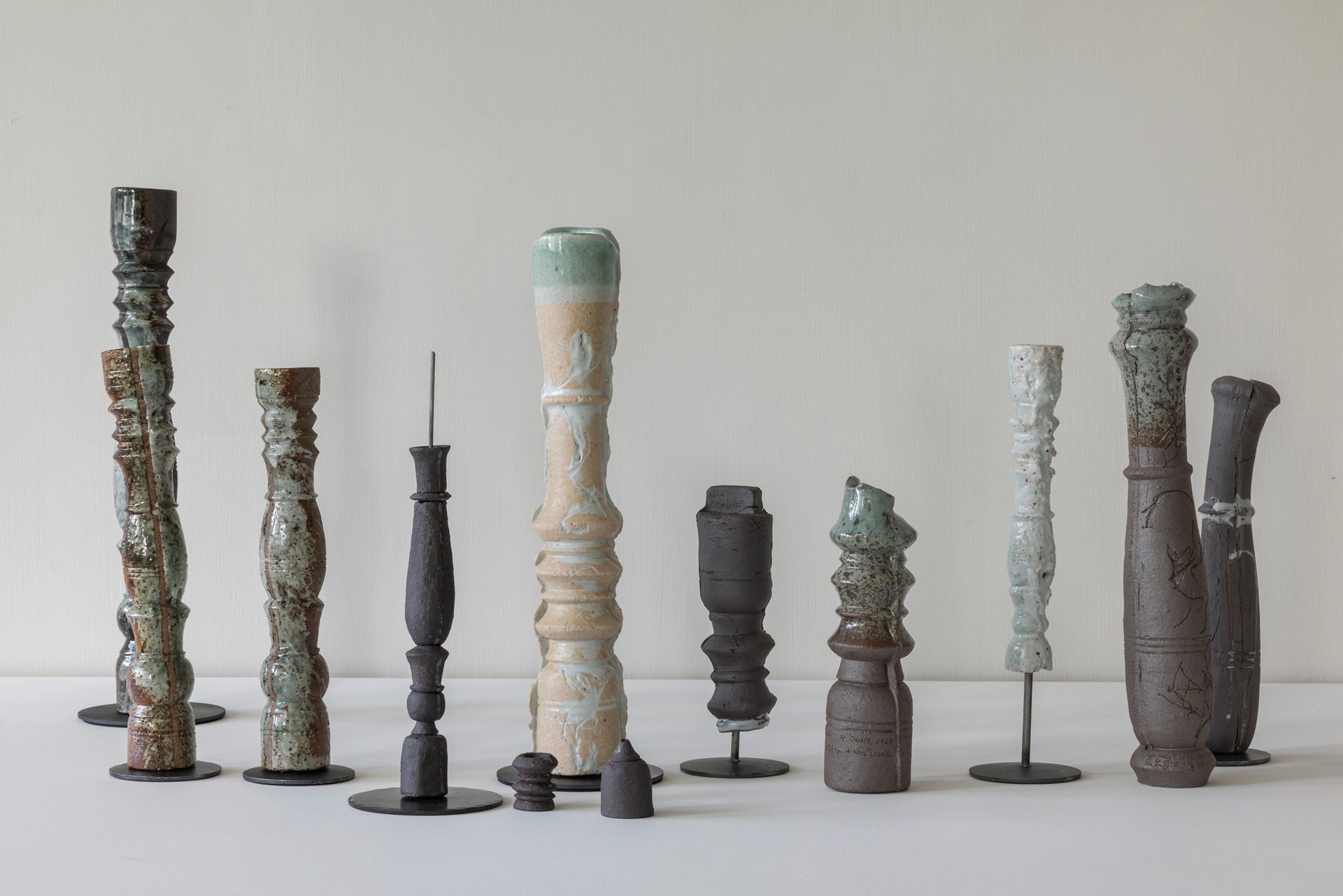
Jaffa Lam’s Windbreak (2025), in her show Asteroid J-734 earlier this year at Axel Vervoordt Gallery, Hong Kong Courtesy of the artist and Axel Vervoordt Gallery
The Art Newspaper: How did your approach differ between recent exhibitions—such as in Hong Kong at Axel Vervoordt Gallery (2026) and Tai Kwun Contemporary (2026), and in the mainland venues of He Art Museum (2024) and Power Station of Art for the Shanghai Biennale (2025-26)?
Jaffa Lam: They’re all quite different. Threads of Kinship, in collaboration with KADIST, is at He Art Museum in Shunde, where I went last summer to learn more about women labourers living there from the past century. I developed this project for more than a year and tried to do something different while still working with the Hong Kong Women Workers’ Association (HKWWA) again.
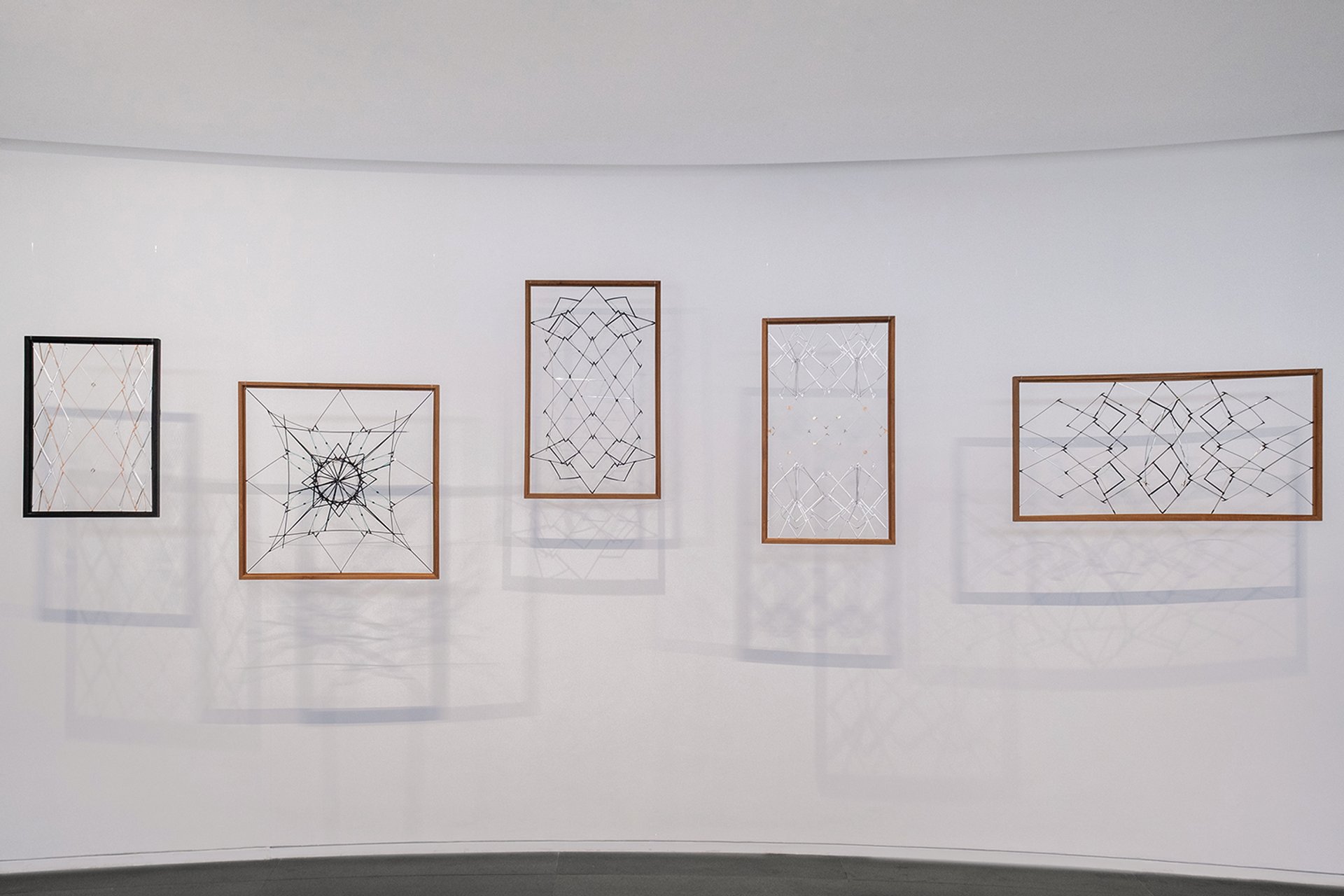
Lam’s Weaving Diary (2025), seen here in the exhibition Threads of Kinship at He Art Museum, Shunde Photo: Chen Yuxin, courtesy of the artist and He Art Museum
Do these organisations find people to work with you?
For 16 years I have made various works with the same organiser and the assistance of their association members. We have built up a friendship. Each time, I tell them my ideas and we try different things based on regular recycling workshops the association gives, often involving the fabric “leftovers” from used umbrellas they collect. This time, I was told about a workshop using aluminium and plastic umbrella “ribs”, which looks like the metal lace you find on windows.
I always think about windows being used to expose or hide yourself inside or outside the house, and the hidden stories I sometimes hear from the women who help me.
Do you consider your frequent collaborations with groups of people a collective practice? How do you approach authorship, skill sharing and storytelling in your work?
So much of my work is about the people helping me. They design their own patterns and I give them advice and encouragement. By teaching them different possibilities and how to apply their skills through the lens of art, it’s also a way to widen my views of the city and consider how they look at me as an artist. I also always ask museums to caption the names of those who helped me make the work.
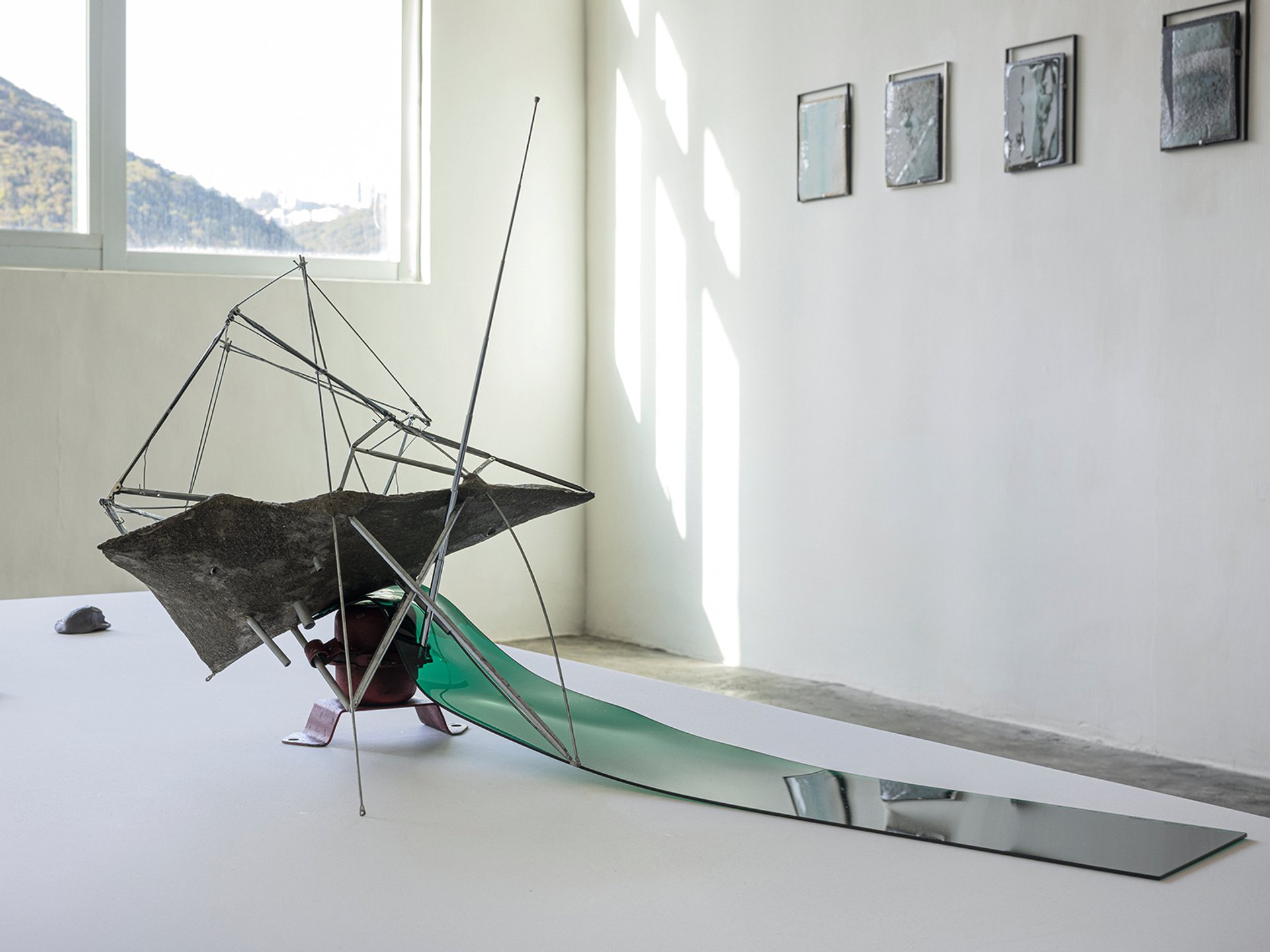
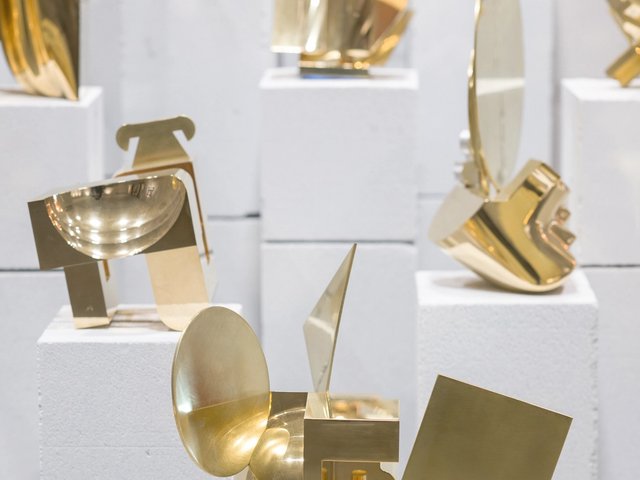
Lam’s Flying No. 4 (2026), was part of the recent show Asteroid J-734 at Axel Vervoordt Gallery Courtesy of the artist and Axel Vervoordt Gallery
How did you approach Asteroid J-734, your recent Axel Vervoordt Gallery exhibition in Hong Kong?
I never think about my work in commercial terms, but I was making pieces for He Art Museum at the same time so everyone thought these would show in the gallery. But because I collaborated with those ladies, it was better to show these works with their names in the museum.
For Asteroid J-734, which recalls the lost character from Antoine de Saint-Exupéry’s book, The Little Prince, I created three and a half rooms. The first room greets people coming to visit, like in a domestic setting. Then it goes into a starlit universe, before going back into the dark, as if seeing Hong Kong from the sky. In the last room, you go nowhere, kind of like a memory replay. It’s really about the journey, including through my experience with loneliness as I was grieving my mum’s passing for almost two years while working in the mainland. So, the show is like my report about the places I have been, now having come back to Hong Kong.
Why is incorporating objects from daily life, like umbrellas and wooden spindles, important to you?
My practice blends history and heritage. Asteroid J-734 shows work associated with art history, like references to Morandi and Brancusi, or, it’s been suggested, Arte Povera and Duchamp, but also what I call “little” history, my history. This has been in my practice for a long time, sharing stories which affect me in art history, human history and, at times, how this might connect to political or environmental factors.
I use my art background to play with these historical objects
I use my art background to play with these historical objects, like the poles normally used for fences, handrails, posts or balusters, which I make smaller, like a candleholder, or enlarge, which when built up can be architectural, like trees, pillars or columns. Of course, these connect to the history and culture of Westernised, colonialised shapes, but I also found these in old Chinese spittoons for Vase (2025).
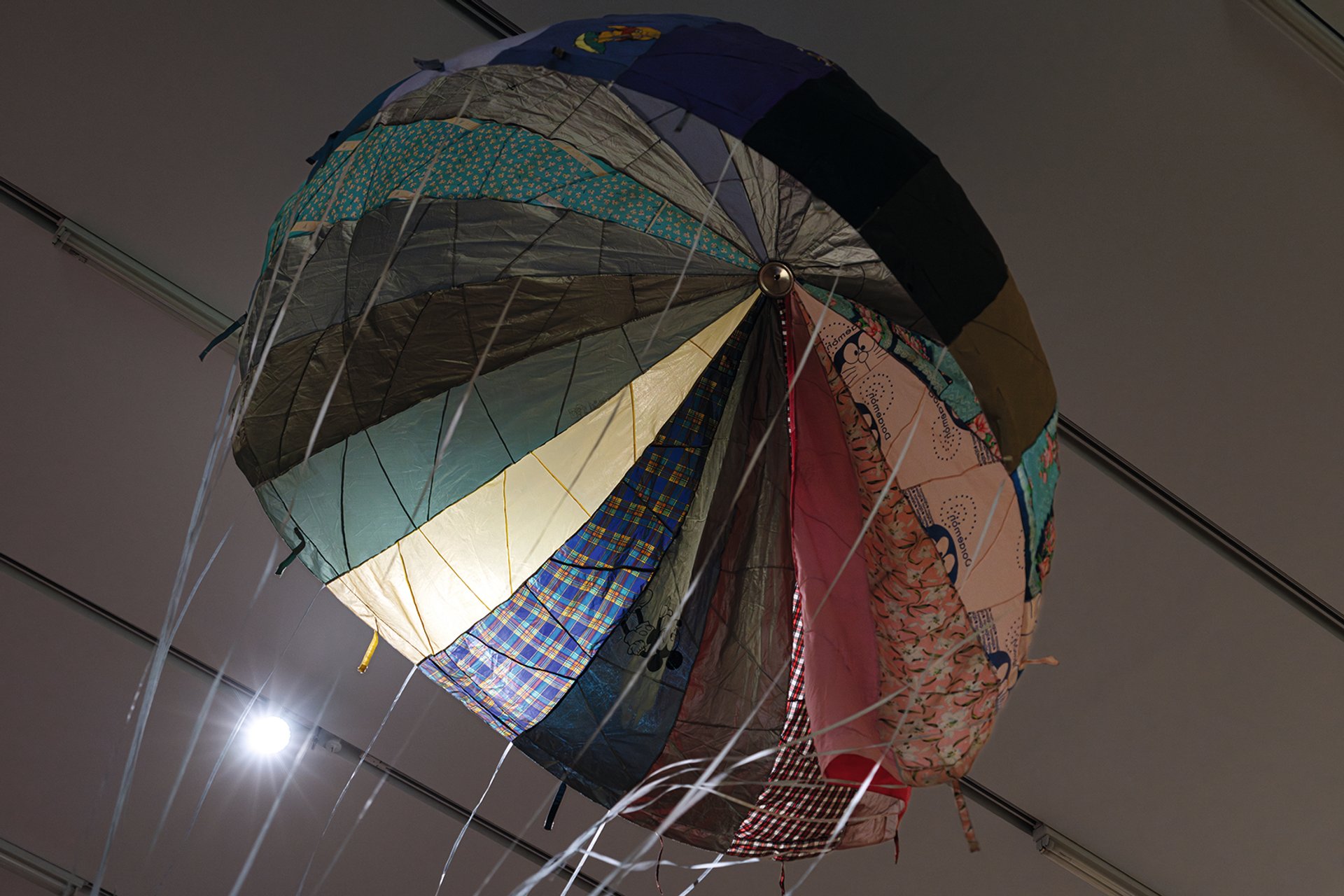
Lam’s Parachute no. 2 (2015) was in Stay Connected: Supplying the Globe at Tai Kwun Contemporary, Hong Kong © Tai Kwun Contemporary
Have your sojourns for shows in Shanghai and Shunde provided any new perspectives?
For me, something new is not about materials, but about how works are composed or something accidentally happening in my studio. For example, the umbrella ribs I’ve been using are generally light, but the metal is also tough because they have “joints”. So, I like this material because it could be the object which I treat to become a new “medium”.
What have your ongoing collaborations and recent residencies taught you about craftsmanship?
I consider every technique I have learned when I work on my projects, and those of my collaborators, who I trust and respect; often, their skills are better than mine. But, as an artist, I try to make the process easier, as I usually need to scale up for the final works. All these techniques blend in my mind, and I still make works by hand, so my art is always marked by human touch.
What is your relationship like now to your home base of Hong Kong, where the art infrastructure has changed so fundamentally?
I just focus on where my work is being exhibited, like my solo show or at Tai Kwun for the group exhibition Stay Connected: Supplying the Globe during Art Week in March. Honestly, I just want to harness my energy, a lot of which comes from meeting with my collaborators in preparing for my next project.
How much do exhibition spaces impact how you present your artwork?
The site is very important to me. I ask for the architectural plans or request a site visit before I take the commission or show. Then, I go to study the history, “feel” the atmosphere and talk to people associated with the venue or city where my work will be presented. For the Shanghai Biennale, I randomly visited the city and talked to different people who may not be familiar with art, before going back to work in my studio. If there’s a group show, I always ask, “Who’s my neighbour?” because I want my work to be complementary.