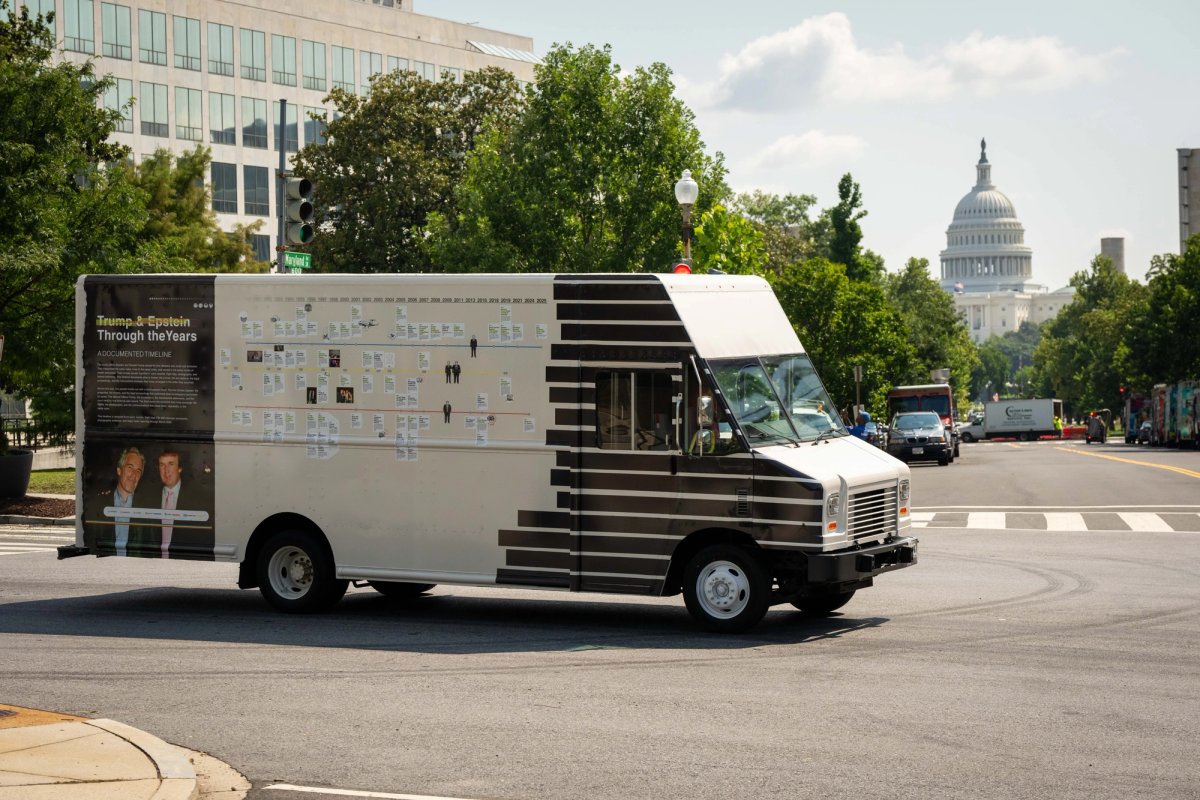
Concurrent with the Republican party’s unusual midterm convention in Dallas this week, a pop-up exhibition and bookmobile carrying millions of publicly released files related to Jeffrey Epstein launched a national tour in the city. It is part of a push to release the full record of the government’s investigation into the convicted sex offender and hold accountable high-powered figures linked to him. The travelling project includes paintings created by Maria Farmer, an artist who survived Epstein’s abuse and was one of the first women to inform federal law enforcement about his actions.
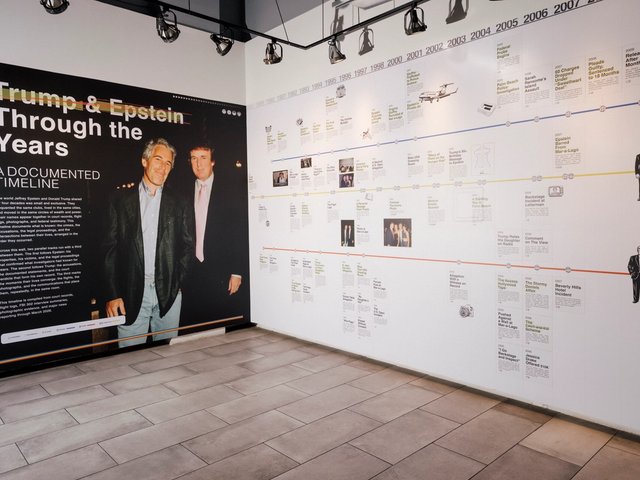
The Donald J. Trump and Jeffrey Epstein Memorial Reading Room originally opened in New York last May as a pop-up exhibition. It travelled to Washington, DC, in June, where it was later joined by a Bookmobile version. Thousands of visitors came to see the project in those cities; the response from the public and abuse survivors was often emotional but supportive.
The presentation in Washington, which coincided with the Ultimate Fighting Championship (UFC) event organised on the White House lawn to celebrate president Donald Trump's birthday, was a turning point. “We had a lot of people in UFC gear. They came in a little bit more sceptical but left more thoughtful,” says David Garrett, the executive director of the Institute for Primary Facts, which is organising the project with Defiance.org. “It was really powerful to watch people have an experience and see the gears turn behind their eyes.”
This led to discussions about touring the installation to more cities this year, in the run-up to the national midterm elections in November. “We all realised that it wasn't just important for these messages to get out to elected officials. It was important to get out to their constituents,” Garrett says.
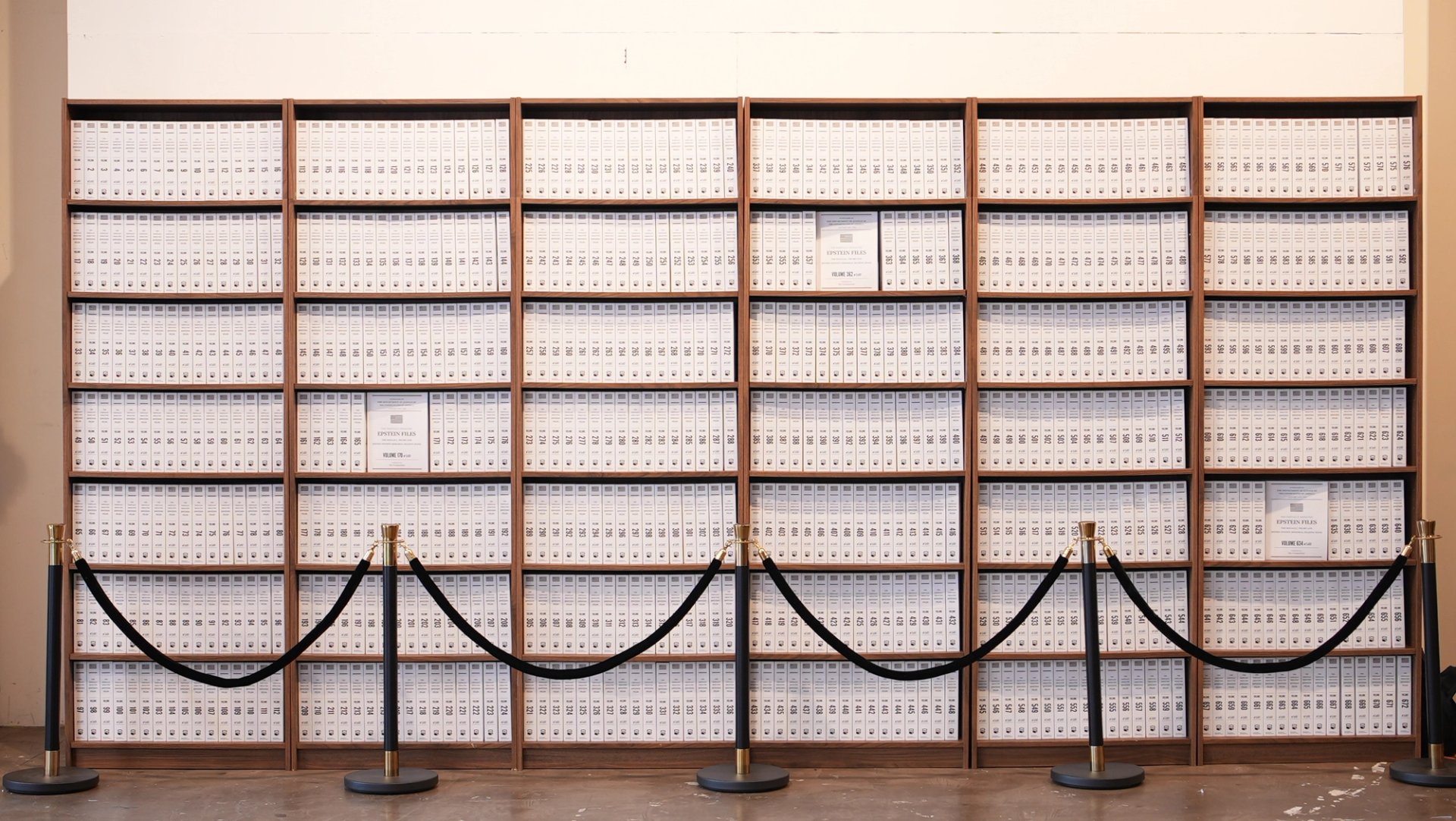
The complete Epstein files on display at the Donald J. Trump and Jeffrey Epstein Memorial Reading Room Courtesy Institute for Primary Facts
In addition to Dallas, the Reading Room exhibition will appear in Des Moines, Iowa, later this month, while the Bookmobile will make stops in Omaha, Nebraska, and two cities in Iowa. Garrett says there are plans in the works to visit around five cities in total by the end of the year.
In addition to the Epstein files, which have been printed and bound into more than 3,000 volumes and displayed on racks in the Reading Room, both versions of the project include paintings made by Farmer that depict high-profile figures tied to the case.
“As an artist, I hope to combine dark humour with the grotesque nature of the elites who orbited Epstein,” Farmer says of the works, adding that she based the series on French political cartoons she studied before attending graduate school. “Those cartoons weighed heavily in the back of my mind when I embarked upon EPSTEIN’S DECK, a series of 30in-by-50in tarot cards. I hoped to use mockery to publicly display the antics of Epstein’s colleagues and friends of ‘society’.”
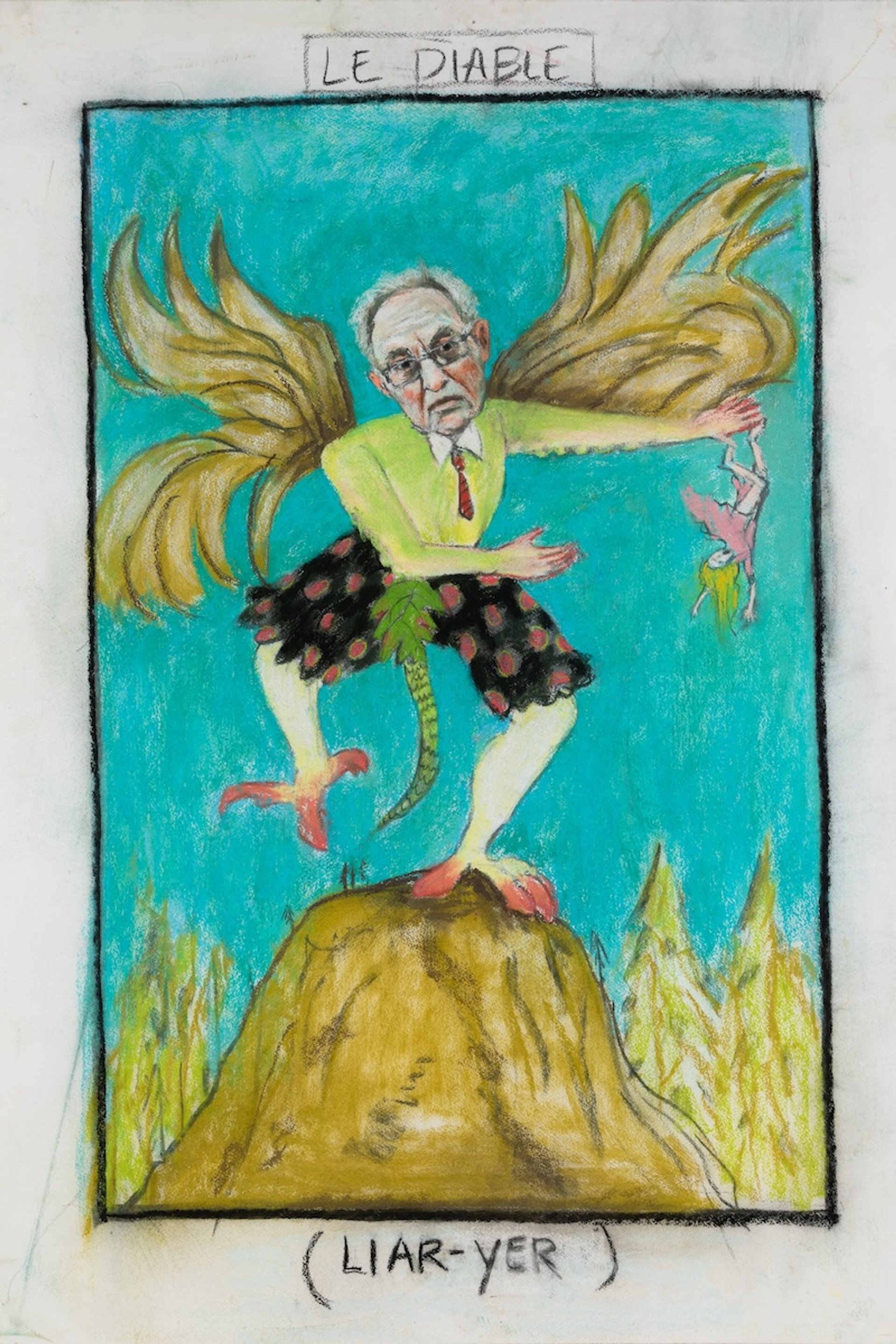
One of Maria Farmer’s tarot cards from her ongoing series EPSTEIN’S DECK Courtesy Institute for Primary Facts
Programming around both the Reading Room and Bookmobile will include talks and performances by artists, politicians and survivors. Annie Farmer, Maria’s sister who also survived assault by Epstein and his partner Ghislaine Maxwell, will appear in Dallas this week and hopes audiences in Texas will have similar awakenings to the extent of the crimes committed.
“You can have a cognitive idea about what that number [of files] means. But then to be surrounded by the volumes of material, I think something clicks for people about the scale of what happened here and how really indefensible it is, to say we don't have enough for investigations or there wasn't anybody else involved,” she says. “Presenting this in a way that makes it more approachable to people, I think it really resonates.”
That personal impact is apparent in the thousands of notecards visitors leave sharing their own stories, drawings and messages after viewing the installation, which are displayed on a wall in the Reading Room. The organisers have been collecting and scanning this spontaneous creative outpouring from the public and hope to find a permanent home for the collection. “We're taking very good care of it, because we think it’s one of the most powerful pieces,” Garrett says.
As for Maria Farmer, aside from an ongoing series of portraits she is giving to other survivors and their families, her next series will pivot away from the Epstein topic, “which has unfairly usurped 30 years of my life as well as my career”, she says. (She was introduced to Epstein while a student at the New York Academy of Art.) Farmer instead plans to focus on the ethereal aspects of nature in a series titled UNSEEN.
This resilience is a defining part of her character, her sister says: “She is through and through an artist, from the time she was in the crib. I don't think anything could actually take that away from her.”