In 2014, I was fortunate enough to co-curate an exhibition at Tate Britain, Kenneth Clark: Looking for Civilisation. Aside from his writing, collecting and broadcasting, one of Clark’s greatest moments was to place the National Gallery at the patriotic heart of wartime efforts in the dark years of the Blitz, staging a series of now-famous lunchtime concerts inaugurated by the German pianist Myra Hess.
It was especially exciting to work on this part of the exhibition. We obtained recordings made around the same time by those who had performed at the National Gallery (when the galleries had been cleared of paintings, taken for safe storage to an abandoned mine in Wales), including Hess, Elena Gerhardt, Kathleen Ferrier and Benjamin Britten. In a gallery of paintings made during the war, or relating to the wartime efforts, these atmospheric old recordings evoked very movingly, I thought, a spirit of culture as a source of endurance and hope.
Varied experiences
These recordings, however, were the only part of the exhibition that was the subject of written complaints and singled out negatively in reviews—“that scratchy music”, as one reviewer in The Burlington Magazine wrote. The music was distracting and intrusive, people complained, and could we not have got better recordings? Others might have appreciated the combination of sound and image, but the lesson had been learned that visitors can view such experiences of art in widely divergent ways.
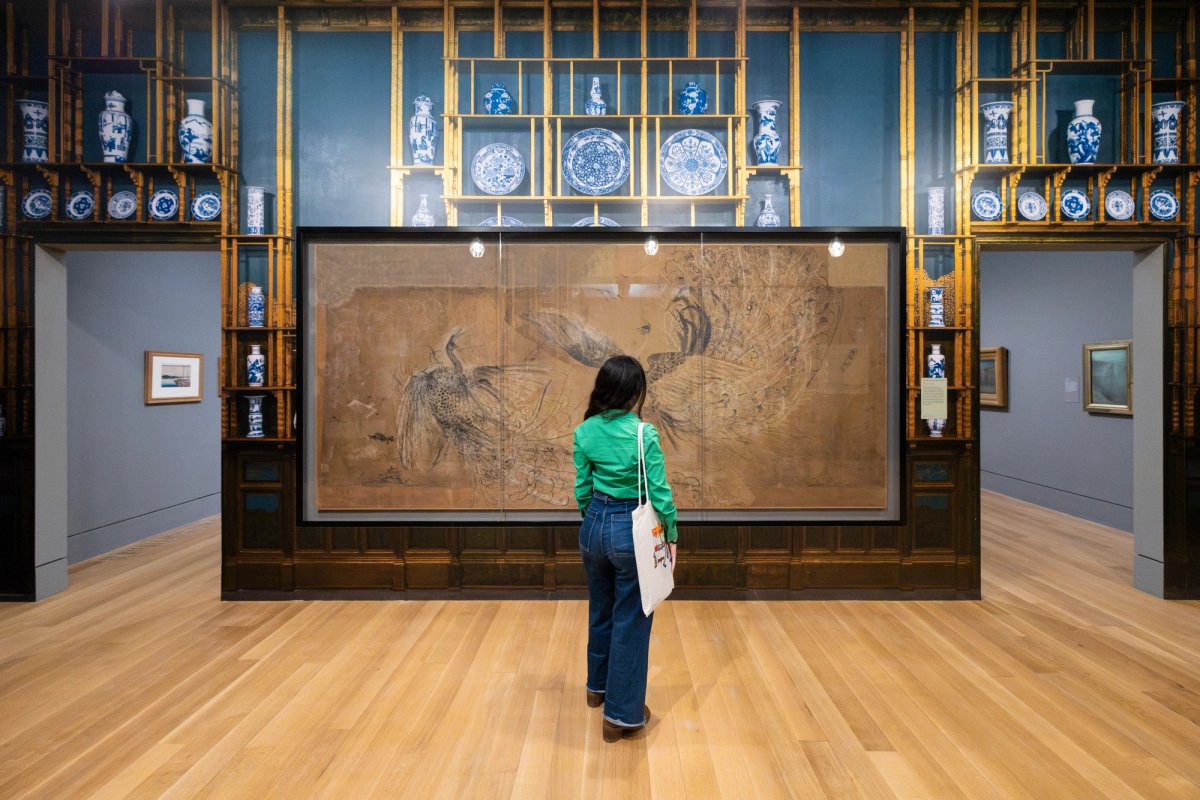
The exhibition James McNeill Whistler (until 27 September) features audio and video in a way that has united visitors in audible shock. In a re-creation of Whistler’s interior design for the Peacock Room, held in the Smithsonian’s National Museum of Asian Art in Washington, DC, a loud and violent argument between Whistler and his patron, Frederick Leyland, restaged by actors, is played every five minutes on a loop.
In the next gallery hang some of Whistler’s most meditative Nocturnes, and it was around these paintings that people were joining in criticism of this execrable audio intrusion: “Great, more angry white men shouting at us!,” “How on earth are you supposed to appreciate these paintings with that racket going on?!”. The exhibition guard explained that the recording was playing on a regular loop and driving those working in the exhibition on a daily basis round the bend. It is utterly impossible to view the Nocturnes and other paintings on display; visitors either have agitated voices shouting around the gallery space, or are tensely waiting for the loop to begin again.
There was little respite as the exhibition progressed. A full-length projection of an actor playing Whistler expatiating loudly on his art in one of the final galleries, echoing through the surrounding rooms, makes it impossible to look at any of the works hanging on the walls—a tragic shame considering the quality of many of the loans, and the enormous effort that goes into the preparation of such an exhibition.
Energy drain
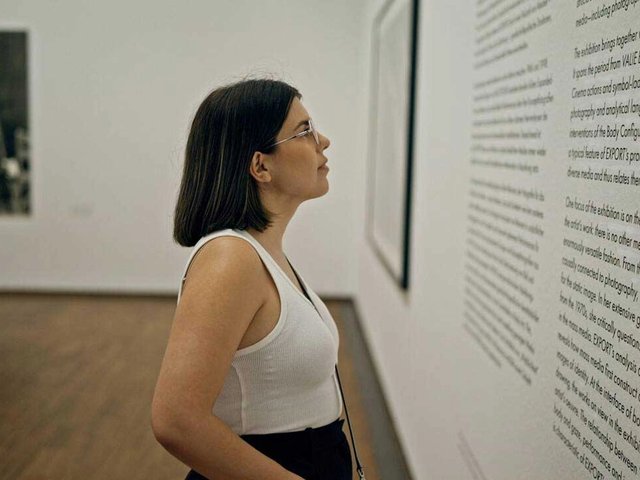
It was a spectacularly bad decision to include such video and audio, but hardly egregious. Such intrusions are now common. As if we had not had enough of screens in our daily lives, turn the corner of most exhibitions and there is some talking head, dramatisation or film clip (such as Timothy Spall as Turner in the recent Turner & Constable exhibition), draining the energy from the room and monopolising our attention. Put a screen next to a painting and you kill the painting, and deaden the room in which it hangs.
Beyond the irritation and distraction, what this trend points to is something deeper and more worrying still: the increasingly dominant view of art as a “visitor attraction” that attracts “footfall”, and of museums as institutions existing to impart information about works of art, to educate and lecture, rather than to create a setting in which art can be meaningfully experienced. Such a view shows a profound mistrust of works of art, as if they were not enough and could not speak or stand for themselves.
At stake is the debate between education and experience, which goes to the heart of our definition of what art is, the place it has in our society as part of a “national story” and the wider world in which we live. It also reaches to the heart of what museums do. If cultural objects are to have any value then it is the job of museums not to lecture audiences in art history, or to suggest that a work can be ‘explained’ by its context; but rather to help us all in a far more difficult task: looking at art and experiencing it in the context of our own lives.
• John-Paul Stonard is an author and art historian. He is speaking about his latest book, The Worst Exhibition in the World: Degenerate Art, 1937, at the Cheltenham Literature Festival on 14 October